Review
. 2010 Aug;8(8):600-7.
doi: 10.1038/nrmicro2391.

Entropy as the driver of chromosome segregation

Affiliations
Review

Entropy as the driver of chromosome segregation

Suckjoon Jun et al. Nat Rev Microbiol. 2010 Aug.

Abstract

We present a new physical biology approach to understanding the relationship between the organization and segregation of bacterial chromosomes. We posit that replicated Escherichia coli daughter strands will spontaneously demix as a result of entropic forces, despite their strong confinement within the cell; in other words, we propose that entropy can act as a primordial physical force which drives chromosome segregation under the right physical conditions. Furthermore, proteins implicated in the regulation of chromosome structure and segregation may in fact function primarily in supporting such an entropy-driven segregation mechanism by regulating the physical state of chromosomes. We conclude that bacterial chromosome segregation is best understood in terms of spontaneous demixing of daughter strands. Our concept may also have important implications for chromosome segregation in eukaryotes, in which spindle-dependent chromosome movement follows an extended period of sister chromatid demixing and compaction.


Figures
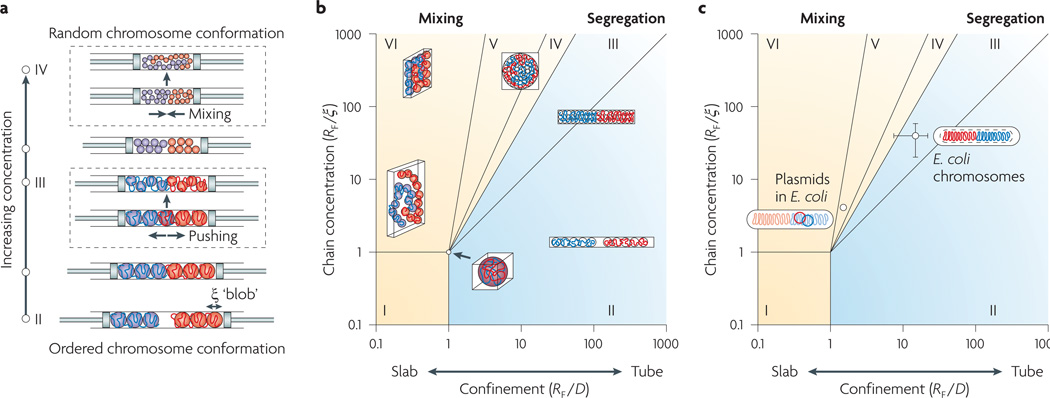
Figure 1
Figure 1. Predicting chromosome segregation using physical parameters of the nucleoid
a | The piston analogy, illustrating the effect of the degree of confinement on the organization of two chains. Two long chains are confined in a cylinder of fixed width that is capped by two pistons. As the volume of the cylinder is decreased by the pistons, chains go through two simultaneous transitions: a change in the principal ordering of each chain from linear to random, and from segregation to mixing of the two chains. b | A phase diagram explaining how two long chains will segregate or mix depending on the degree of confinement and the concentration of the chains in a box. This phase diagram can be used to predict the entropy-driven segregatability of other organisms (see main text and Supplementary information S4 (box) for details). c | Escherichia coli chromosomes are in the segregation regime, whereas plasmids are in the mixing regime because they are too small. ξ, size of the structural unit (also called the correlation length); D, width of the nucleoid inside the cell; RF, Flory radius of gyration of the isolated nucleoid (the diameter of the fully expanded nucleoid released from the lysed cell).
Figure 2
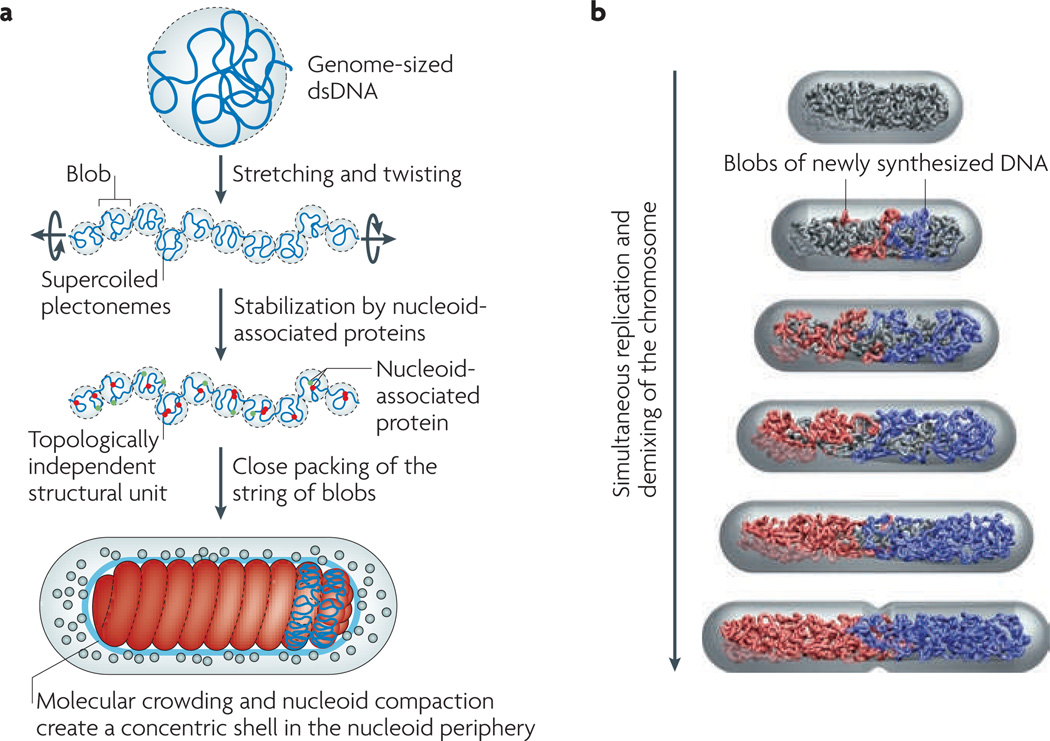
Figure 2. Physical model of a bacterial chromosome and its segregation
a | A reductionist model of the Escherichia coli chromosome. First, we stretch a bacterial-genome-sized naked double-stranded DNA (dsDNA). This breaks the DNA into a series of blobs, the total volume of which gradually decreases as pulling continues. In parallel, we also twist the DNA to match the supercoil density of a bacterial chromosome. As a result, the DNA blobs will consist of supercoiled plectonemes (a shape of the DNA in which the two strands are intertwined). We stop the simultaneous pulling and twisting processes when the total volume of the blobs equals the target volume of the nucleoid inside the cell. Next, we ‘sprinkle’ the chromosome with nucleoid-associated proteins. These stabilize the supercoiled DNA blobs as topologically independent structural units of the chromosome. Finally, we connect the two ends of the chromosome to make it circular, and then pack it tightly in the cell. For the simpler case of chains without supercoiling, the phase diagram in FIG. 1 provides a model for the close-packed organization and segregatability of the chains inside the cell. In general, supercoiling will only increase the tendency for chromosome demixing because of the branched structure that it induces. b | The concentric shell model predicts extrusion of the newly synthesized DNA (blue and red) to the periphery of the nucleoid. The newly replicated DNA is extruded to the periphery of the unreplicated nucleoid (grey) and forms a string of DNA blobs in the order of replication, promoted by SMC (structural maintenance of chromosomes) proteins and other nucleoid-associated proteins. In our model, the two strings of blobs repel each other and drift apart owing to the excluded-volume interaction and conformational entropy.

References

    1. Kornberg A, Baker TA. DNA Replication. 2nd edn. New York: Freeman & Company; 1992.
    1. Murray A, Hunt T, editors. The Cell Cycle: an Introduction. New York: Oxford Univ. Press; 1993.
    1. Wang JC. DNA topoisomerases. Annu. Rev. Biochem. 1996;65:635–692. - PubMed
    1. Sullivan NL, Marquis KA, Rudner DZ. Recruitment of SMC to the origin by ParB-parS organizes the origin and promotes efficient chromosome segregation. Cell. 2009;137:697–707. - PMC - PubMed
    1. Gruber S, Errington J. Recruitment of condensin to replication origin regions by ParB/SpoOJ promotes chromosome segregation in B. subtilis. Cell. 2009;137:685–696. - PubMed

Publication types

MeSH terms