Impact of metabolic syndrome and its individual components on the presence and severity of angiographic coronary artery disease
- PMID: 20635441
- PMCID: PMC2908873
- DOI: 10.3349/ymj.2010.51.5.676
Impact of metabolic syndrome and its individual components on the presence and severity of angiographic coronary artery disease
Abstract
Purpose: Metabolic syndrome (MS) has been reported as a potential risk factor of coronary artery disease (CAD). The aims of this study were to assess whether there was a relationship between MS score and CAD angiographic severity, and to assess the predictive value of individual components of MS for CAD.
Materials and methods: We retrospectively enrolled 632 patients who underwent coronary angiography for suspected CAD (394 men, 61.0 +/- 10.6 years of age). MS was defined by the National Cholesterol Education Program criteria with the waist criterion modified into a body mass index (BMI) of more than 25 kg/m(2). The MS score defined as the number of MS components. CAD was defined as > 50% luminal diameter stenosis of at least one major epicardial coronary artery. CAD angiographic severity was evaluated with a Gensini scoring system.
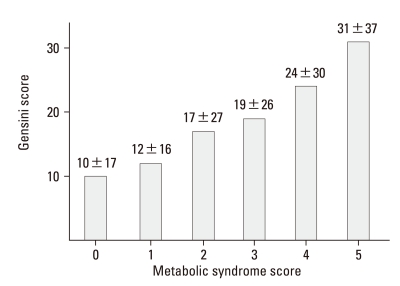
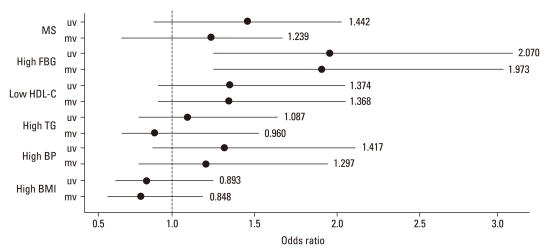
Results: Of the patients, 497 (78.6%) had CAD and 283 (44.8%) were diagnosed with MS. The MS score was significantly related to the Gensini score. High fasting blood glucose (FBG) was the only predictive factor for CAD. A cluster including high FBG, high blood pressure (BP), and low high-density lipoprotein cholesterol (HDL-C) showed the highest CAD risk.
Conclusion: The MS score correlates with the angiographic severity of CAD. The predictive ability of MS for CAD was carried almost completely by high FBG, and individual traits with high BP and low HDLC may act synergistically as risk factors for CAD.
Conflict of interest statement
The authors have no financial conflicts of interest.
Figures
References
-
- Reaven GM. Banting lecture 1988. Role of insulin resistance in human disease. Diabetes. 1988;37:1595–1607. - PubMed
-
- James PT, Rigby N, Leach R International Obesity Task Force. The obesity epidemic, metabolic syndrome and future prevention strategies. Eur J Cardiovasc Prev Rehabil. 2004;11:3–8. - PubMed
-
- Jørgensen ME, Borch-Johnsen K. The metabolic syndrome--is one global definition possible? Diabet Med. 2004;21:1064–1065. - PubMed
-
- Ford ES. Risks for all-cause mortality, cardiovascular disease, and diabetes associated with the metabolic syndrome: a summary of the evidence. Diabetes Care. 2005;28:1769–1778. - PubMed
-
- Galassi A, Reynolds K, He J. Metabolic syndrome and risk of cardiovascular disease: a meta-analysis. Am J Med. 2006;119:812–819. - PubMed
Publication types
MeSH terms
LinkOut - more resources
Full Text Sources
Medical
Miscellaneous