


Communication practices in physician decision-making for an unstable critically ill patient with end-stage cancer
- PMID: 20642362
- PMCID: PMC4047851
- DOI: 10.1089/jpm.2010.0053
Communication practices in physician decision-making for an unstable critically ill patient with end-stage cancer
Abstract
Background: Shared decision-making has become the standard of care for most medical treatments. However, little is known about physician communication practices in the decision making for unstable critically ill patients with known end-stage disease.
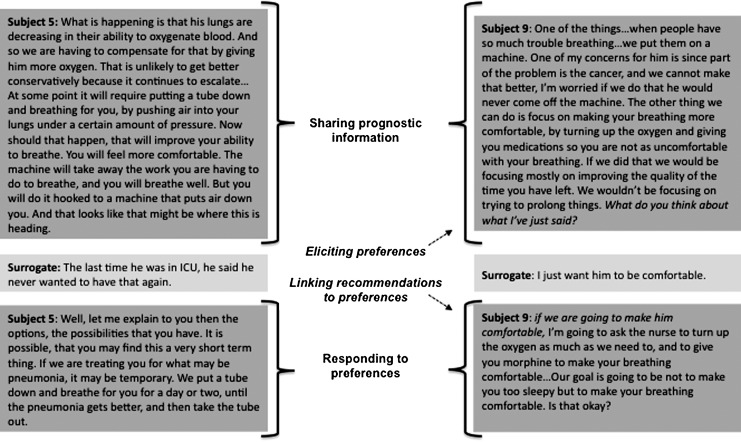
Objective: To describe communication practices of physicians making treatment decisions for unstable critically ill patients with end-stage cancer, using the framework of shared decision-making.
Design: Analysis of audiotaped encounters between physicians and a standardized patient, in a high-fidelity simulation scenario, to identify best practice communication behaviors. The simulation depicted a 78-year-old man with metastatic gastric cancer, life-threatening hypoxia, and stable preferences to avoid intensive care unit (ICU) admission and intubation. Blinded coders assessed the encounters for verbal communication behaviors associated with handling emotions and discussion of end-of-life goals. We calculated a score for skill at handling emotions (0-6) and at discussing end of life goals (0-16).
Subjects: Twenty-seven hospital-based physicians.
Results: Independent variables included physician demographics and communication behaviors. We used treatment decisions (ICU admission and initiation of palliation) as a proxy for accurate identification of patient preferences. Eight physicians admitted the patient to the ICU, and 16 initiated palliation. Physicians varied, but on average demonstrated low skill at handling emotions (mean, 0.7) and moderate skill at discussing end-of-life goals (mean, 7.4). We found that skill at discussing end-of-life goals was associated with initiation of palliation (p = 0.04).
Conclusions: It is possible to analyze the decision making of physicians managing unstable critically ill patients with end-stage cancer using the framework of shared decision-making.
Figures
References
-
- Institute of Medicine. Crossing the Quality Chasm. Washington D.C.: National Academy of Sciences; 2001.
-
- Davidson JE. Powers K. Hedayat KM. Tieszen M. Kon AA. Shepard E. Spuhler V. Todres ID. Levy M. Barr J. Ghandi R. Hirsch G. Armstrong D. American College of Critical Care Medicine Task Force 2004–2005, Society of Critical Care Medicine: Clinical practice guidelines for support of the family in the patient-centered intensive care unit: American College of Critical Care Medicine task force 2004–2005. Crit Care Med. 2007;35:605–622. - PubMed
-
- Kuehn BM. States explore shared decision-making. JAMA. 2009;301:2539–2540. - PubMed
-
- Butow P. Juraskova I. Chang S. Lopez AL. Brown R. Bernhard J. Shared decision making coding systems: how do they compare in the oncology context. Patient Educ Couns. 2010;78:261–268. - PubMed
Publication types
MeSH terms
Grants and funding
LinkOut - more resources
Full Text Sources
