


Factors associated with nonresponse to a computer-tailored asthma management program for urban adolescents with asthma
- PMID: 20642376
- PMCID: PMC4017358
- DOI: 10.3109/02770900903518827
Factors associated with nonresponse to a computer-tailored asthma management program for urban adolescents with asthma
Abstract
Background: The ability to identify potentially resistant participants early in the course of an intervention could inform development of strategies for behavior change and improve program effectiveness.
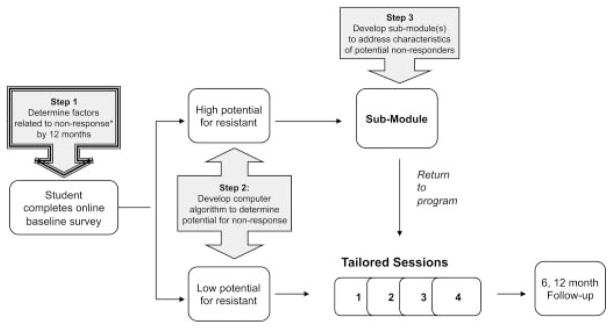
Objective: The objective of this analysis was to identify factors related to nonresponse (i.e., lack of behavior change) to an asthma management intervention for urban teenagers. The intervention targeted several behaviors, including medication adherence, having a rescue inhaler nearby, and smoking.
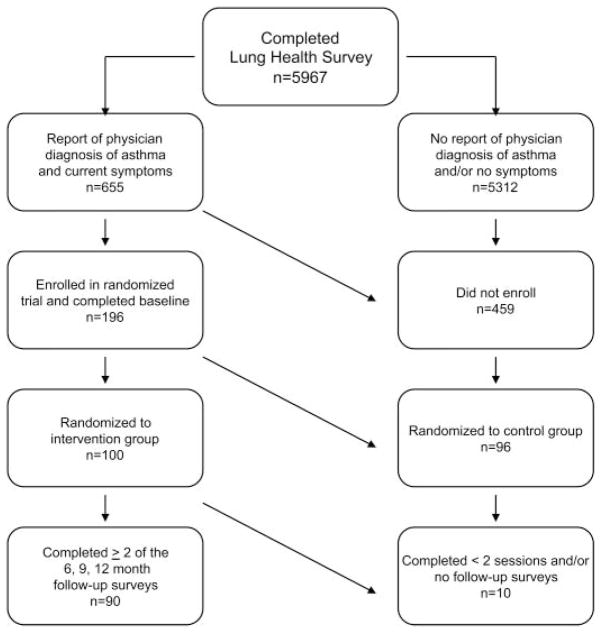
Methods: A discriminate analysis was conducted using data from a randomized trial of the intervention. Included in this analysis are participants who reported a physician diagnosis of asthma, completed a baseline questionnaire, were randomized to the treatment group, completed >or=2 of 4 educational sessions, and completed >or=2 of 3 follow-up questionnaires. Ninety students met criteria for inclusion in this subgroup analysis.
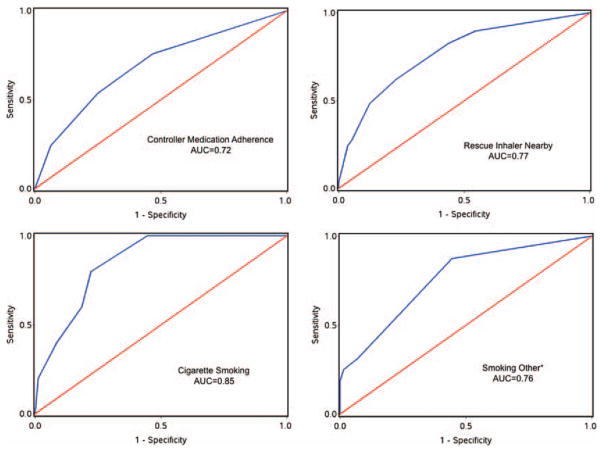
Results: In logistic regression models for medication adherence, nonresponse was related to low baseline asthma self-regulation, odds ratio = 3.6 (95% confidence interval = 1.3-9.5). In models for having an inhaler nearby, nonresponse was related to low baseline self-regulation and to rebelliousness, OR = 4.7 (1.6-13.2) and 5.6 (1.7-18.0), respectively. Nonresponse to smoking messages was related to rebelliousness, low emotional support, and low religiosity, ORs = 7.6 (1.8-32.3), 9.5 (1.4-63.5), and 6.6 (1.5-29.8) respectively.
Conclusions: Certain variables had the ability to discriminate the likelihood of response from that of nonresponse to an asthma program for urban, African American adolescents with asthma. These variables can be used to identify resistant subgroups early in the intervention, allowing the application of specialized strategies through tailoring. These types of analyses can inform behavioral interventions.
Conflict of interest statement
Declaration of Interest
The authors report no conflicts of interest. The authors alone are responsible for the content and writing of the paper.
Figures
References
-
- McGhan SL, Cicutto LC, Befus AD. Advances in development and evaluation of asthma education programs [review] Curr Opin Pulm Med. 2005;11:61–68. - PubMed
-
- Howland J, Bauchner H, Adair R. The impact of pediatric asthma education on morbidity. Assessing the evidence Chest. 1988;94:964–969. - PubMed
-
- Cote J, Cartier A, Robichaud P, Boutin H, Malo JL, Rouleau M, et al. Influence of asthma education on asthma severity, quality of life and environmental control. Can Respir J. 2000;7:395–400. - PubMed
-
- Kreuter MW, Skinner CS. Tailoring: what’s in a name? Health Educ Res. 2000;15:1–4. - PubMed
-
- Prochaska JO, DiClemente CC, Norcross JC. In search of how people change. Applications to addictive behaviors. Am Psychol. 1992;47:1102–1114. - PubMed
Publication types
MeSH terms
Substances
Grants and funding
LinkOut - more resources
Full Text Sources
Medical
Miscellaneous
