


Review
doi: 10.1111/j.1755-5949.2010.00184.x.
Targeting histone deacetylases for the treatment of Huntington's disease
Affiliations
- PMID: 20642797
- PMCID: PMC6493857
- DOI: 10.1111/j.1755-5949.2010.00184.x
Item in Clipboard
Review
Targeting histone deacetylases for the treatment of Huntington's disease
CNS Neurosci Ther.
2010 Dec.
Abstract
Huntington's disease is a debilitating neurodegenerative condition with significant burdens on both patient and healthcare costs. Despite the identification of the causative element, an expanded toxic polyglutamine tract in the mutant Huntingtin protein, treatment options for patients with this disease remain limited. In the following review I assess the current evidence suggesting that a family of important regulatory proteins known as histone deacetylases may be an important therapeutic target in the treatment of this disease.
© 2010 Blackwell Publishing Ltd.
Conflict of interest statement
The authors have no conflict of interest.
Figures
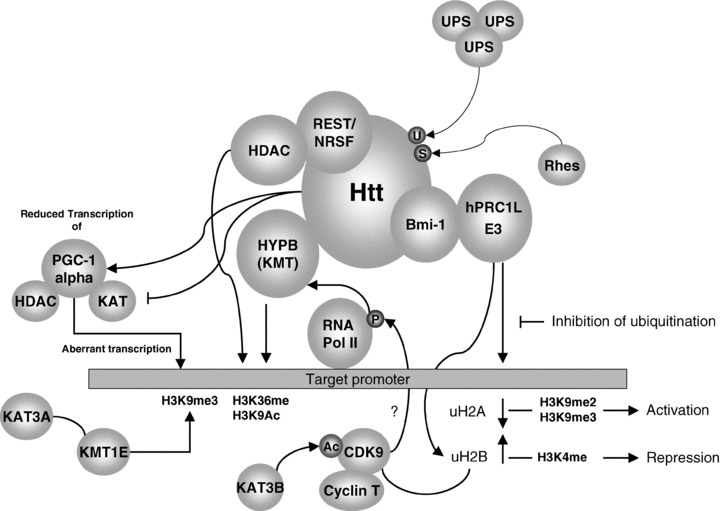
An overview of various pathways involving epigenetic regulators in Huntington's disease.
References
-
- Walker FO. Huntington's disease. Lancet 2007;369:218–228. - PubMed
-
- DiFiglia M, Sapp E, Chase K, et al Huntingtin is a cytoplasmic protein associated with vesicles in human and rat brain neurons. Neuron 1995;14:1075–1081. - PubMed
-
- Group THsDCR . A novel gene containing a trinucleotide repeat that is expanded and unstable on Huntington's disease chromosomes. Cell 1993;72:971–983. - PubMed
-
- Klement IA, Skinner PJ, Kaytor MD, et al. Ataxin‐1 nuclear localization and aggregation: Role in polyglutamine‐induced disease in SCA1 transgenic mice. Cell 1998;95:41–53. - PubMed
-
- Sieradzan KA, Mechan AO, Jones L, Wanker EE, Nukina N, Mann DM. Huntington's disease intranuclear inclusions contain truncated, ubiquitinated huntingtin protein. Exp Neurol 1999;156:92–99. - PubMed
Publication types
MeSH terms
Substances
LinkOut - more resources
Full Text Sources
Other Literature Sources
Medical
