


Linking sexual and reproductive health and HIV interventions: a systematic review
- PMID: 20642843
- PMCID: PMC2918569
- DOI: 10.1186/1758-2652-13-26
Linking sexual and reproductive health and HIV interventions: a systematic review
Abstract
Background: The international community agrees that the Millennium Development Goals will not be achieved without ensuring universal access to both sexual and reproductive health (SRH) services and HIV/AIDS prevention, treatment, care and support. Recently, there has been increasing awareness and discussion of the possible benefits of linkages between SRH and HIV programmes at the policy, systems and service delivery levels. However, the evidence for the efficacy of these linkages has not been systematically assessed.
Methods: We conducted a systematic review of the evidence for interventions linking SRH and HIV. Structured methods were employed for searching, screening and data extraction. Studies from 1990 to 2007 reporting pre-post or multi-arm evaluation data from SRH-HIV linkage interventions were included. Study design rigour was scored on a nine-point scale. Unpublished programme reports were gathered as "promising practices".
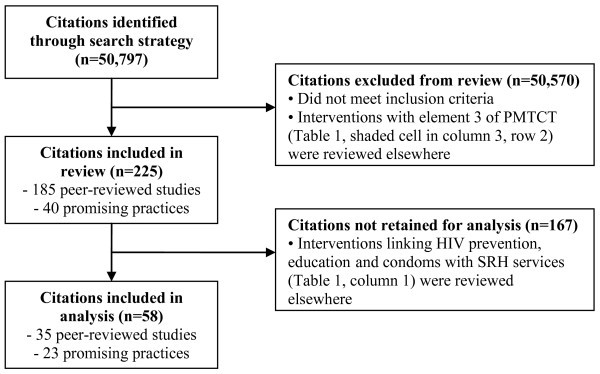
Results: Of more than 50,000 citations identified, 185 studies were included in the review and 35 were analyzed. These studies had heterogeneous interventions, populations, objectives, study designs, rigour and measured outcomes. SRH-HIV linkage interventions were generally considered beneficial and feasible. The majority of studies showed improvements in all outcomes measured. While there were some mixed results, there were very few negative findings. Generally, positive effects were shown for key outcomes, including HIV incidence, sexually transmitted infection incidence, condom use, contraceptive use, uptake of HIV testing and quality of services. Promising practices (n = 23) tended to evaluate more recent and more comprehensive programmes. Factors promoting effective linkages included stakeholder involvement, capacity building, positive staff attitudes, non-stigmatizing services, and engagement of key populations.
Conclusions: Existing evidence provides support for linkages, although significant gaps in the literature remain. Policy makers, programme managers and researchers should continue to advocate for, support, implement and rigorously evaluate SRH and HIV linkages at the policy, systems and service levels.
Figures
References
-
- United Nations. Millennium development goals. http://www.un.org/millenniumgoals/
-
- WHO, UNFPA, IPPF, UN, UNAIDS. Sexual and reproductive health and HIV/AIDS: a framework for priority linkages. 2005. http://whqlibdoc.who.int/hq/2005/WHO_HIV_2005.05_eng.pdf
-
- UNFPA, UNAIDS, Family Care International: T. The New York Call to Commitment: Linking HIV/AIDS and Sexual and Reproductive Health. 2004. http://www.unfpa.org/upload/lib_pub_file/321_filename_New%20York%20Call%...
-
- WHO, UNFPA. The Glion call to action on family planning and HIV/AIDS in women and children. 2004. http://www.unfpa.org/public/publications/pid/1435
Publication types
MeSH terms
LinkOut - more resources
Full Text Sources
Medical
Molecular Biology Databases
