


Modelling of inquiry diagnosis for coronary heart disease in Traditional Chinese Medicine by using multi-label learning
- PMID: 20642856
- PMCID: PMC2921356
- DOI: 10.1186/1472-6882-10-37
Modelling of inquiry diagnosis for coronary heart disease in Traditional Chinese Medicine by using multi-label learning
Abstract
Background: Coronary heart disease (CHD) is a common cardiovascular disease that is extremely harmful to humans. In Traditional Chinese Medicine (TCM), the diagnosis and treatment of CHD have a long history and ample experience. However, the non-standard inquiry information influences the diagnosis and treatment in TCM to a certain extent. In this paper, we study the standardization of inquiry information in the diagnosis of CHD and design a diagnostic model to provide methodological reference for the construction of quantization diagnosis for syndromes of CHD. In the diagnosis of CHD in TCM, there could be several patterns of syndromes for one patient, while the conventional single label data mining techniques could only build one model at a time. Here a novel multi-label learning (MLL) technique is explored to solve this problem.
Methods: Standardization scale on inquiry diagnosis for CHD in TCM is designed, and the inquiry diagnostic model is constructed based on collected data by the MLL techniques. In this study, one popular MLL algorithm, ML-kNN, is compared with other two MLL algorithms RankSVM and BPMLL as well as one commonly used single learning algorithm, k-nearest neighbour (kNN) algorithm. Furthermore the influence of symptom selection to the diagnostic model is investigated. After the symptoms are removed by their frequency from low to high; the diagnostic models are constructed on the remained symptom subsets.
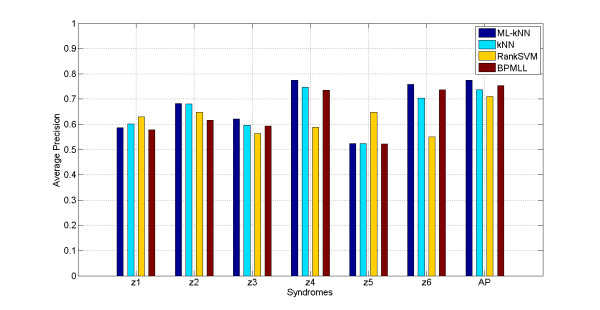
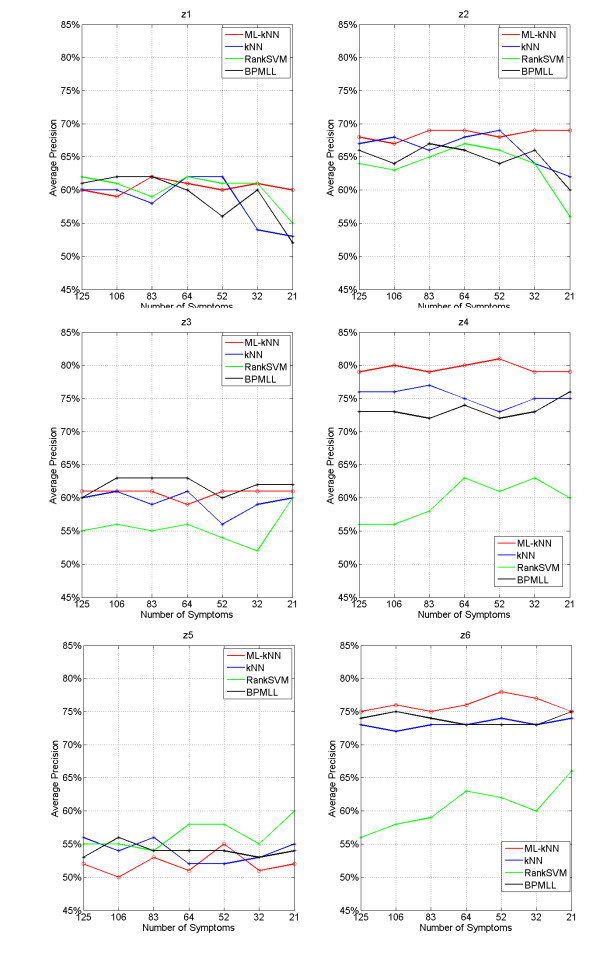
Results: A total of 555 cases are collected for the modelling of inquiry diagnosis of CHD. The patients are diagnosed clinically by fusing inspection, pulse feeling, palpation and the standardized inquiry information. Models of six syndromes are constructed by ML-kNN, RankSVM, BPMLL and kNN, whose mean results of accuracy of diagnosis reach 77%, 71%, 75% and 74% respectively. After removing symptoms of low frequencies, the mean accuracy results of modelling by ML-kNN, RankSVM, BPMLL and kNN reach 78%, 73%, 75% and 76% when 52 symptoms are remained.
Conclusions: The novel MLL techniques facilitate building standardized inquiry models in CHD diagnosis and show a practical approach to solve the problem of labelling multi-syndromes simultaneously.
Figures
References
-
- Zhang S, Song YQ, Yue W. Multicentric randomized double blinded clinical study of Yiqi Tongmai Oral Liquid against angina pectoris in patients with coronary heart disease. Chinese Journal of Integrated Traditional and Western Medicine. 2007;5(4):383–391. - PubMed
-
- Li JB, Zhu WF. My thinking on the disease name of TCM and its differentiation diagnosis standardization of CHD. Hunan Journal of Traditional Chinese Medicine. 1994;10(6):24.
-
- Jia ZH, Li YS, Wu YL. Application of entuopy-based complex systems partition method in research on quantizing TCM sydrome diagnostic criteria of angina petoris. Chinese Journal of Integrated Traditional and Western Medicine. 2007;27(9):804–806. - PubMed
-
- Wang J, Chen KJ. A survey on signs and symptoms about blood stasis syndrome. Liaoning Journal of Traditional Chinese Medicine. 1990;14(5):45–48.
-
- Wang J, Chen KJ, Song XH. Objectified study of abdomen diagnosis on blood stasis syndrome, Chinese. Journal of Integrated Traditional and Western Medicine. 1996;16(10):596–599.
Publication types
MeSH terms
LinkOut - more resources
Full Text Sources
