


The safety and efficacy of {+/-}3,4-methylenedioxymethamphetamine-assisted psychotherapy in subjects with chronic, treatment-resistant posttraumatic stress disorder: the first randomized controlled pilot study
- PMID: 20643699
- PMCID: PMC3122379
- DOI: 10.1177/0269881110378371
The safety and efficacy of {+/-}3,4-methylenedioxymethamphetamine-assisted psychotherapy in subjects with chronic, treatment-resistant posttraumatic stress disorder: the first randomized controlled pilot study
Erratum in
- J Psychopharmacol. 2011 Jun;25(6):852
Abstract
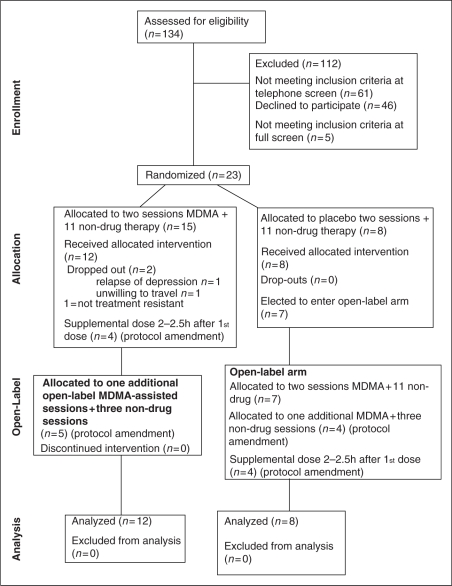
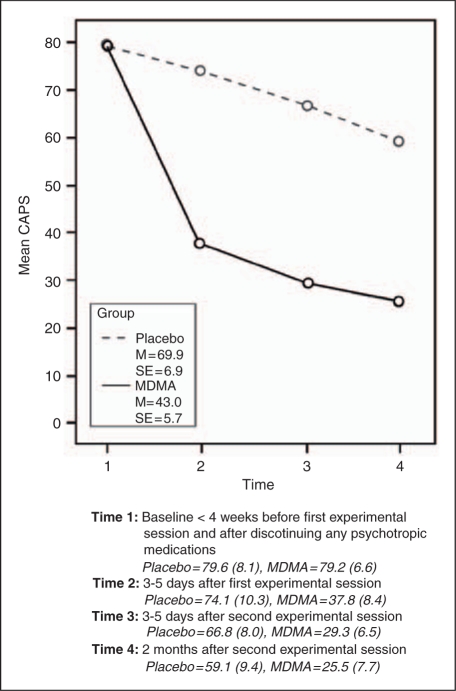
Case reports indicate that psychiatrists administered ±3,4-methylenedioxymethamphetamine (MDMA) as a catalyst to psychotherapy before recreational use of MDMA as 'Ecstasy' resulted in its criminalization in 1985. Over two decades later, this study is the first completed clinical trial evaluating MDMA as a therapeutic adjunct. Twenty patients with chronic posttraumatic stress disorder, refractory to both psychotherapy and psychopharmacology, were randomly assigned to psychotherapy with concomitant active drug (n = 12) or inactive placebo (n = 8) administered during two 8-h experimental psychotherapy sessions. Both groups received preparatory and follow-up non-drug psychotherapy. The primary outcome measure was the Clinician-Administered PTSD Scale, administered at baseline, 4 days after each experimental session, and 2 months after the second session. Neurocognitive testing, blood pressure, and temperature monitoring were performed. After 2-month follow-up, placebo subjects were offered the option to re-enroll in the experimental procedure with open-label MDMA. Decrease in Clinician-Administered PTSD Scale scores from baseline was significantly greater for the group that received MDMA than for the placebo group at all three time points after baseline. The rate of clinical response was 10/12 (83%) in the active treatment group versus 2/8 (25%) in the placebo group. There were no drug-related serious adverse events, adverse neurocognitive effects or clinically significant blood pressure increases. MDMA-assisted psychotherapy can be administered to posttraumatic stress disorder patients without evidence of harm, and it may be useful in patients refractory to other treatments.
Trial registration: ClinicalTrials.gov NCT00090064.
Figures


References
-
- Baggott MJ, Galloway G, Jang M, Didier R, Pournajafi-Nazarloo H, Carter CS, et al. (2008) 3,4-methylenedioxymethamphetamine (MDMA, ‘Ecstasy’) and prazosin interactions in humans. 70th Annual Meeting of the College on Problems of Drug Dependence. San Juan, Puerto Rico.
-
- Baumgartner T, Heinrichs M, Vonlanthen A, Fischbacher U, Fehr E. (2008) Oxytocin shapes the neural circuitry of trust and trust adaptation in humans. Neuron 58: 639–650 - PubMed
-
- Benish SG, Imel ZE, Wampold BE. (2008) The relative efficacy of bona fide psychotherapies for treating post-traumatic stress disorder: a meta-analysis of direct comparisons. Clin Psychol Rev 28: 746–758 - PubMed
-
- Benzenhoefer UP, Passie T. (2006) The early history of ecstasy. Nervenartz 77: 95–96 (98–99 - PubMed
-
- Brady K, Pearlstein T, Asnis GM, Baker D, Rothbaum B, Sikes CR, et al. (2000) Efficacy and safety of sertraline treatment of posttraumatic stress disorder: a randomized controlled trial. JAMA 283: 1837–1844 - PubMed
Publication types
MeSH terms
Substances
Associated data
LinkOut - more resources
Full Text Sources
Other Literature Sources
Medical
