. 2010 Aug 24;107(34):15269-74.
doi: 10.1073/pnas.1001738107. Epub 2010 Jul 19.

22-Nucleotide RNAs trigger secondary siRNA biogenesis in plants

Affiliations

22-Nucleotide RNAs trigger secondary siRNA biogenesis in plants

Ho-Ming Chen et al. Proc Natl Acad Sci U S A. .

Abstract

The effect of RNA silencing in plants can be amplified if the production of secondary small interfering RNAs (siRNAs) is triggered by the interaction of microRNAs (miRNAs) or siRNAs with a long target RNA. miRNA and siRNA interactions are not all equivalent, however; most of them do not trigger secondary siRNA production. Here we use bioinformatics to show that the secondary siRNA triggers are miRNAs and transacting siRNAs of 22 nt, rather than the more typical 21-nt length. Agrobacterium-mediated transient expression in Nicotiana benthamiana confirms that the siRNA-initiating miRNAs, miR173 and miR828, are effective as triggers only if expressed in a 22-nt form and, conversely, that increasing the length of miR319 from 21 to 22 nt converts it to an siRNA trigger. We also predicted and validated that the 22-nt miR771 is a secondary siRNA trigger. Our data demonstrate that the function of small RNAs is influenced by size, and that a length of 22 nt facilitates the triggering of secondary siRNA production.


Conflict of interest statement

The authors declare no conflict of interest.

Figures
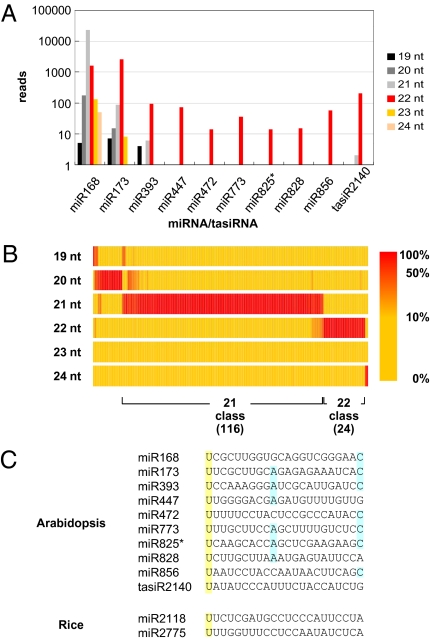
Fig. 1.
Fig. 1.
siRNA triggers are predominantly 22 nt. (A) Size distribution of Arabidopsis siRNA triggers. The abundance of siRNA triggers in size classes from 19 to 24 nt is plotted according to the pooled data of several available sRNA sequencing datasets (, , –18). (B) A heat map showing clusters of Arabidopsis miRNAs with sizes enriched mainly as 21 or 22 nt. Each vertical column represents one miRNA species. A gradient of yellow to red represents the frequency (%) of each size class for a given miRNA. The map is organized according to the relative abundance of the sizes (19–24 nt) for each miRNA. (C) Alignment of siRNA triggers. Identical nucleotides and conserved nucleotides among siRNA triggers are highlighted in yellow and blue, respectively.
Fig. 2.
Fig. 2.
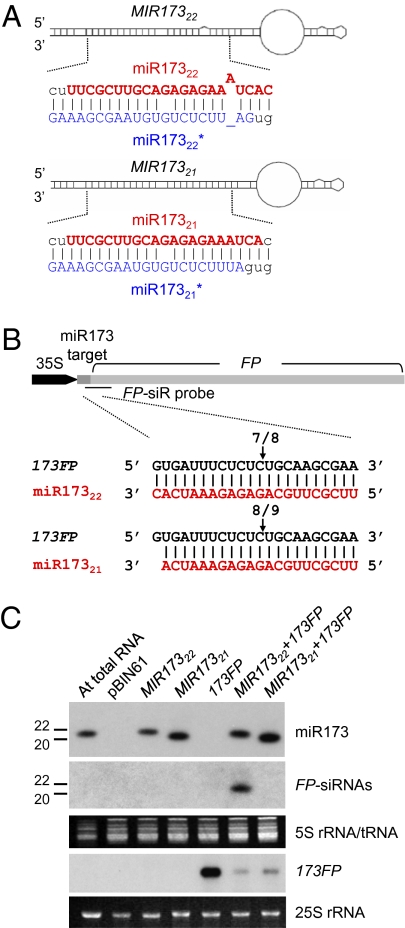
A size of 22 nt is required for miR173 to trigger secondary siRNA. (A) Predicted foldback structures of MIR17322 and MIR17321 for expressing 22- and 21-nt miR173, respectively. Expected duplexes of miR173 and miR173* are highlighted. (B) Construct of 35S:173FP and cleavage sites identified by 5′ RACE assay. The position of the cleavage site is indicated by an arrow with the proportion of sequenced clones. FP-siR probe (horizontal line) indicates a DNA oligonucleotide probe complementary to the 42-nt region downstream of the predicted cleavage site directed by miR173 for the detection of FP-derived siRNA shown below. (C) Northern blot analysis of miR173, FP-derived siRNA, and 173FP transcripts.
Fig. 3.
Fig. 3.
A change in size from 21 to 22 nt is sufficient to convert miR319 to an siRNA trigger. (A) Predicted foldback structures of MIR31921 and MIR31922 for expressing 21- and 22-nt miR319, respectively. Expected duplexes of miR319 and miR319* are highlighted. Sizes of miR319s produced from MIR31921 or MIR31922 were obtained by small RNA sequencing and shown as percentage (%) of each size class. (B) Construct of 35S:319FP and cleavage sites identified by 5′ RACE assay. The position of the cleavage site is indicated by an arrow with the proportion of sequenced clones. FP-siR probe (horizontal line) indicates a DNA oligonucleotide probe complementary to the 42-nt region downstream of the predicted cleavage site directed by miR319 for the detection of FP-derived siRNA shown below. (C) Northern blot analysis of miR319, FP-derived siRNA, and 319FP transcripts. N. benthamiana miR159 (NbmiR159) has a high sequence similarity with miR319 and likely was cross-hybridized with the miR319 probe. (D) Normalized abundance (TP10M) of FP-derived 21-nt small RNA species was plotted for both sense (S) and antisense (AS) strands of 319FP in N. benthamiana coinfiltrated with 35S:319FP/35S:MIR31921 or 35S:319FP/35S:MIR31922. 21-nt sRNAs in registers (reg.) 1 and 2 corresponding to the miR319-directed cleavage site are highlighted in red.
Fig. 4.
Fig. 4.
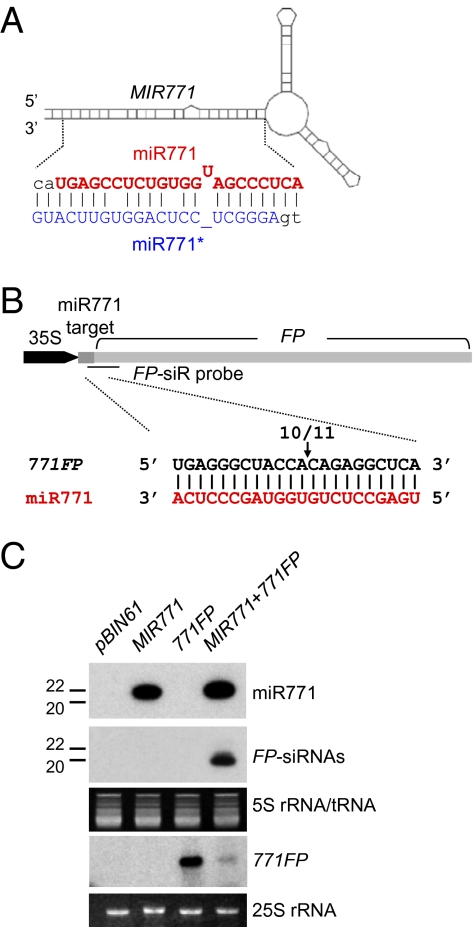
miR771 is a new siRNA trigger. (A) Predicted foldback of MIR771. The expected duplexes of miR771 and miR771* are highlighted. (B) Construct of 35S:771FP and cleavage sites identified by 5′ RACE assay. The position of the cleavage site is indicated by an arrow with the proportion of sequenced clones. FP-siR probe (horizontal line) indicates a DNA oligonucleotide probe complementary to the 42-nt region downstream of the predicted cleavage site directed by miR771 for the detection of FP-derived siRNAs shown below. (C) Northern blot analysis of miR771, FP-derived siRNA, and 771FP transcripts.

Comment in

  • RNA silencing amplification in plants: size matters.
    Schwab R, Voinnet O. Schwab R, et al. Proc Natl Acad Sci U S A. 2010 Aug 24;107(34):14945-6. doi: 10.1073/pnas.1009416107. Epub 2010 Aug 13. Proc Natl Acad Sci U S A. 2010. PMID: 20709960 Free PMC article. No abstract available.

References

    1. Voinnet O. Use, tolerance and avoidance of amplified RNA silencing by plants. Trends Plant Sci. 2008;13:317–328. - PubMed
    1. Vaucheret H. MicroRNA-dependent trans-acting siRNA production. Sci STKE. 2005;2005:pe43. - PubMed
    1. Allen E, Xie Z, Gustafson AM, Carrington JC. MicroRNA-directed phasing during trans-acting siRNA biogenesis in plants. Cell. 2005;121:207–221. - PubMed
    1. Yoshikawa M, Peragine A, Park MY, Poethig RS. A pathway for the biogenesis of trans-acting siRNAs in Arabidopsis. Genes Dev. 2005;19:2164–2175. - PMC - PubMed
    1. Rajagopalan R, Vaucheret H, Trejo J, Bartel DP. A diverse and evolutionarily fluid set of microRNAs in Arabidopsis thaliana. Genes Dev. 2006;20:3407–3425. - PMC - PubMed

Publication types