. 2010 Jul 13;8(7):e1000422.
doi: 10.1371/journal.pbio.1000422.

Involvement of Lgl and Mahjong/VprBP in cell competition

Affiliations

Involvement of Lgl and Mahjong/VprBP in cell competition

Yoichiro Tamori et al. PLoS Biol. .

Abstract

During the initial stages of carcinogenesis, transformation events occur in a single cell within an epithelial monolayer. However, it remains unknown what happens at the interface between normal and transformed epithelial cells during this process. In Drosophila, it has been recently shown that normal and transformed cells compete with each other for survival in an epithelial tissue; however the molecular mechanisms whereby "loser cells" undergo apoptosis are not clearly understood. Lgl (lethal giant larvae) is a tumor suppressor protein and plays a crucial role in oncogenesis in flies and mammals. Here we have examined the involvement of Lgl in cell competition and shown that a novel Lgl-binding protein is involved in Lgl-mediated cell competition. Using biochemical immunoprecipitation methods, we first identified Mahjong as a novel binding partner of Lgl in both flies and mammals. In Drosophila, Mahjong is an essential gene, but zygotic mahjong mutants (mahj(-/-)) do not have obvious patterning defects during embryonic or larval development. However, mahj(-/-) cells undergo apoptosis when surrounded by wild-type cells in the wing disc epithelium. Importantly, comparable phenomena also occur in Mahjong-knockdown mammalian cells; Mahjong-knockdown Madin-Darby canine kidney epithelial cells undergo apoptosis, only when surrounded by non-transformed cells. Similarly, apoptosis of lgl(-/-) cells is induced when they are surrounded by wild-type cells in Drosophila wing discs. Phosphorylation of the c-Jun N-terminal kinase (JNK) is increased in mahj(-/-) or lgl(-/-) mutant cells, and expression of Puckered (Puc), an inhibitor of the JNK pathway, suppresses apoptosis of these mutant cells surrounded by wild-type cells, suggesting that the JNK pathway is involved in mahj- or lgl-mediated cell competition. Finally, we have shown that overexpression of Mahj in lgl(-/-) cells strongly suppresses JNK activation and blocks apoptosis of lgl(-/-) cells in the wild-type wing disc epithelium. These data indicate that Mahjong interacts with Lgl biochemically and genetically and that Mahjong and Lgl function in the same pathway to regulate cellular competitiveness. As far as we are aware, this is the first report that cell competition can occur in a mammalian cell culture system.


Conflict of interest statement

The authors have declared that no competing interests exist.

Figures

Figure 1
Figure 1. VprBP is a novel mLgl2-binding protein.
(A) Identification of VprBP as an mLgl2-binding protein by immunoprecipitation. Immunoprecipitation was performed with lysates from parental or GFP-mLgl2-expressing MCF-7 epithelial cells with control mouse IgG or anti-GFP antibody, followed by SDS-PAGE and SYPRO Ruby protein staining. A magnified image of the last two lanes is shown in the right panel. (B) A degradation product of mLgl2 in the GFP-immunoprecipitate. The GFP-immunoprecipitate (the same used for the last lane in A) was examined by Western blotting with anti-GFP antibody. (A and B) Arrowhead, arrow, and asterisk indicate the positions of VprBP, GFP-mLgl2, and a degradation product of GFP-mLgl2, respectively. (C) Confirmation that VprBP is an mLgl2-binding protein. Immunoprecipitation was performed with anti-GFP antibody as described above, followed by Western blotting with anti-VprBP antibody. (D) Coimmunoprecipitation between endogenous mLgl2 and VprBP proteins. Immunoprecipitation was performed with lysates from Madin-Darby canine kidney (MDCK) epithelial cells with control rabbit IgG or anti-VprBP antibody, followed by Western blotting with anti-VprBP or anti-mLgl2 antibody.
Figure 2
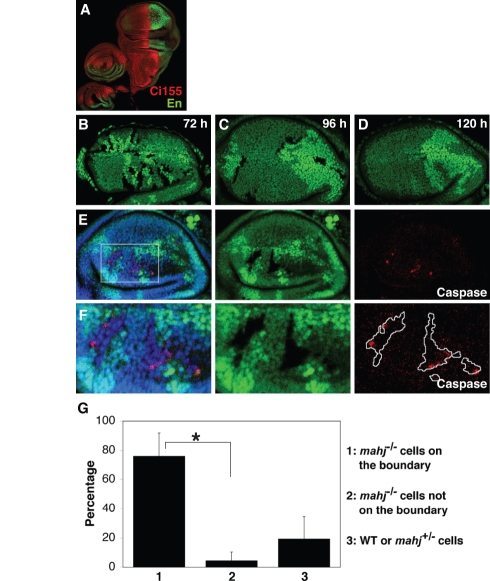
Figure 2. Loss of Mahj function induces cell competition in Drosophila wing disc epithelium.
(A) Wing and leg discs of homozygous mahj1 mutant third-instar Drosophila larvae stained with anti-Ci155 (red) and anti-Engrailed (green) antibodies. (B–F) Wing discs with mahj −/− (lacking GFP), wild-type (expressing GFP strongly), and mahj+/ clones (expressing GFP moderately) at 72 h (B), 96 h (C, E, and F), and 120 h (D) after clone induction. (E) A Z-stack projection of confocal images of a wing disc. Basally extruded apoptotic cells were excluded from the analysis. (F) Magnified images of (E). (E and F) Apoptotic cells were labeled with anti-cleaved Caspase-3 antibody (red). Nuclei were stained with DAPI (blue). (G) Quantification of apoptotic cells in the mahj1 mosaic wing discs showing non-cell-autonomous apoptosis in mahj −/− cells. The results represent means±SD (n = 34 discs, *p<0.001).
Figure 3
Figure 3. Knockdown of Mahjong expression induces cell competition in cultured MDCK epithelial cells.
(A and B) MDCK pTR Mahjong shRNA cells were fluorescently labeled with green fluorescent dye CMFDA (green) and mixed with normal MDCK cells at a ratio of 1∶10, and cultured in the presence (A) or absence (B) of tetracycline with EthD-1 (red) for the indicated times. Images were extracted from a representative time-lapse analysis. Scale bar: 30 µm. (C) Quantification of cell death of MDCK pTR Mahjong shRNA cells. Fluorescently labeled MDCK pTR Mahjong shRNA cells were mixed with normal MDCK or MDCK pTR Mahjong shRNA cells, and cultured in the absence or presence of tetracycline or caspase inhibitor (Z-VAD-FMK) for 60 h. Frequency of cell death that occurred in labeled MDCK pTR Mahjong shRNA cells was analyzed for 30–60 cells in each experimental condition, and the results represent the means±SD of more than three independent experiments. *p<0.005; **p<0.001; ***p<0.02. Noted that all and only dead cells were apically extruded.
Figure 4
Figure 4. Loss of Lgl function induces cell competition in the Drosophila wing disc epithelium.
(A and B) Wing discs with lgl4 homozygous (lacking GFP), wild-type (expressing GFP strongly), and lgl4 heterozygous clones (expressing GFP moderately) at 96 h (A) or 144 h (B) after clone induction. Note that most of the apoptotic lgl4 homozygous clones (lacking GFP) were basally extruded. Upper panels: A Z-stack projection of 40 confocal images of a wing disc. Lower panels: Transverse sections of the white line. (A) Arrows indicate apoptotic lgl −/− cells remaining within the epithelial monolayer. (C) A wing disc where lgl −/− clones are surrounded by Minute/+ heterozygous cells (expressing GFP) at 144 h after clone induction. (A–C) Apoptotic cells were labeled with anti-cleaved Caspase-3 antibody (red). Nuclei were stained with DAPI (blue). (D) Quantification of apoptotic cells in the lgl −/− mosaic wing discs at 96 h after clone induction, showing non-cell-autonomous apoptosis in lgl −/− cells. The results represent means±SD (n = 31 discs, *p<0.001).
Figure 5
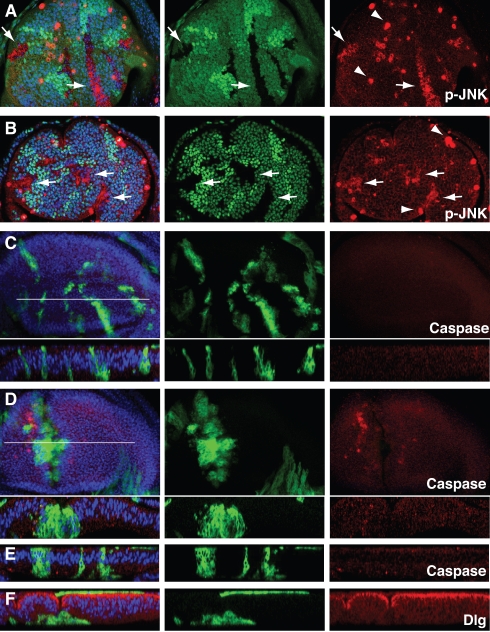
Figure 5. JNK is involved in the apoptosis of mahj −/− and lgl −/− clones.
(A and B) Wing discs with mahj −/− (A) or lgl −/− (B) clones (lacking GFP), wild-type clones (expressing GFP strongly), and heterozygous clones (expressing GFP moderately) at 96 h after clone induction. Arrows indicate phospho JNK (p-JNK)-positive mahj −/− or lgl −/− cells. Some strong punctate p-JNK signals (arrowheads) are derived from cells within the peripodial layer where endogenous JNK activity is upregulated . (C–F) The mosaic analysis with a repressible cell marker (MARCM) system was used to overexpress UAS constructs in either mahj −/− clones (C and E) or lgl −/− clones (D and F), and homozygous mutant clones are marked by the expression of GFP. (C and D) Overexpression of puc in mahj −/− (C) or lgl −/− (D) clones at 120 h after clone induction. Upper panels: A Z-stack projection of 40 confocal images of a wing disc. Lower panels: Transverse sections of the white line. (E and F) Transverse section of a wing disc with mahj −/− (E) or lgl −/− (F) MARCM clones overexpressing p35 at 144 h after clone induction. Anti-phospho JNK (A and B), anti-cleaved Caspase-3 (C–E), and anti-Dlg (F) antibodies were used for immunostaining. (A–F) Nuclei were stained with DAPI (blue).
Figure 6
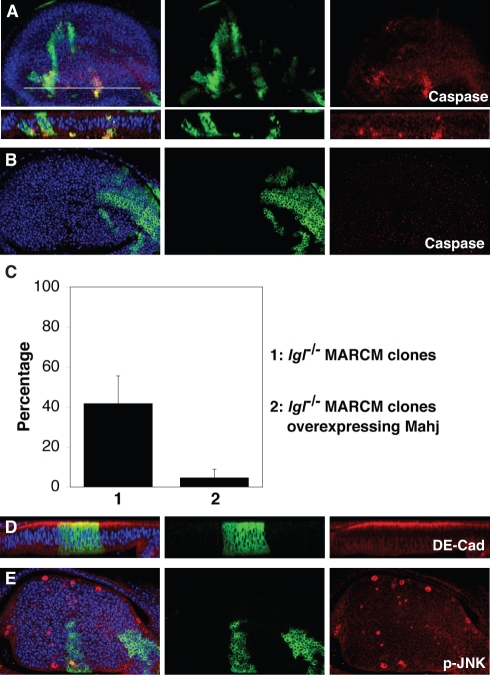
Figure 6. Mahjong acts as a downstream target of Lgl in cell competition and basal cell extrusion.
The mosaic analysis with a repressible cell marker (MARCM) system was used to overexpress UAS constructs in either mahj −/− clones (A) or lgl −/− clones (B, D, and E). Homozygous mutant clones are marked by the expression of GFP. (A) mahj −/− MARCM clones overexpressing Lgl at 96 h after clone induction. (B, D, and E) lgl −/− MARCM clones overexpressing Mahj at 144 h (B and D) or 96 h (E) after clone induction. (C) Quantification of apoptotic cells in the lgl −/− mosaic wing discs with or without overexpression of Mahj. The percentage of apoptosis occurring in lgl −/− cells on the boundary with wild-type cells was examined. The results represent means±SD (n = 13 discs, *p<0.001). (D) A transverse section. Anti-cleaved Caspase-3 (A and B), anti-DE-Cadherin (D), and anti-phospho JNK (E) antibodies were used for immunostaining. (A, B, D, and E) Nuclei were stained with DAPI (blue).

Comment in

References

    1. Hanahan D, Weinberg R. A. The hallmarks of cancer. Cell. 2000;100:57–70. - PubMed
    1. Nowell P. C. The clonal evolution of tumor cell populations. Science. 1976;194:23–28. - PubMed
    1. Fialkow P. J. Clonal origin of human tumors. Biochim Biophys Acta. 1976;458:283–321. - PubMed
    1. Johnston L. A. Competitive interactions between cells: death, growth, and geography. Science. 2009;324:1679–1682. - PMC - PubMed
    1. Moreno E. Is cell competition relevant to cancer? Nat Rev Cancer. 2008;8:141–147. - PubMed

Publication types

MeSH terms