Review
. 2010 Oct;15(5):253-60.
doi: 10.1016/j.siny.2010.05.007. Epub 2010 Jun 19.

Potential biomarkers for hypoxic-ischemic encephalopathy

Affiliations
Review

Potential biomarkers for hypoxic-ischemic encephalopathy

L Bennet et al. Semin Fetal Neonatal Med. 2010 Oct.

Abstract

Cerebral hypothermia reduces brain injury and improves behavioral recovery after hypoxia-ischemia (HI) at birth. However, using current enrolment criteria many infants are not helped, and conversely, a significant proportion of control infants survive without disability. In order to further improve treatment we need better biomarkers of injury. A 'true' biomarker for the phase of evolving, 'treatable' injury would allow us to identify not only whether infants are at risk of damage, but also whether they are still able to benefit from intervention. Even a less specific measure that allowed either more precise early identification of infants at risk of adverse neurodevelopmental outcome would reduce the variance of outcome of trials, improving trial power while reducing the number of infants unnecessarily treated. Finally, valid short-term surrogates for long term outcome after treatment would allow more rapid completion of preliminary evaluation and thus allow new strategies to be tested more rapidly. Experimental studies have demonstrated that there is a relatively limited 'window of opportunity' for effective treatment (up to about 6-8h after HI, the 'latent phase'), before secondary cell death begins. We critically evaluate the utility of proposed biochemical, electronic monitoring, and imaging biomarkers against this framework. This review highlights the two central limitations of most presently available biomarkers: that they are most precise for infants with severe injury who are already easily identified, and that their correlation is strongest at times well after the latent phase, when injury is no longer 'treatable'. This is an important area for further research.


Figures

Figure 1
Figure 1
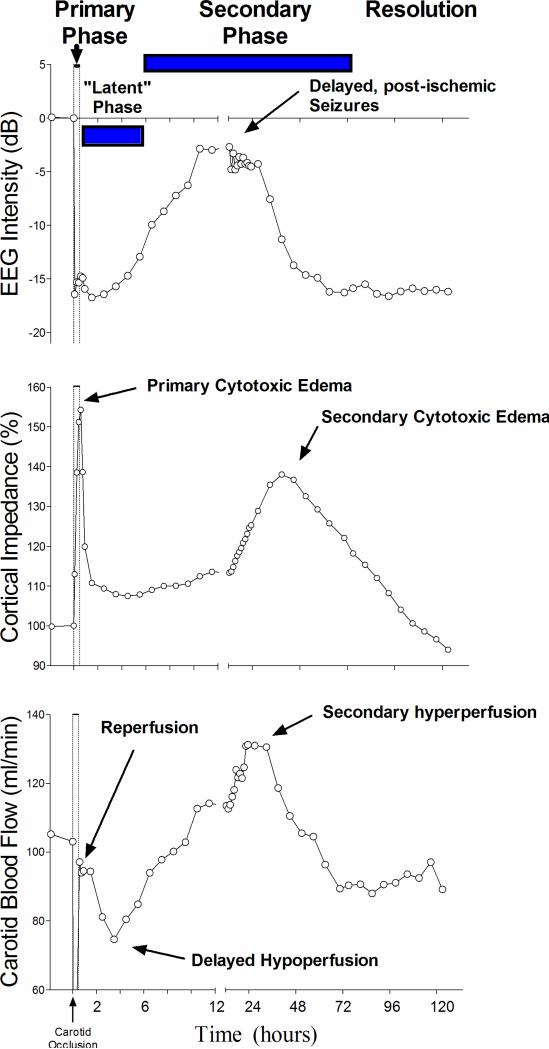
Illustration of the pathophysiological phases of injury after 30 min of global cerebral ischemia in fetal sheep; data derived from Gunn et al. The phases of injury include the immediate reperfusion period lasting about 30 min, during which cellular energy metabolism is restored, with resolution of the acute hypoxic depolarization and cell swelling. This is followed by a latent phase starting about 30–45 min after reperfusion, lasting for up to 6–15 h, in which oxidative cerebral energy metabolism normalizes but electroencephalogram (EEG) activity remains depressed, often with a delayed period of reduced cerebral blood flow. The ‘latent’ phase appears to correspond with the practical window of opportunity for effective neuroprotection. Following the latent phase there is secondary deterioration with delayed seizures and cytotoxic edema as shown by increased tissue impedance, increased blood flow, extracellular accumulation of potential cytotoxins (such as the excitatory neurotransmitters), and about 6–15 h after the asphyxia, failure of oxidative metabolism and damage. The acute changes in this phase may take 3 days or more to resolve.
Figure 2
Figure 2
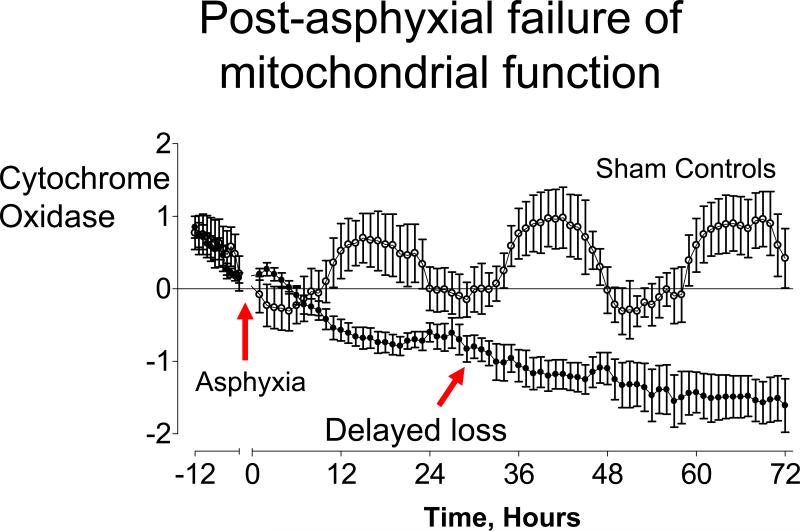
Evidence of delayed mitochondrial dysfunction after severe hypoxia/ischemia in preterm fetal sheep: time sequence of concentration changes in fetal cytochrome oxidase (CytOx) measured by near-infrared spectroscopy before and after asphyxia induced by 25 min of umbilical cord occlusion (•, n = 7) or sham occlusion (○, n = 7) in preterm fetal sheep. Occlusion data not shown. Data are mean ± SEM hourly averages; derived from Bennet et al. [Typesetter: Fig. 2: delete heading above graph. Red arrows: change to black.]
Figure 3
Figure 3
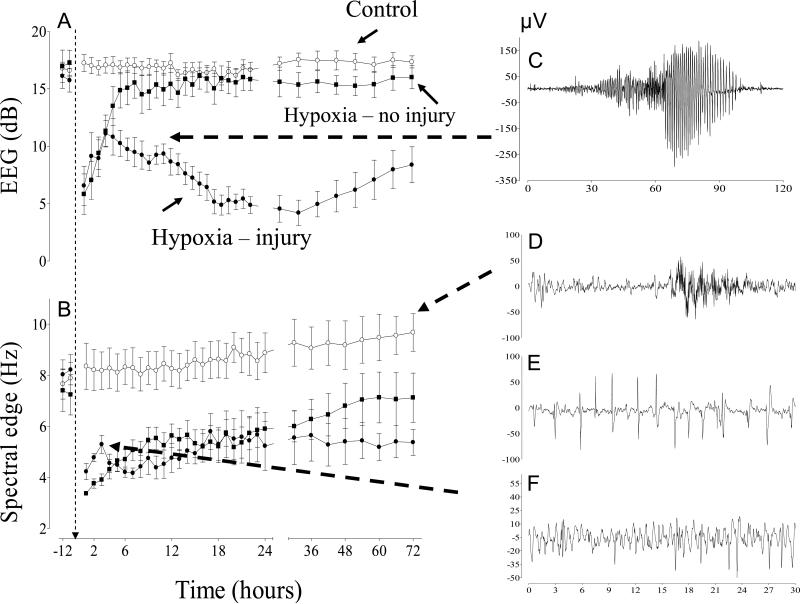
(A, B) Time changes in electroencephalogram (EEG) amplitude and spectral edge in 0.6 gestation fetal sheep before and after either sham asphyxia (○, control group), 20 min of asphyxia (■, hypoxia–no injury group), or 30 min of asphyxia (•, hypoxia–injury group) induced by complete umbilical cord occlusion. (C) Example of a large amplitude stereotypic evolving seizure occurring 10 h after the end of asphyxia in the 30 min hypoxia–injury group. (D) Example of a normal EEG showing mixed amplitude and frequencies in the control group. (E, F) Examples of epileptiform transient activity occurring in the first 2 h after the end of asphyxia in the 30 min injury group. Spectral edge transiently increases at this time. No seizures or epileptiform transients were observed in the 20 min hypoxia–no injury group or the control group. Data derived from George et al.

References

    1. Bennet L, Dean JM, Gunn AJ. The pathogenesis of preterm brain injury. In: Stevenson DK, Benitz WE, Sunshine P, Druzin ML, editors. Fetal and neonatal brain injury: mechanisms, management, and the risks of practice. 4th edition Cambridge University Press; Cambridge: 2009. pp. 48–57.
    1. Gunn AJ, Bennet L. Timing of injury in the fetus and neonate. Curr Opin Obstet Gynecol. 2008;20:175–81. - PubMed
    1. Edwards AD, Brocklehurst P, Gunn AJ, et al. Neurological outcomes at 18 months of age after moderate hypothermia for perinatal hypoxic ischaemic encephalopathy: synthesis and meta-analysis of trial data. Br Med J. 2010;340:c363. - PMC - PubMed
    1. Shankaran S, Laptook AR, Ehrenkranz RA, et al. Whole-body hypothermia for neonates with hypoxic–ischemic encephalopathy. N Engl J Med. 2005;353:1574–84. - PubMed
    1. Eicher DJ, Wagner CL, Katikaneni LP, et al. Moderate hypothermia in neonatal encephalopathy: efficacy outcomes. Pediatr Neurol. 2005;32:11–17. - PubMed

Publication types

MeSH terms