Factors affecting the decision of breast cancer patients to undergo contralateral prophylactic mastectomy
- PMID: 20647335
- PMCID: PMC4340054
- DOI: 10.1158/1940-6207.CAPR-09-0130
Factors affecting the decision of breast cancer patients to undergo contralateral prophylactic mastectomy
Abstract
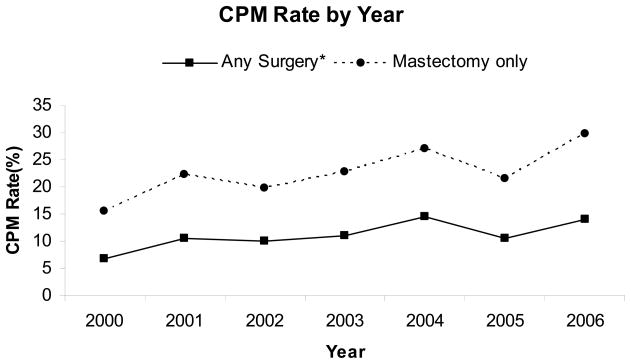
Increasing numbers of women with breast cancer are electing for contralateral prophylactic mastectomy (CPM) to reduce the risk of developing contralateral breast cancer. The objective of this study was to identify factors that may affect a patient's decision to undergo CPM. We identified 2,504 women with stage 0 to III unilateral primary breast cancer who underwent breast surgery at our institution from January 2000 to August 2006 from a prospectively maintained database. We did logistic regression analyses to determine which factors were associated with undergoing CPM. Of 2,504 breast cancer patients, 1,223 (48.8%) underwent total mastectomy. Of the 1,223 patients who underwent mastectomy, 284 (23.2%) underwent immediate or delayed CPM. There were 33 patients (1.3%) who had genetic testing before the surgery, with the use of testing increasing in the latter years of the study (0.1% in 2000-2002 versus 2.0% in 2003-2006; P < 0.0001). Multivariable analysis revealed several factors that were associated with a patient undergoing CPM: age younger than 50 years, white ethnicity, family history of breast cancer, BRCA1/2 mutation testing, invasive lobular histology, clinical stage, and use of reconstruction. We identified specific patient and tumor characteristics associated with the use of CPM. Although genetic testing is increasing, most women undergoing CPM did not have a known genetic predisposition to breast cancer. Evidence-driven models are needed to better inform women of their absolute risk of contralateral breast cancer as well as their competing risk of recurrence from the primary breast cancer to empower them in their active decision making.
2010 AACR.
Figures
References
-
- Goldflam K, Hunt KK, Gershenwald JE, et al. Contralateral prophylactic mastectomy. Predictors of significant histologic findings. Cancer. 2004;101(9):1977–1986. - PubMed
-
- Herrinton LJ, Barlow WE, Yu O, et al. Efficacy of prophylactic mastectomy in women with unilateral breast cancer: a cancer research network project. J Clin Oncol. 2005;23(19):4275–4286. - PubMed
-
- Kollias J, Ellis IO, Elston CW, Blamey RW. Clinical and histological predictors of contralateral breast cancer. Eur J Surg Oncol. 1999;25(6):584–589. - PubMed
-
- Robbins GF, Berg JW. Bilateral Primary Breast Cancer; a Prospective Clinicopathological Study. Cancer. 1964;17:1501–1527. - PubMed
-
- Gao X, Fisher SG, Emami B. Risk of second primary cancer in the contralateral breast in women treated for early-stage breast cancer: a population-based study. Int J Radiat Oncol Biol Phys. 2003 Jul 15;56(4):1038–1045. - PubMed
MeSH terms
Grants and funding
LinkOut - more resources
Full Text Sources
Medical
Miscellaneous