. 2010 Dec;18(12):1310-4.
doi: 10.1038/ejhg.2010.116. Epub 2010 Jul 21.

Mesomelic dysplasia Kantaputra type is associated with duplications of the HOXD locus on chromosome 2q

Affiliations

Mesomelic dysplasia Kantaputra type is associated with duplications of the HOXD locus on chromosome 2q

Piranit N Kantaputra et al. Eur J Hum Genet. 2010 Dec.

Abstract

Mesomelic dysplasia Kantaputra type (MDK) is characterized by marked mesomelic shortening of the upper and lower limbs originally described in a Thai family. To identify the cause of MDK, we performed array CGH and identified two microduplications on chromosome 2 (2q31.1-q31.2) encompassing ∼481 and 507 kb, separated by a segment of normal copy number. The more centromeric duplication encompasses the entire HOXD cluster, as well as the neighboring genes EVX2 and MTX2. The breakpoints of the duplication localize to the same region as the previously identified inversion of the mouse mutant ulnaless (Ul), which has a similar phenotype as MDK. We propose that MDK is caused by duplications that modify the topography of the locus and as such result in deregulation of HOXD gene expression.


Figures
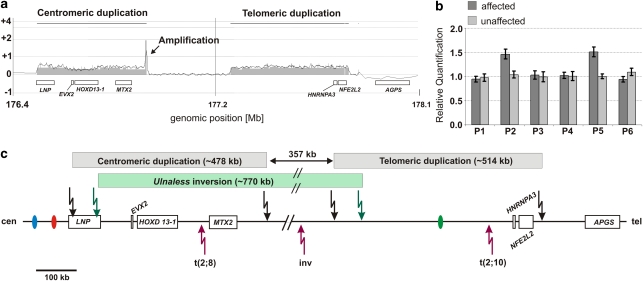
Figure 1
Figure 1
(a) Profile of custom tiling array-CGH analysis, which covers 3 Mb of the critical region on chromosome 2q at high density demonstrating two duplications separated by a segment of normal copy number in individual III.26. The centromeric duplication encompasses the HOXD cluster. A small amplification at the distal end of the centromeric duplication is indicated. Regions with a log2 ratio >0.3 represent duplications and are shaded in gray. Genomic positions are according to human genome version hg18. (b) Microduplications and segregation confirmed by qPCR. For one affected (individual III.16; dark gray bars) and one unaffected (individual IV.23; light gray bars) individual, mean values and SDs (error bars) for each target amplicon relative to Albumin as a two-copy reference gene were calculated. The amplicons P2 and P4 located within the centromeric and telomeric duplicated region, respectively, show a ratio of ∼1.5 in the affected individual indicating a copy-number gain, whereas the unaffected individual shows a ratio of ∼1.0, which corresponds to a normal copy number (two copies). The unaffected individual is the daughter of the affected individual III.26 with whom we performed the array CGH shown in (a). (c) Schematic illustration of aberrations at the HOXD cluster and flanking region on chromosome 2q associated with limb malformations. The two duplications detected in the MDK family (gray bars), as well as the inversion in the mouse mutant ulnaless (green bar) are indicated. The centromere (cen) is on the left, and telomere (tel) on the right. The breakpoints are indicated by arrows in the corresponding colors. Red arrows below indicate published translocations and the inversion (inv)., The translocation t(2;8) and the inversion result in mesomelic shortening. Regulatory elements are indicated by colored ovals (blue: global control region (GCR); red: centromeric repressor (CenR); green: early limb control region (ELCR)). Genomic positions are according to human genome version hg18. The color reproduction of the figure is available on the html full text version of the paper.
Figure 2
Figure 2
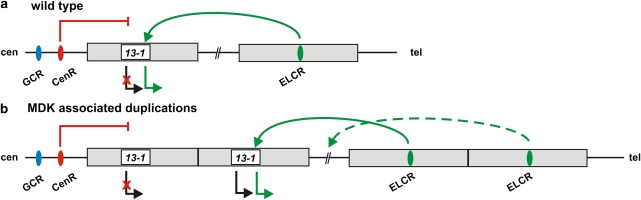
(a) Regulation of HOXD cluster during early limb development. A complex time-dependent mechanism involving two control elements on the centromeric and telomeric side of the HOXD cluster controls the expression of HOXD genes in the early limb bud. One regulatory element centromeric of the HOXD cluster (CenR, red oval) represses the expression of 5′ HOXD genes (HOXD10–13) indicated by the red bar. The transcriptional activation of the 3′ HOXD genes (HOXD1–9) is simultaneously induced by the early limb control region (ELCR, green oval), which is located on the telomeric side of the HOXD cluster indicated by the green arrow (Tarchini and Duboule, 2006). Small green arrow marks active genes. The centromere (cen) is on the left, and telomere (tel) on the right. GCR, global control region; CenR, centromeric repressor. (b) Hypothesis on disturbance of HOXD cluster regulation in MDK. The two duplications detected in the MDK family (gray bars) are arranged in direct tandem orientation and result in a duplication of the HOXD cluster (centromeric dup) and of the ELCR (telomeric dup). As the ELCR is promoter independent, the onset of transcription depends on the distance between gene and ELCR. The duplicated HOXD cluster can be activated by the ELCR (small arrows); however, the 5′ HOXD genes (HOXD10–13) escape the repression by the centromeric regulator CenR and thus the posterior restriction. As a consequence, HOXD13 is expressed too early and ectopically leading to the MDK phenotype. The later HOXD expression in the digit domain controlled by the GCR is unaffected by the genomic duplications. The color reproduction of the figure is available on the html full text version of the paper.

References

    1. Kantaputra PN, Gorlin RJ, Langer LO., Jr Dominant mesomelic dysplasia, ankle, carpal, and tarsal synostosis type: a new autosomal dominant bone disorder. Am J Med Genet. 1992;44:730–737. - PubMed
    1. Kantaputra PN. Thirteen-year-follow up report on mesomelic dysplasia, Kantaputra type (MDK), and comments on the paper of the second reported family of MDK by Shears et al. Am J Med Genet A. 2004;128A:1–5. - PubMed
    1. Shears DJ, Offiah A, Rutland P, Sirimanna T, Bitner-Glindzicz M, Hall C. Kantaputra mesomelic dysplasia: a second reported family. Am J Med Genet A. 2004;128A:6–11. - PubMed
    1. Kwee ML, van de Sluijs JA, van Vugt JM, Wijnaendts LC, Gille JJ. Mesomelic dysplasia, Kantaputra type: clinical report, prenatal diagnosis, no evidence for SHOX deletion/mutation. Am J Med Genet A. 2004;128A:404–409. - PubMed
    1. Ventruto V, Festa B, Renda S, et al. [Phenotype anomalies in subjects with balanced chromosome translocation. Presentation of 4 cases] Pathologica. 1983;75 (Suppl:258–261. - PubMed

Publication types

Substances

Supplementary concepts