


doi: 10.1016/j.ddmec.2009.02.001.
CARNITINE HOMEOSTASIS, MITOCHONDRIAL FUNCTION, AND CARDIOVASCULAR DISEASE
Affiliations
- PMID: 20648231
- PMCID: PMC2905823
- DOI: 10.1016/j.ddmec.2009.02.001
Item in Clipboard
CARNITINE HOMEOSTASIS, MITOCHONDRIAL FUNCTION, AND CARDIOVASCULAR DISEASE
Drug Discov Today Dis Mech.
2009.
Abstract
Carnitines are involved in mitochondrial transport of fatty acids and are of critical importance for maintaining normal mitochondrial function. This review summarizes recent experimental and clinical studies showing that mitochondrial dysfunction secondary to a disruption of carnitine homeostasis may play a role in decreased NO signaling and the development of endothelial dysfunction. Future challenges include development of agents that can positively modulate L-carnitine homeostasis which may have high therapeutic potential.
Figures
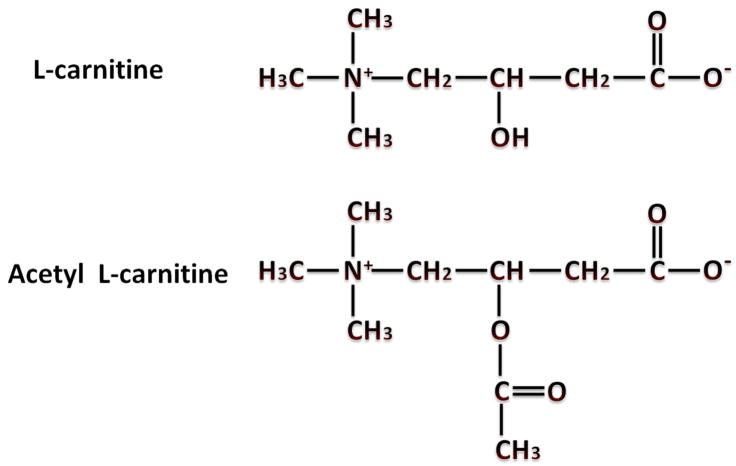
Chemical structures of L-carnitine and Acetyl L-carnitine (Panel A) and the Carnitine Biosynthetic Pathway (Panel B). Abbreviations: TML, trimethyl-lysine; TMLD, trimethyl-lysine deoxygenase; HTML, 3-hydroxy-trimethyl-lysine; TMABA, 4-trimethylaminobutyraldehyde; TMABA-DH, 4-timethylaminobutanal dehydrogenase, BBD, butyrobetaine dioxygenase.
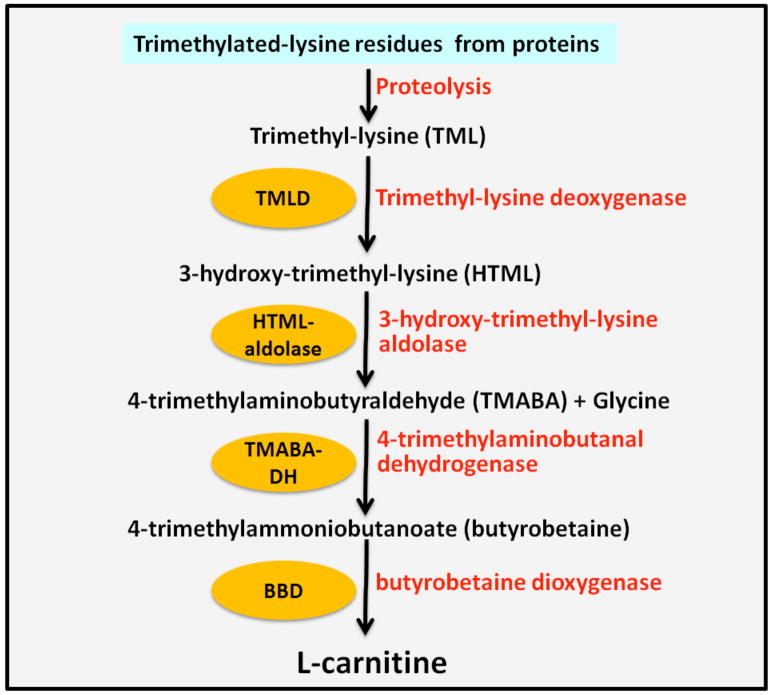
Chemical structures of L-carnitine and Acetyl L-carnitine (Panel A) and the Carnitine Biosynthetic Pathway (Panel B). Abbreviations: TML, trimethyl-lysine; TMLD, trimethyl-lysine deoxygenase; HTML, 3-hydroxy-trimethyl-lysine; TMABA, 4-trimethylaminobutyraldehyde; TMABA-DH, 4-timethylaminobutanal dehydrogenase, BBD, butyrobetaine dioxygenase.
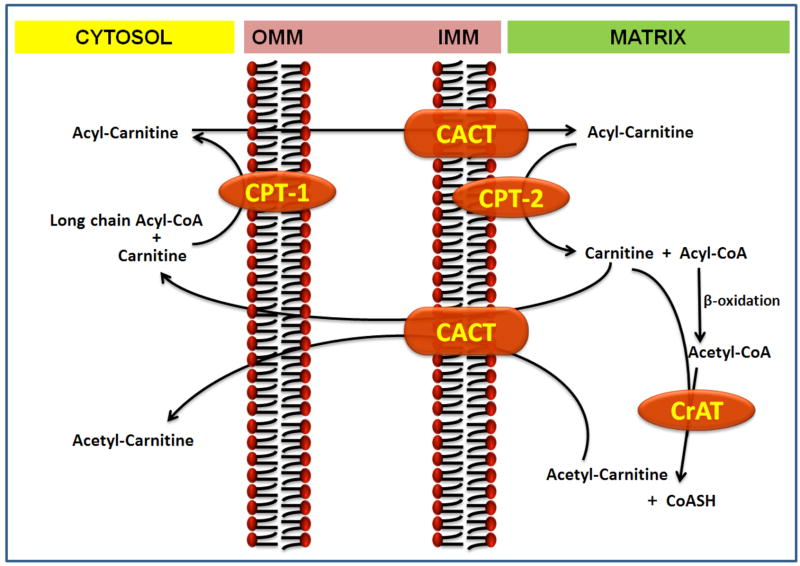
The Carnitine Shuttle and role of carnitine in the mitochondrial oxidation of fatty acids. Abbreviations: CPT-I, carnitine palmitoyltransferase-1; CPT-II, carnitine palmitoyltransferase-2; CACT, carnitine acylcarnitine translocase; CrAT, carnitine acetyl transferase; OMM, outer mitochondrial membrane; IMM, inner mitochondrial membrane.
References
-
- Bremer J. Carnitine--metabolism and functions. Physiol Rev. 1983;63(4):1420–1480. - PubMed
-
- Sahajwalla CG, et al. Multiple-dose pharmacokinetics and bioequivalence of L-carnitine 330-mg tablet versus 1-g chewable tablet versus enteral solution in healthy adult male volunteers. J Pharm Sci. 1995;84(5):627–633. - PubMed
-
- Tamai I, et al. Molecular and functional identification of sodium ion-dependent, high affinity human carnitine transporter OCTN2. J Biol Chem. 1998;273(32):20378–20382. - PubMed
Grants and funding
LinkOut - more resources
Full Text Sources