. 2010 Sep;21(9):1057-66.
doi: 10.1089/hum.2010.136.

"Mesenchymal" stem cells in human bone marrow (skeletal stem cells): a critical discussion of their nature, identity, and significance in incurable skeletal disease

Affiliations

"Mesenchymal" stem cells in human bone marrow (skeletal stem cells): a critical discussion of their nature, identity, and significance in incurable skeletal disease

Paolo Bianco et al. Hum Gene Ther. 2010 Sep.

Abstract

At the turn of a decade of intensive wishful thinking, "mesenchymal stem cells" are changing their profile, while retaining their charm. As hopes to turn bone into brain or vice versa seem on the wane, we learn (1) that the archetypal "mesenchymal stem cell," the skeletal stem cell found in the bone marrow, can be directly identified as a specialized type of mural cell/pericyte, found in the wall of sinusoids and long known as adventitial reticular cells; (2) that bone marrow skeletal stem cells are also defined by expression of CD146, and can self-renew in vivo, while giving rise to skeletal tissues, and therefore earn consideration as bona fide stem cells; (3) that a broader class of microvascular mural cells endowed with clonogenicity and progenitor properties may exist in other tissues, although their true potency needs to be firmly established by stringent assays and thorough comparisons across tissues; (4) that bone marrow skeletal stem cells display unique angiopoietic and hematopoietic niche-related functions, consisting in their ability to transfer the hematopoietic microenvironment and to guide the assembly of microvascular networks, which seem to define their inherent biology; and (5) that use of skeletal stem cells as disease models, and as models of high-risk strategies for cell and gene therapy specifically in incurable skeletal diseases, may provide new challenges for the next decade, and perhaps reward for medicine in the one that follows.


Conflict of interest statement

The authors state that they have no conflicts of interest.

Figures
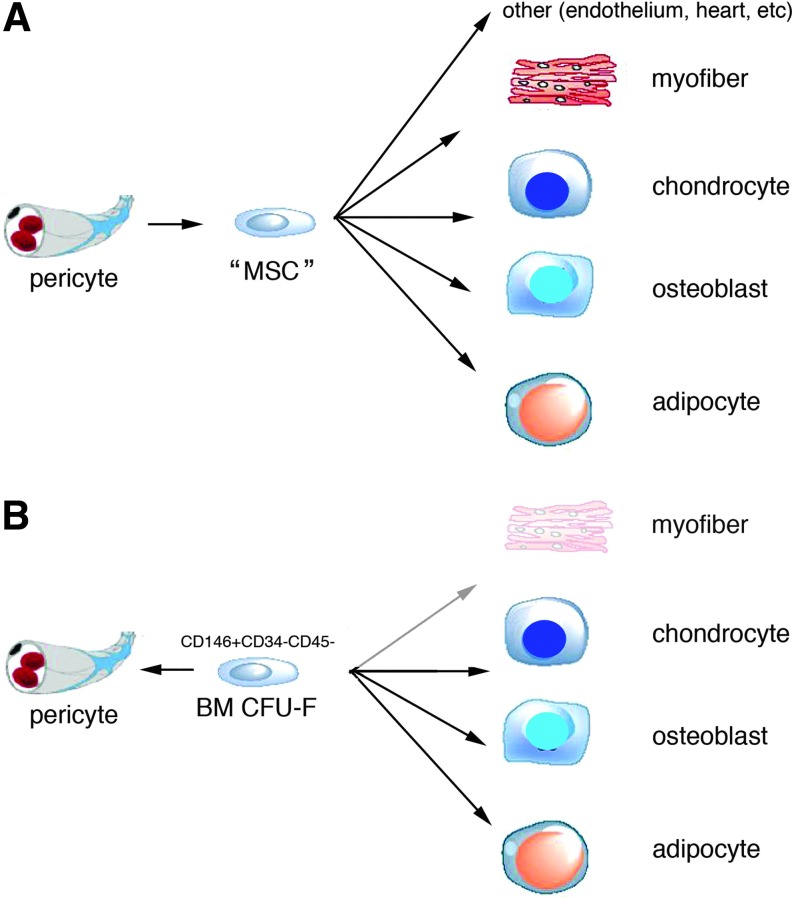
FIG. 1.
FIG. 1.
The two alternative concepts of mesenchymal stem cells (MSCs) and bone marrow skeletal stem cells. (A) The dominant view of MSCs holds that they are able to differentiate into more cell types than those found within a skeletal segment (bone, cartilage, fibrous tissue, fat, and myelosupportive stroma), to include striated muscle, other nonskeletal mesoderm derivatives, and possibly ecto- and mesoderm derivatives. In addition, MSCs as commonly viewed are not found only in the bone marrow stroma, but in virtually every tissue. (B) Skeletal stem cells are found only in the bone marrow stroma, and are able to give rise, without exposure to reprogramming cues (e.g., 5-azacytodine and BMPs) and in vivo, to skeletal tissues (bone, cartilage, fat, myelosupportive stroma, and fibrous tissue) but not to skeletal muscle, other mesoderm-derived tissues, and nonmesodermally derived tissues. It is likely that local committed progenitors also exist in other tissues, such as myogenic microvascular cells in skeletal muscle, with restricted and tissue-specific differentiation potential. The two views also diverge in the relationship of tissue progenitors to mural cells/pericytes. In the MSC view, pericytes from any tissue give rise to MSCs with identical potency. In the alternative view, it is preexisting local committed progenitors that are recruited to a mural cell fate, as is shown to happen in vivo for bone marrow skeletal stem cells (Sacchetti et al., 2007). This again postulates diversity rather than equivalence of pericytes across tissues (Bianco et al., 2008).
FIG. 2.
FIG. 2.
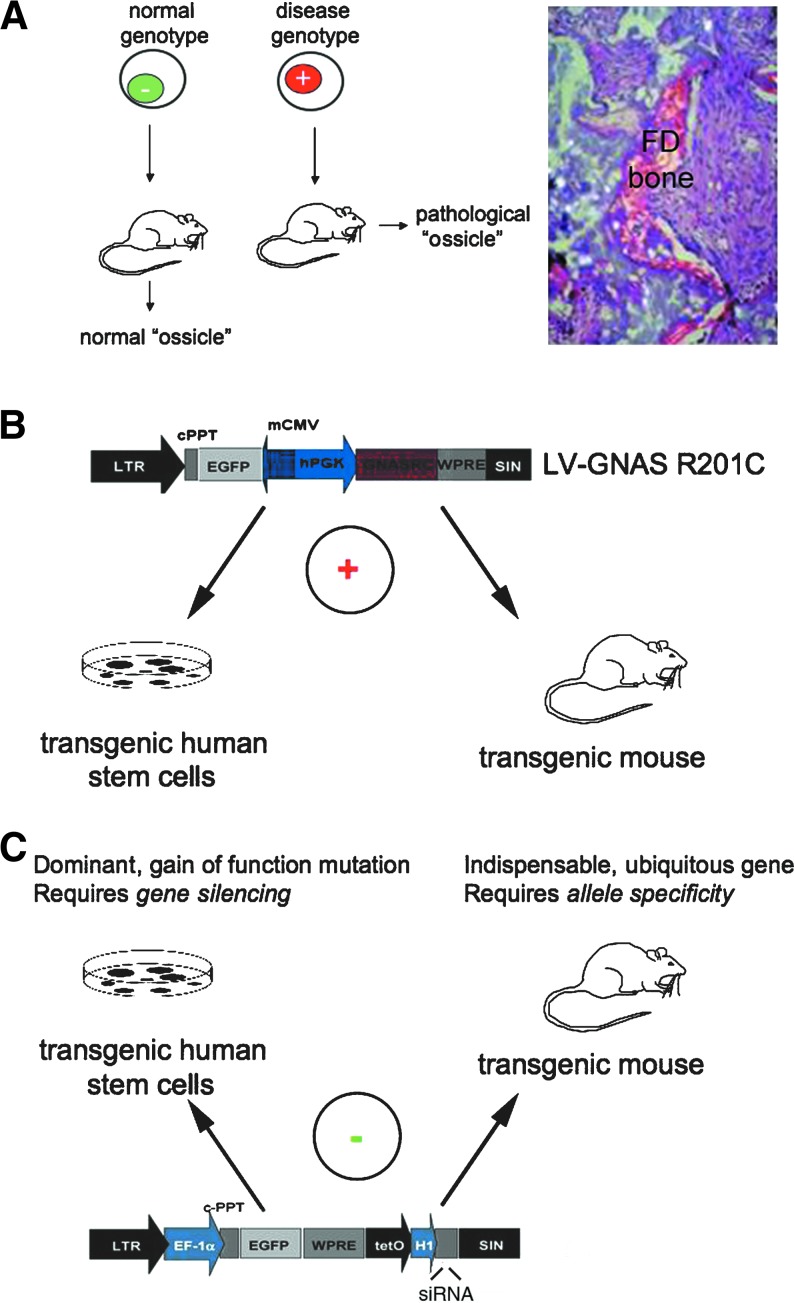
Use of skeletal stem cells for modeling fibrous dysplasia (FD) and its genetic correction. (A) Isolation of mutated skeletal stem cells from FD bone marrow followed by heterotopic transplantation in immunocompromised mice generates miniature replicas of abnormal human FD bone in vivo in the mouse. This approach borrows the principle of heterotopic transplantation of normal skeletal progenitors to create normal “ossicles,” and has provided insights into the role of skeletal stem cells for generating bone lesions in FD (Bianco et al., 1998). (B) Use of lentiviral vectors for transfer of the FD disease gene (GNAS R201C) into normal human skeletal stem cells creates an ample source of mutated progenitors for experimental work, and reveals, specifically, the early responses of stem cells to mutated Gsα, including adaptive responses that can be exploited for designing pharmacological intervention (Piersanti et al., 2010). The same vectors used to create human transgenic stem cells can then be used to create murine models of disease (P. Bianco, unpublished data). (C) Genetic correction of FD requires specific silencing of the mutated Gsα allele, which carries a point mutation. This is feasible with lentivirally encoded RNA-interfering sequences. In this way, the fundamental cellular phenotype (excess production of cAMP) and certain abnormalities in the differentiation properties of mutated skeletal progenitors (loss of adipogenic potential) can be reverted in mutated skeletal stem cells. This establishes proof of principle for a model of RNA interference-based gene therapy in FD.

References

    1. Arai F. Hirao A. Ohmura M. Sato H. Matsuoka S. Takubo K. Ito K. Koh G.Y. Suda T. Tie2/angiopoietin-1 signaling regulates hematopoietic stem cell quiescence in the bone marrow niche. Cell. 2004;118:149–161. - PubMed
    1. Au P. Tam J. Fukumura D. Jain R.K. Bone marrow-derived mesenchymal stem cells facilitate engineering of long-lasting functional vasculature. Blood. 2008;111:4551–4558. - PMC - PubMed
    1. Barry F.P. Boynton R.E. Haynesworth S. Murphy J.M. Zaia J. The monoclonal antibody SH-2, raised against human mesenchymal stem cells, recognizes an epitope on endoglin (CD105) Biochem. Biophys. Res. Commun. 1999;265:134–139. - PubMed
    1. Bianco P. Boyde A. Confocal images of marrow stromal (Westen-Bainton) cells. Histochemistry. 1993;100:93–99. - PubMed
    1. Bianco P. Gehron Robey P. Marrow stromal stem cells. J. Clin. Invest. 2000;105:1663–1668. - PMC - PubMed

Publication types