


Long-term effects of conjugated equine estrogen therapies on domain-specific cognitive function: results from the Women's Health Initiative study of cognitive aging extension
- PMID: 20649689
- PMCID: PMC2917208
- DOI: 10.1111/j.1532-5415.2010.02953.x
Long-term effects of conjugated equine estrogen therapies on domain-specific cognitive function: results from the Women's Health Initiative study of cognitive aging extension
Abstract
Objectives: To determine whether small decrements in global cognitive function that conjugated equine estrogen (CEE) therapies have been shown to produce in older women persist after cessation and extend to specific cognitive domains.
Design: Randomized controlled clinical trial.
Setting: Fourteen clinical centers of the Women's Health Initiative.
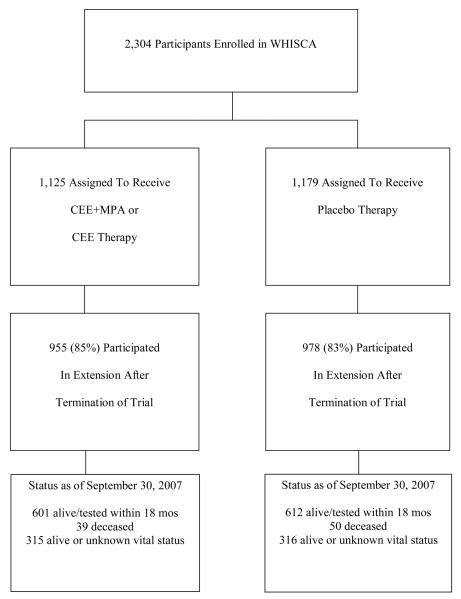
Participants: Two thousand three hundred four women aged 65 to 80 free of probable dementia at enrollment.
Intervention: CEE 0.625 mg/d with or without medroxyprogesterone acetate (MPA, 10 mg/d) and matching placebos.
Measurements: Annual administrations of a battery of cognitive tests during and after the trial.
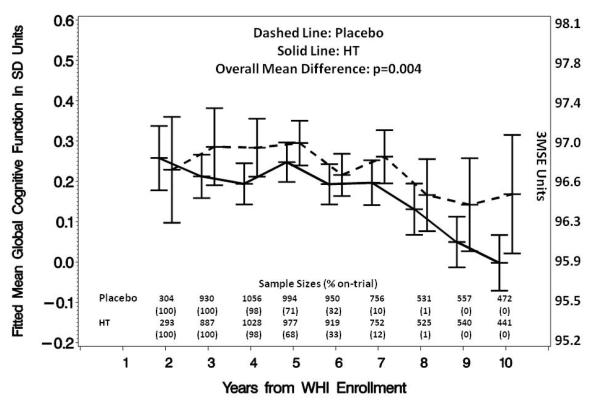
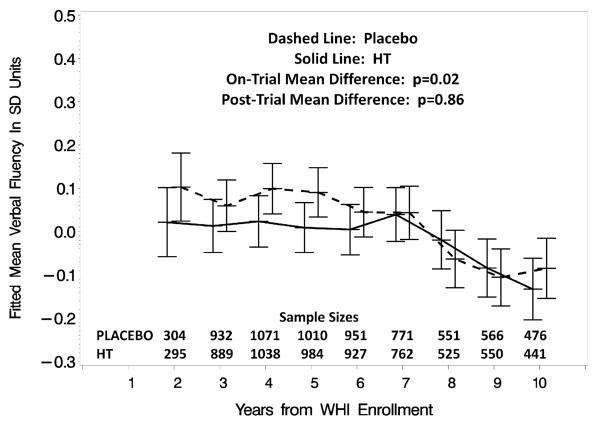
Results: Assignment to CEE-based therapies was associated with small mean relative decrements in global cognitive function and several domain-specific cognitive functions during the trial, which largely persisted through up to 4 years after the trial. The strongest statistical evidence was for global cognitive function (0.07-standard deviation decrements during (P=.007) and after (P=.01) the trial. For domain-specific scores, the mean decrements were slightly smaller, were less significant, and tended to be larger for CEE-alone therapy.
Conclusion: CEE-based therapies, when initiated after the age of 65, produce a small broad-based decrement in cognitive function that persists after their use is stopped, but the differences in cognitive function are small and would not be detectable or have clinical significance for an individual woman. Differences in effects between cognitive domains suggest that more than one mechanism may be involved.
Figures
References
-
- Rapp S, Espeland MA, Shumaker SA, et al. Effect of estrogen plus progestin on global cognitive function in postmenopausal women: Women's Health Initiative Memory Study. JAMA. 2003;289:2663–2672. - PubMed
-
- Espeland MA, Rapp SR, Shumaker SA, et al. Conjugated equine estrogens and global cognitive function in postmenopausal women. JAMA. 2004;291:2959–2968. - PubMed
-
- Resnick SM, Coker LH, Maki PM, Rapp SR, Espeland MA, Shumaker SA. The Women's Health Initiative Study of Cognitive Aging (WHISCA): a randomized clinical trial of the effects of hormone therapy on age-associated cognitive decline. Clinical Trials. 2004;1:440–450. - PubMed
-
- Resnick SM, Maki PM, Rapp SR, et al. Effects of combination estrogen plus progestin hormone treatment on cognition and affect: The Women's Health Initiative Study of Cognitive Aging (WHISCA) J Clin Endocrinol Metabol. 2006;91:1802–1810. - PubMed
Publication types
MeSH terms
Substances
Grants and funding
LinkOut - more resources
Full Text Sources
Medical
Molecular Biology Databases
