


Honey compared with silver sulphadiazine in the treatment of superficial partial-thickness burns
- PMID: 20649832
- PMCID: PMC7951523
- DOI: 10.1111/j.1742-481X.2010.00717.x
Honey compared with silver sulphadiazine in the treatment of superficial partial-thickness burns
Abstract
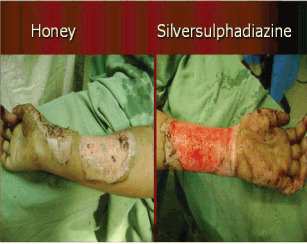
Burn injury is associated with a high incidence of death and disability; yet, its management remains problematic and costly. We conducted this clinical study to evaluate the efficacy of honey in the treatment of superficial and partial-thickness burns covering less than 40% of body surface area and compared its results with those of silver sulphadiazine (SSD). In this randomised comparative clinical trial, carried out Burn Center of POF Hospital, Wah Cantt, Pakistan, from May 2007 to February 2008, 150 patients of all ages having similar types of superficial and partial-thickness burns at two sites on different parts of body were included. Each patient had one burn site treated with honey and one treated with topical SSD, randomly. The rate of re-epithelialization and healing of superficial and partial-thickness burns was significantly faster in the sites treated with honey than in the sites treated with SSD (13·47 ± 4·06 versus 15·62 ± 4·40 days, respectively: P < 0·0001). The site treated with honey healed completely in less than 21 days versus 24 days for the site treated with SSD. Six patients had positive culture for Pseudomonas aeroginsa in honey-treated site, whereas 27 patients had positive culture in SSD-treated site. The results clearly showed greater efficacy of honey over SSD cream for treating superficial and partial-thickness burns.
2010 The Authors. Journal Compilation © 2010 Blackwell Publishing Ltd and Medicalhelplines.com Inc.
Figures
References
-
- Campbell F, Seers K. Dressing and topical agents for burns. Cochrane Database Syst Rev 2000; Issue 2.
-
- Cooper R, Molan P. The use of honey as an antiseptic in managing Pseudomonas infection. J Wound Care 1999a;8:161–4. - PubMed
-
- Edwards‐Jones V, Greenwood JE. What's new in burn microbiology? James Laing Memorial Prize Essay 2000. Burns 2003;29:15–24. - PubMed
-
- Atiyeh BS, Costagliola M, Hayek SN, Dibo S. Effect of silver on burn wound infection control and healing: review of the literature. Burns 2007;33:139–48. - PubMed
Publication types
MeSH terms
Substances
LinkOut - more resources
Full Text Sources
Medical
