Effects of Tai Chi and Western exercise on physical and cognitive functioning in healthy community-dwelling older adults
- PMID: 20651414
- PMCID: PMC4699673
- DOI: 10.1123/japa.18.3.261
Effects of Tai Chi and Western exercise on physical and cognitive functioning in healthy community-dwelling older adults
Abstract
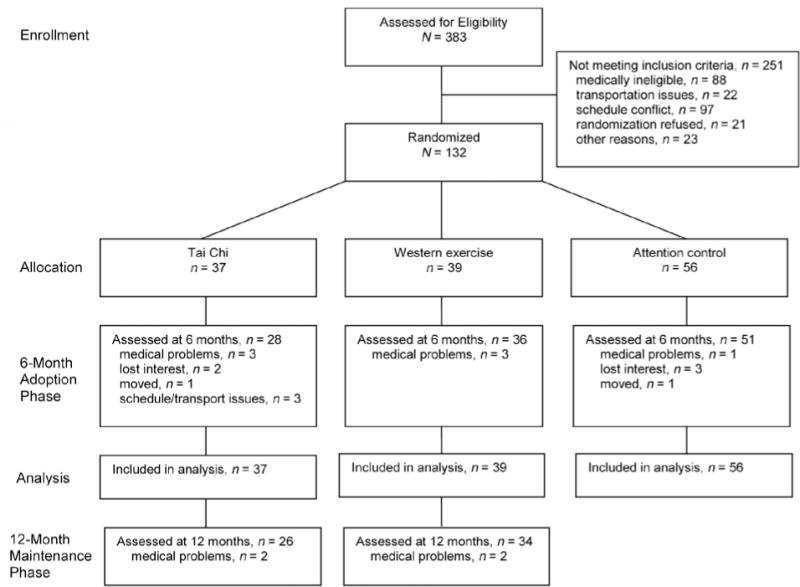
Objective: To compare the effects of Tai Chi (TC, n = 37) and Western exercise (WE, n = 39) with an attention-control group (C, n = 56) on physical and cognitive functioning in healthy adults age 69 +/- 5.8 yr, in a 2-phase randomized trial.
Methods: TC and WE involved combined class and home-based protocols. Physical functioning included balance, strength, flexibility, and cardiorespiratory endurance. Cognitive functioning included semantic fluency and digit-span tests. Data were analyzed using intention-to-treat analysis.
Results: At 6 mo, WE had greater improvements in upper body flexibility (F = 4.67, p = .01) than TC and C. TC had greater improvements in balance (F = 3.36, p = .04) and a cognitive-function measure (F = 7.75, p < .001) than WE and C. The differential cognitive-function improvements observed in TC were maintained through 12 mo.
Conclusion: The TC and WE interventions resulted in differential improvements in physical functioning among generally healthy older adults. TC led to improvement in an indicator of cognitive functioning that was maintained through 12 mo.
Figures
References
-
- Ainsworth BE, Haskell WL, Whitt MC, Irwin ML, Swartz AM, Strath SJ, Leon AS. Compendium of physical activities: An update of activity codes and MET intensities. Medicine and Science in Sports and Exercise. 2000;32(9, Suppl):S498–S504. - PubMed
-
- American College of Sports Medicine. American College of Sports Medicine practice guideline: Physical activity programs and behavior counseling in older adult populations. Medicine and Science in Sports and Exercise. 2004;36(11):1997–2003. - PubMed
-
- American College of Sports Medicine. American College of Sports Medicine’s guidelines for exercise testing and prescription. 7th. Philadelphia, PA: Lippincott Williams & Wilkins; 2005.
-
- Angevaren M, Aufdemkampe G, Verhaar HJ, Aleman A, Vanhees L. Physical activity and enhanced fitness to improve cognitive function in older people without known cognitive impairment. Cochrane Database of Systematic Reviews (Online: Update Software) 2008;3:CD005381. - PubMed