


Coupled dynamics of body mass and population growth in response to environmental change
- PMID: 20651690
- PMCID: PMC5677226
- DOI: 10.1038/nature09210
Coupled dynamics of body mass and population growth in response to environmental change
Abstract
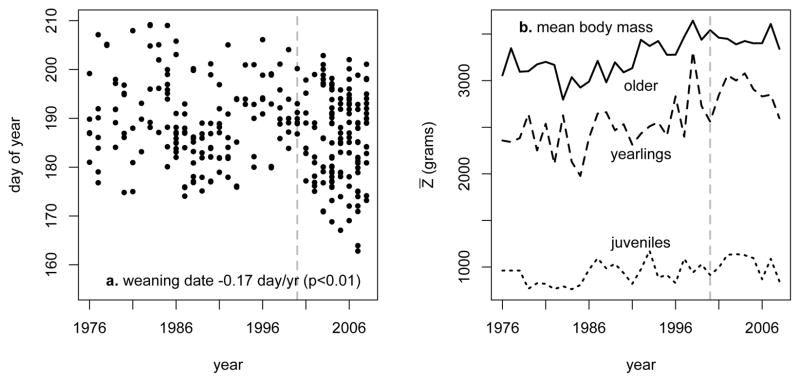
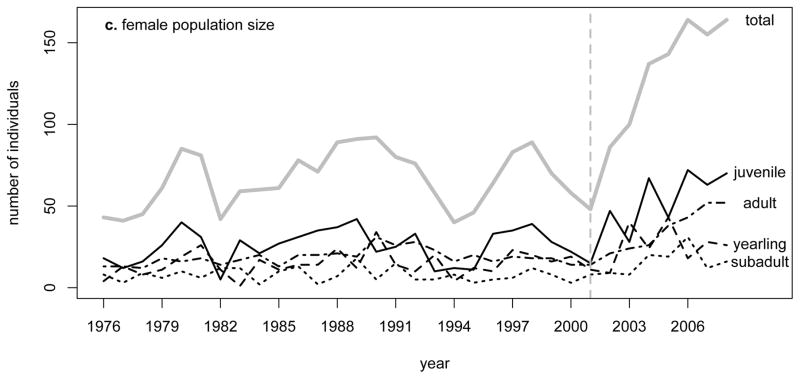
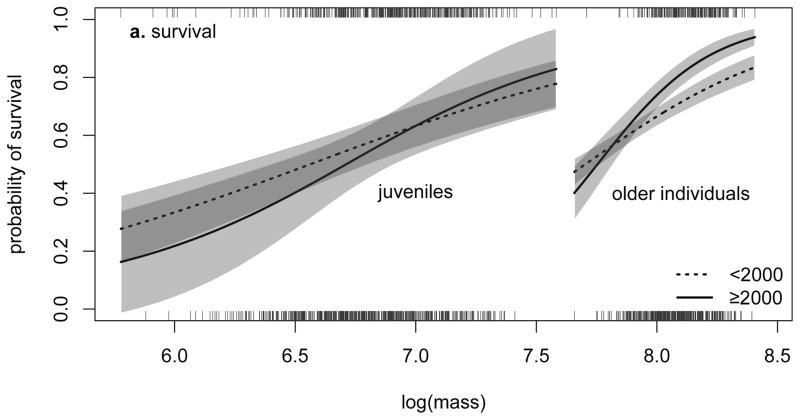
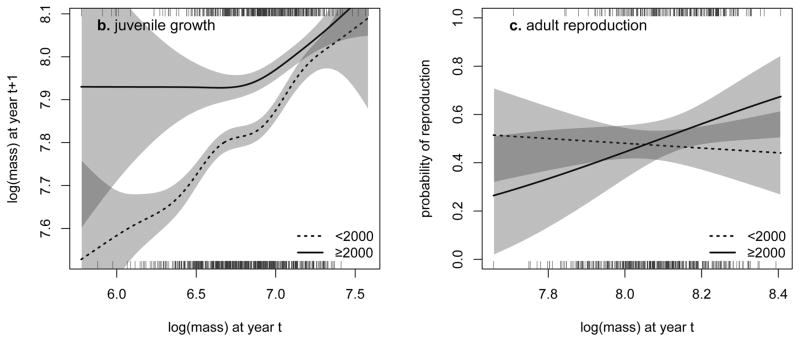
Environmental change has altered the phenology, morphological traits and population dynamics of many species. However, the links underlying these joint responses remain largely unknown owing to a paucity of long-term data and the lack of an appropriate analytical framework. Here we investigate the link between phenotypic and demographic responses to environmental change using a new methodology and a long-term (1976-2008) data set from a hibernating mammal (the yellow-bellied marmot) inhabiting a dynamic subalpine habitat. We demonstrate how earlier emergence from hibernation and earlier weaning of young has led to a longer growing season and larger body masses before hibernation. The resulting shift in both the phenotype and the relationship between phenotype and fitness components led to a decline in adult mortality, which in turn triggered an abrupt increase in population size in recent years. Direct and trait-mediated effects of environmental change made comparable contributions to the observed marked increase in population growth. Our results help explain how a shift in phenology can cause simultaneous phenotypic and demographic changes, and highlight the need for a theory integrating ecological and evolutionary dynamics in stochastic environments.
Figures
Comment in
-
Climate change: Fatter marmots on the rise.Nature. 2010 Jul 22;466(7305):445-7. doi: 10.1038/466445a. Nature. 2010. PMID: 20651679 No abstract available.
References
-
- Walther G, et al. Ecological responses to recent climate change. Nature. 2002;416:389–395. - PubMed
-
- Parmesan C. Ecological and evolutionary responses to recent climate change. Annual Review of Ecology Evolution and Systematics. 2006;37:637–669.
-
- Coulson T, Benton TG, Lundberg P, Dall SRX, Kendall BE. Putting evolutionary biology back in the ecological theatre: a demographic framework mapping genes to communities. Evolutionary Ecology Research. 2006;8:1155–1171.
