A clinical comparison of continuous interscalene brachial plexus block with different basal infusion rates of 0.2% ropivacaine for shoulder surgery
- PMID: 20651995
- PMCID: PMC2908223
- DOI: 10.4097/kjae.2010.59.1.27
A clinical comparison of continuous interscalene brachial plexus block with different basal infusion rates of 0.2% ropivacaine for shoulder surgery
Abstract
Background: A continuous interscalene brachial plexus block is a highly effective postoperative analgesic modality after shoulder surgery. However, there is no consensus regarding the optimal basal infusion rate of ropivacaine for a continuous interscalene brachial plexus block. A prospective, double blind study was performed to compare two different basal rates of 0.2% ropivacaine for a continuous interscalene brachial plexus block after shoulder surgery.
Methods: Sixty-two patients receiving shoulder surgery under an interscalene brachial plexus block were included. The continuous interscalene brachial plexus block was performed using a modified lateral technique with 30 ml of 0.5% ropivacaine. Surgery was carried out under an interscalene brachial plexus block or general anesthesia. After surgery, the patients were divided randomly into two groups containing 32 each. During the first 48 h after surgery, groups R8 and R6 received a continuous infusion of 0.2% ropivacaine at 8 ml/h and 6 ml/h, respectively. The pain scores at rest and on movement, supplemental analgesia, motor block, adverse events and patient's satisfaction were recorded.
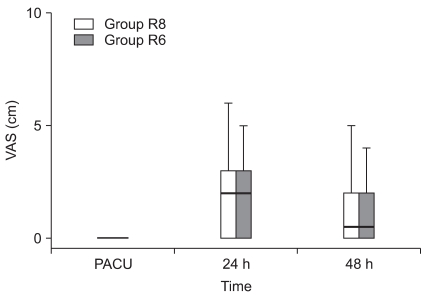
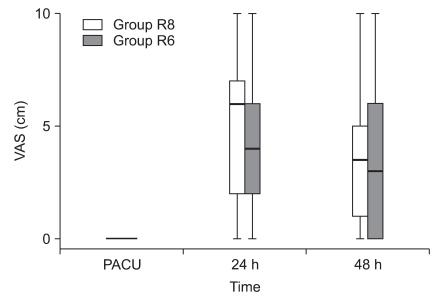
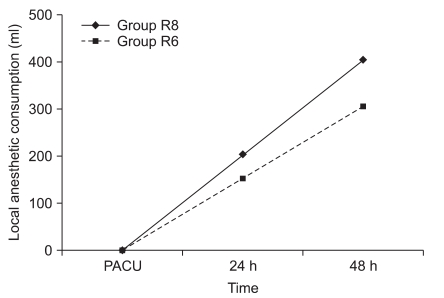
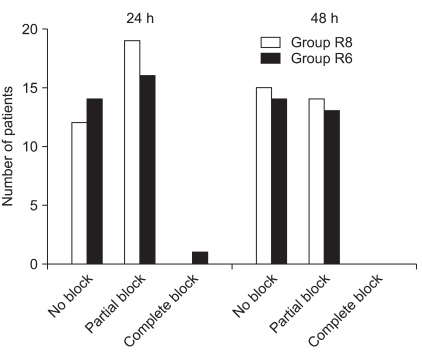
Results: The pain scores, supplemental analgesia, motor block, adverse events and patient's satisfaction were similar in the two groups.
Conclusions: When providing continuous interscalene brachial plexus block after shoulder surgery, 0.2% ropivacaine at a basal rate of 8 ml/h or 6 ml/h produces similar clinical efficacy. Therefore, decreasing the basal rate of CISB is more appropriate considering the toxicity of local anesthetics.
Keywords: Continuous interscalene block; Ropivacaine; Shoulder surgery.
Figures
References
-
- Borgeat A, Schappi B, Biasca N, Gerber C. Patient-controlled analgesia after major shoulder surgery: patient-controlled interscalene analgesia versus patient-controlled analgesia. Anesthesiology. 1997;87:1343–1347. - PubMed
-
- Borgeat A, Tewes E, Biasca N, Gerber C. Patient-controlled interscalene analgesia with ropivacaine after major shoulder surgery: PCIA vs PCA. Br J Anaesth. 1998;81:603–605. - PubMed
-
- Knudsen K, Beckman Suurkula M, Blomberg S, Sjovall J, Edvardsson N. Central nervous and cardiovascular effects of i.v. infusions of ropivacaine, bupivacaine and placebo in volunteers. Br J Anaesth. 1997;78:507–514. - PubMed
-
- Borgeat A, Kalberer F, Jacob H, Ruetsch YA, Gerber C. Patient-controlled interscalene analgesia with ropivacaine 0.2% versus bupivacaine 0.15% after major open shoulder surgery: the effects on hand motor function. Anesth Analg. 2001;92:218–223. - PubMed
-
- Ilfeld BM, Morey TE, Wright TW, Chidgey LK, Enneking FK. Interscalene perineural ropivacaine infusion:a comparison of two dosing regimens for postoperative analgesia. Reg Anesth Pain Med. 2004;29:9–16. - PubMed
LinkOut - more resources
Full Text Sources