Review
. 2011 Feb;1808(2):538-46.
doi: 10.1016/j.bbamem.2010.07.015. Epub 2010 Jul 23.

Drug sensitivity, drug-resistant mutations, and structures of three conductance domains of viral porins

Affiliations
Review

Drug sensitivity, drug-resistant mutations, and structures of three conductance domains of viral porins

Mukesh Sharma et al. Biochim Biophys Acta. 2011 Feb.

Abstract

Recent controversies associated with the structure of the M2 protein from influenza A virus and the binding site of drug molecules amantadine and rimantadine motivated the comparison here of the drug binding to three viral porins including the M2 proteins from influenza A and B as well as the viral protein 'u' from HIV-1. While the M2 protein from influenza B does not normally bind amantadine, chimeras with the M2 protein from influenza A show blockage by amantadine. Similarly, Vpu does not normally bind rimantadine, but the single site mutation A18H converts a non-specific channel to a selective proton channel that is sensitive to rimantadine. The comparison of structures and amino acid sequences shows that the membrane protein sample environment can have a significant influence on the structural result. While a bilayer surface bound amphipathic helix has been characterized for AM2, such a helix may be possible for BM2 although it has evaded structural characterization in detergent micelles. A similar amphipathic helix seems less likely for Vpu. Even though the A18H Vpu mutant forms rimantadine sensitive proton channels, the binding of drug and its influence on the protein structure appears to be very different from that for the M2 proteins. Indeed, drug binding and drug resistance in these viral porins appears to result from a complex set of factors.


Figures

Fig. 1
Fig. 1
N-terminal sequences of AM2 (Udorn/72), BM2 (Lee/40), and Vpu (HIV-1 isolate HTLVIIIB) extended membrane domains. The italicized residues in BM2 and Vpu are from AM2 and the histidine and tryptophan residues in the HxxxW are highlighted in red.
Fig. 2
Fig. 2
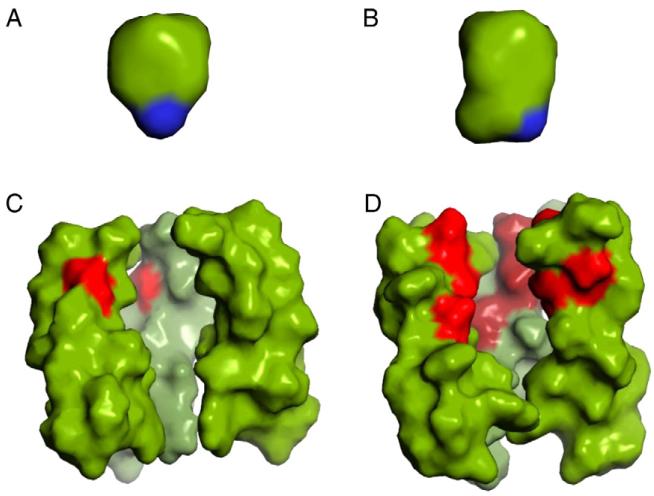
Comparison of the amphipathic drugs, amantadine (A) and rimantadine (B), with the pores from AM2 (C, PDB 2H95) and BM2 (D, PDB 2KIX) on the same scale. The AM2 and BM2 structures are represented by only 3 of the 4 helices so that a view into the pore can be achieved. Furthermore, only residues Leu26-Ile42 (AM2 numbering) are displayed. The amino group of the drugs is colored blue, the AM2 drug binding site is primarily hydrophobic indicated by green (left) while BM2 (right) channel pore is lined with polar residues in red.
Fig. 3
Fig. 3
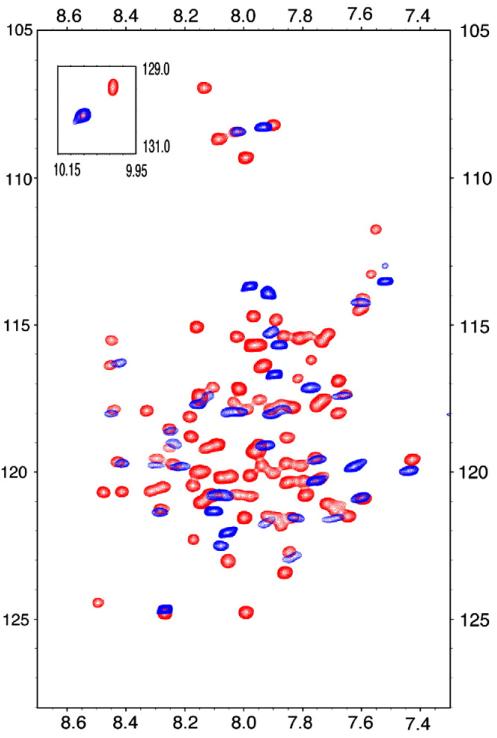
Overlay of solution NMR HSQC spectra of the AM2 conductance domain (residues 22-62) (blue) and the full-length protein (red) in LPPG micelles at pH 4. The conductance domain of AM2 folds independently of other domains, thus providing the basis for the divide-and-conquer approach for characterizing viral ion channels structures.
Fig. 4
Fig. 4
Comparison of the two drug binding sites described for M2 proteins. (A) Rimantadine binding site in the conductance domain of AM2 based on the solution NMR structure in DHPC micelles. The drug is near the bilayer interfacial region interacting with the lipid and a hydrophobic pocket on the external structure of the protein (PDB 2RLF) [23]. (B) Amantadine modeled into the pore of the TM domain of AM2 (based on data used for PDB 2H95) [26,37,38].
Fig. 5
Fig. 5
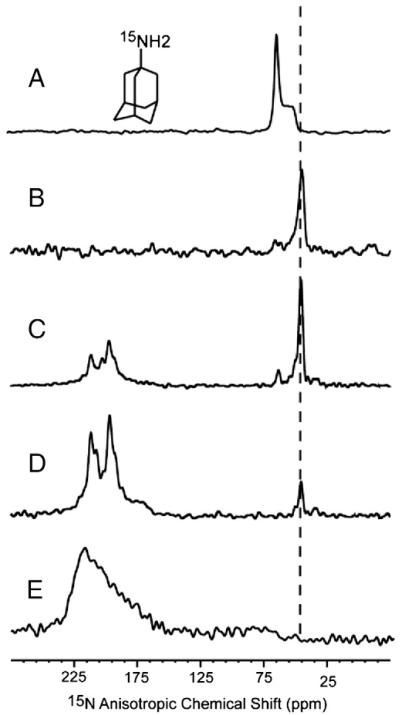
15N static spectra by cross-polarization of (A) randomly oriented bilayer sample with amantadine; (B) uniformly aligned sample of (A); (C) uniformly aligned bilayer sample with 5-site 15N leucine-labeled AM2-TM domain, at a 1:8 molar ratio of M2 TM domain to amantadine; (D) a sample similar to (C) but with a 1:1 molar ratio; (E) a sample similar to (C) but without amantadine. All the samples were prepared at pH 8.0 in DMPC bilayers; the oriented sample was uniformly aligned with the bilayer normal parallel to the static magnetic field.
Fig. 6
Fig. 6
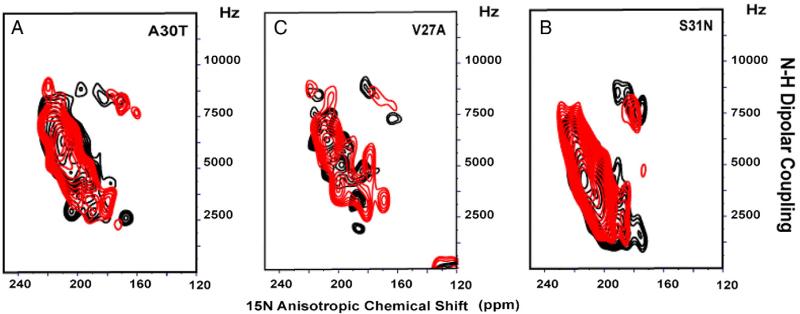
PISEMA spectra of 5-site 15N Leu-labeled amantadine-resistant mutants of AM2 TM domain with (red) and without amantadine (black). (A) A30T; (B) S31N; and (C) V27A.
Fig. 7
Fig. 7
PISEMA spectra of the V27S mutant. (A) Comparison of V27S with and without amantadine; 2-site 15N Ile (33, 42 )-labeled V27S mutant of AM2 TM domain with (blue) and without (red) amantadine. (B) Comparison of V27S and WT AM2 in the presence of amantadine; 2-site 15N Ile V27S AM2 TM domain with amantadine (blue—as in panel A) superimposed with 5 site 15N Ile (32, 33, 35, 39, 42) WT AM2 TM domain with amantadine (red).
Fig. 8
Fig. 8
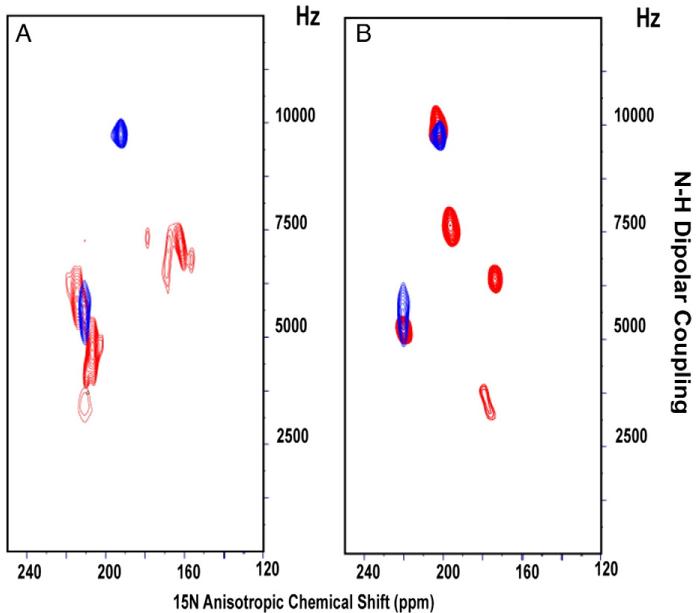
PISEMA spectra of 15N Phe-labeled full-length M2 protein in DMPC:DMPG (4:1) bilayers. A simulated PISA wheel for a helix tilted at 100° with respect to the bilayer normal is superimposed.

References

    1. Hout DR, Gomez LM, Pacyniak E, Miller JM, Hill MS, Stephens EB. A single amino acid substitution within the transmembrane domain of the human immunodeficiency virus type 1 Vpu protein renders simian-human immunodeficiency virus (SHIV(KU-1bMC33)) susceptible to rimantadine. Virology. 2006;348:449–461. - PubMed
    1. Hout DR, Gomez ML, Pacyniak E, Gomez LM, Fegley B, Mulcahy ER, Hill MS, Culley N, Pinson DM, Nothnick W, Powers MF, Wong SW, Stephens EB. Substitution of the transmembrane domain of Vpu in simian–human immunodeficiency virus (SHIVKU1bMC33) with that of M2 of influenza A results in a virus that is sensitive to inhibitors of the M2 ion channel and is pathogenic for pig-tailed macaques. Virology. 2006;344:541–559. - PubMed
    1. Pinto LH, Lamb RA. Influenza virus proton channels. Photochem. Photobiol. Sci. 2006;5:629–632. - PubMed
    1. Mould JA, Paterson RG, Takeda M, Ohigashi Y, Venkataraman P, Lamb RA, Pinto LH. Influenza B virus BM2 protein has ion channel activity that conducts protons across membranes. Dev. Cell. 2003;5:175–184. - PubMed
    1. Wang J, Pielak RM, McClintock MA, Chou JJ. Solution structure and functional analysis of the influenza B proton channel. Nat. Struct. Mol. Biol. 2009 - PMC - PubMed

Publication types

MeSH terms

Substances

LinkOut - more resources