


Desert dust exposure is associated with increased risk of asthma hospitalization in children
- PMID: 20656941
- PMCID: PMC3159090
- DOI: 10.1164/rccm.201002-0296OC
Desert dust exposure is associated with increased risk of asthma hospitalization in children
Abstract
Rationale: Desert dust particles, including quartz, which causes inflammatory responses in the airway in animal studies, are transported to widespread regions around the globe. Epidemiologically, areas impacted by desert dust storms, such as communities in the Middle East and the Caribbean, seem to have higher incidences of asthma than might be expected.
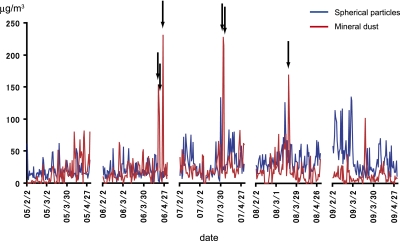
Objectives: We investigated the magnitude of association between airborne mineral dust concentration and hospitalization of children for asthma exacerbation by using Light Detection And Ranging (LIDAR) with a polarization analyzer for an exposure measurement, which can distinguish mineral dust particles from other particles.
Methods: A case-crossover design was used. The exposure measurement was LIDAR's nonspherical extinction coefficient. The outcome measurement was hospitalization of children aged 1 to 15 years for asthma exacerbation in eight principal hospitals in Toyama, a local area in Japan bordering the Japan Sea, during February to April, 2005 to 2009.
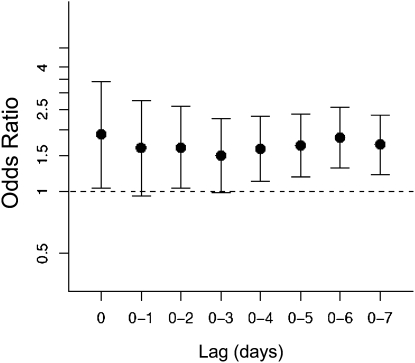
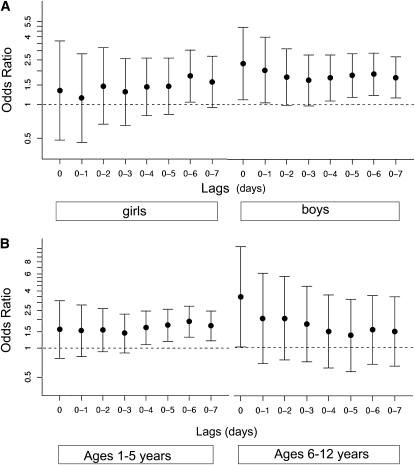
Measurements and main results: During the study period, there were 620 admissions for asthma exacerbation, and 6 days with a heavy dust event (daily mineral dust concentration > 0.1 mg/m(3)). Conditional logistic regression showed a statistically significant association between asthma hospitalization and a heavy dust event. The crude odds ratio (OR) of the heavy dust event for hospitalization on the day was 1.88 (95% confidence interval [CI], 1.04-3.41; P = 0.037), and the OR of heavy dust event during the previous week was 1.83 (95% CI, 1.31-2.56; P = 0.00043). The OR adjusted by other air pollutant levels, pollen, and meteorological factors was 1.71 (95% CI, 1.18-2.48; P = 0.0050).
Conclusions: Heavy dust events are associated with an increased risk of hospitalizations for asthma.
Figures
References
-
- Tegen I, Fung I. Contribution to the atmospheric mineral aerosol load from land surface modification. J Geophys Res 1995;100:18707–18726.
-
- Eagan TM, Gulsvik A, Eide GE, Bakke PS. Occupational airborne exposure and the incidence of respiratory symptoms and asthma. Am J Respir Crit Care Med 2002;166:933–938. - PubMed
Publication types
MeSH terms
Substances
LinkOut - more resources
Full Text Sources
Medical
Molecular Biology Databases
Miscellaneous
