


Left-to-right atrial inward rectifier potassium current gradients in patients with paroxysmal versus chronic atrial fibrillation
- PMID: 20657029
- PMCID: PMC5832445
- DOI: 10.1161/CIRCEP.110.954636
Left-to-right atrial inward rectifier potassium current gradients in patients with paroxysmal versus chronic atrial fibrillation
Abstract
Background: Recent evidence suggests that atrial fibrillation (AF) is maintained by high-frequency reentrant sources with a left-to-right-dominant frequency gradient, particularly in patients with paroxysmal AF (pAF). Unequal left-to-right distribution of inward rectifier K(+) currents has been suggested to underlie this dominant frequency gradient, but this hypothesis has never been tested in humans.
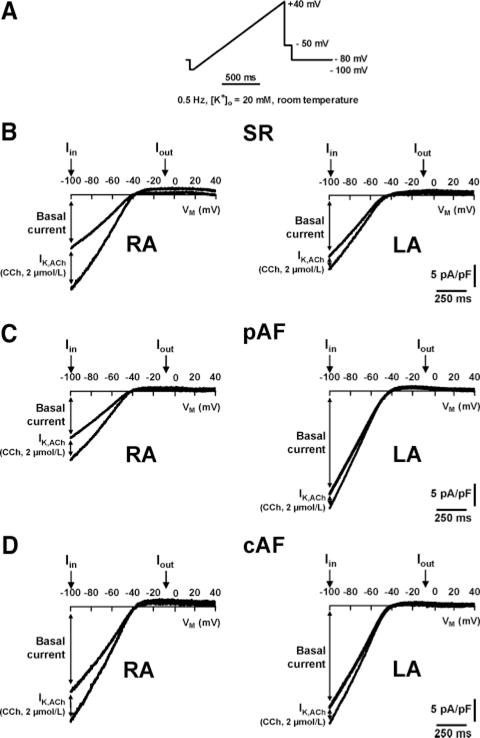
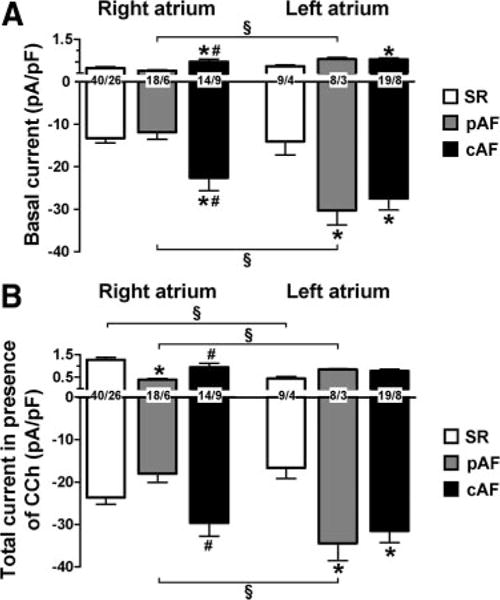
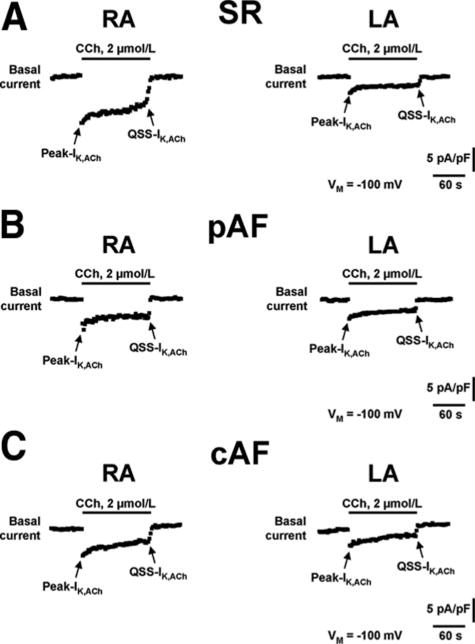
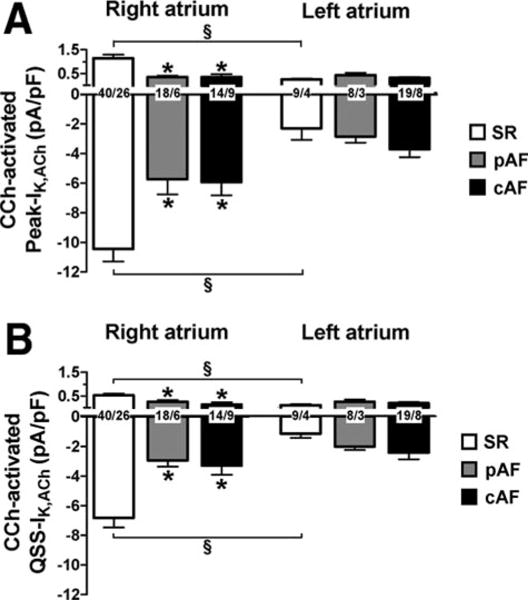
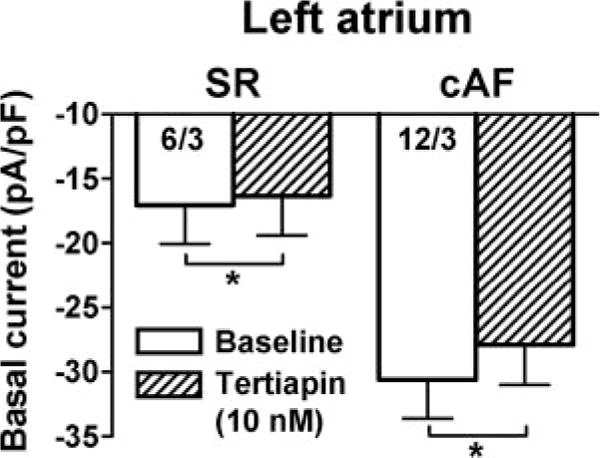
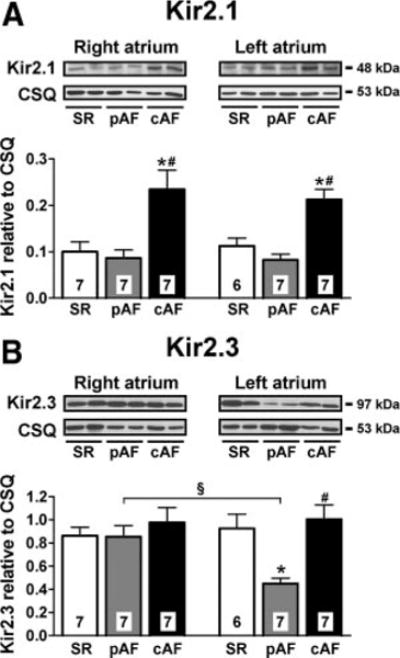
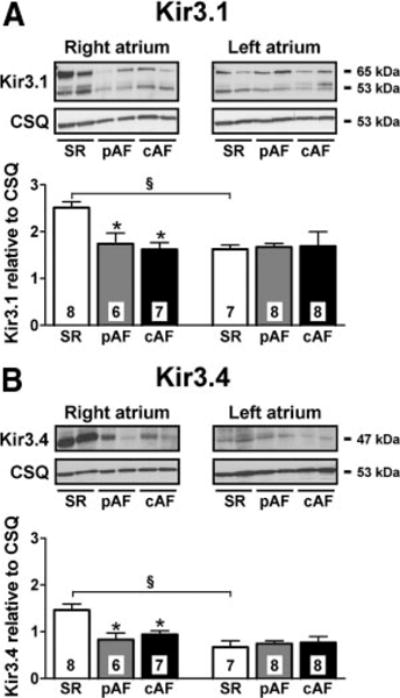
Methods and results: Currents were measured with whole-cell voltage-clamp in cardiomyocytes from right atrial (RA) and left (LA) atrial appendages of patients in sinus rhythm (SR) and patients with AF undergoing cardiac surgery. Western blot was used to quantify protein expression of I(K1) (Kir2.1 and Kir2.3) and I(K,ACh) (Kir3.1 and Kir3.4) subunits. Basal current was ≈2-fold larger in chronic AF (cAF) versus SR patients, without RA-LA differences. In pAF, basal current was ≈2-fold larger in LA versus RA, indicating a left-to-right atrial gradient. In both atria, Kir2.1 expression was ≈2-fold greater in cAF but comparable in pAF versus SR. Kir2.3 levels were unchanged in cAF and RA-pAF but showed a 51% decrease in LA-pAF. In SR, carbachol-activated (2 μmol/L) I(K,ACh) was 70% larger in RA versus LA. This right-to-left atrial gradient was decreased in pAF and cAF caused by reduced I(K,ACh) in RA only. Similarly, in SR, Kir3.1 and Kir3.4 proteins were greater in RA versus LA and decreased in RA of pAF and cAF. Kir3.1 and Kir3.4 expression was unchanged in LA of pAF and cAF.
Conclusion: Our results support the hypothesis that a left-to-right gradient in inward rectifier background current contributes to high-frequency sources in LA that maintain pAF. These findings have potentially important implications for development of atrial-selective therapeutic approaches.
Figures
References
-
- Atienza F, Almendral J, Moreno J, Vaidyanathan R, Talkachou A, Kalifa J, Arenal A, Villacastin JP, Torrecilla EG, Sanchez A, Ploutz-Snyder R, Jalife J, Berenfeld O. Activation of inward rectifier potassium channels accelerates atrial fibrillation in humans: evidence for a reentrant mechanism. Circulation. 2006;114:2434–2442. - PubMed
-
- Lazar S, Dixit S, Marchlinski FE, Callans DJ, Gerstenfeld EP. Presence of left-to-right atrial frequency gradient in paroxysmal but not persistent atrial fibrillation in humans. Circulation. 2004;110:3181–3186. - PubMed
-
- Mandapati R, Skanes A, Chen J, Berenfeld O, Jalife J. Stable microreentrant sources as a mechanism of atrial fibrillation in the isolated sheep heart. Circulation. 2000;101:194–199. - PubMed
-
- Mansour M, Mandapati R, Berenfeld O, Chen J, Samie FH, Jalife J. Left-to-right gradient of atrial frequencies during acute atrial fibrillation in the isolated sheep heart. Circulation. 2001;103:2631–2636. - PubMed
-
- Sahadevan J, Ryu K, Peltz L, Khrestian CM, Stewart RW, Markowitz AH, Waldo AL. Epicardial mapping of chronic atrial fibrillation in patients: preliminary observations. Circulation. 2004;110:3293–3299. - PubMed
Publication types
MeSH terms
Substances
Grants and funding
LinkOut - more resources
Full Text Sources
Other Literature Sources
Medical
Research Materials
