


doi: 10.1097/RCT.0b013e3181d564e8.
Noninterleaved velocity encodings for improved temporal and spatial resolution in phase-contrast magnetic resonance imaging
Affiliations
- PMID: 20657227
- PMCID: PMC3071154
- DOI: 10.1097/RCT.0b013e3181d564e8
Item in Clipboard
Noninterleaved velocity encodings for improved temporal and spatial resolution in phase-contrast magnetic resonance imaging
J Comput Assist Tomogr.
2010 Jul.
Abstract
A segmented k-space acquisition technique using noninterleaved velocity encodings is presented to reduce spatial and temporal blur in phase-contrast cardiovascular magnetic resonance imaging. A translating phantom with pulsatile flow was used to simulate imaging of coronary arteries on a 1.5-T GE Echospeed scanner, using both interleaved and noninterleaved velocity encodings. The results demonstrate that the use of noninterleaved velocity encodings reduces spatial and temporal blur by improving the temporal resolution.
Figures
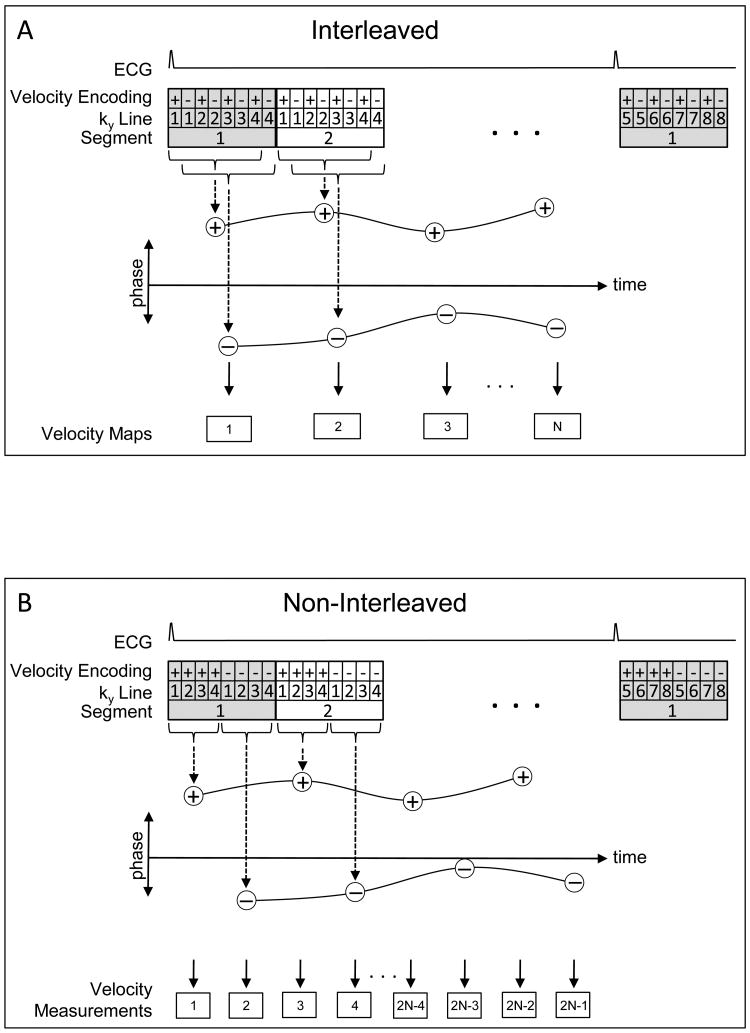
Comparison of the acquisition strategies for the interleaved (A) and non-interleaved (B) velocity encoding phase-contrast techniques. (A) Temporal window for each velocity/magnitude pair is 7 TRs (time to collect all positive or all negative encodings) with a 1TR offset between positively and negatively velocity encoded images, providing velocity measurements every 8 TRs. (B) Temporal window for each image is 4 TRs with a 4TR offset between positively and negatively velocity encoded images, which, with appropriate processing of ROIs, produces velocity measurements every 4 TRs. Phase-difference is derived from subtracting spline curves fit between the two sets of data points.
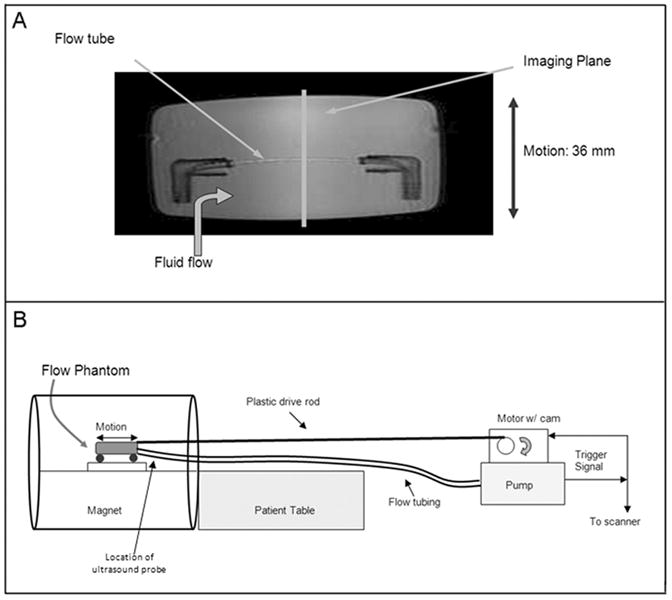
(A) A 6mm diameter flow tube was embedded in gelatin in a plastic container which could be moved in a back-and-forth manner by a motor triggered in synchrony with the flow. This phantom provides a simulation of both motion and pulsatile flow as exhibited by the coronary arteries. (B) The flow pump and motor were placed two meters beyond the foot of the patient table with the plastic drive shaft and flow tubing running to the phantom in the magnet. The flow pump triggered the scanner and the motor for synchronized flow, motion, and acquisition.
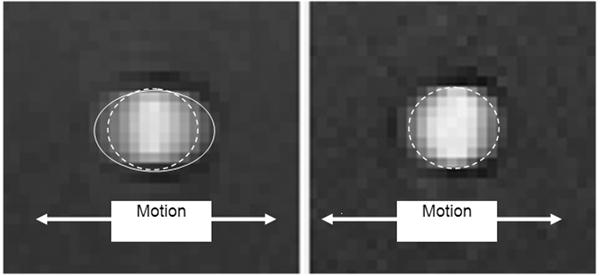
Standard interleaved velocity encodings (left) exhibit significant motion blur, with the apparent lumen shown by the solid elliptical line. The shorter acquisition windows for the non-interleaved encodings (right) produces much less blur and more accurate flow measurements. The true lumen size is shown by the dashed line in both images.
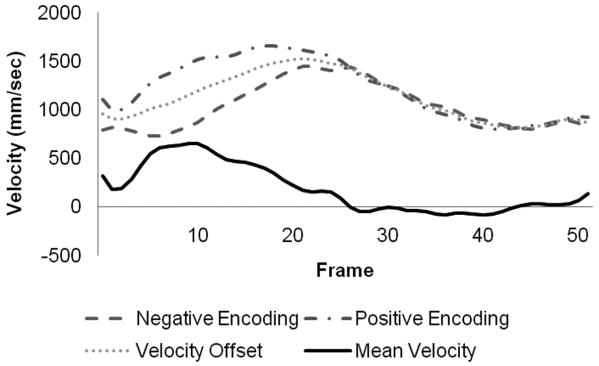
Positive and negative velocity encodings measured with non-interleaved encodings, and the resultant mean luminal velocity.
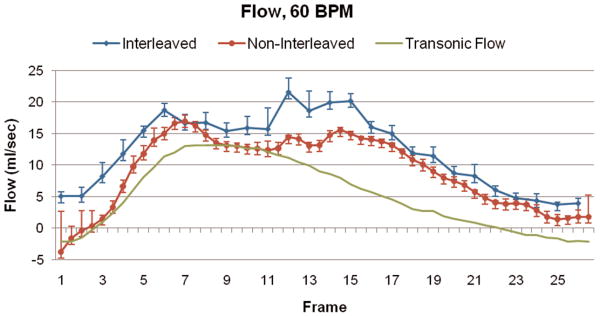
(A) Calculated flow over the heart cycle for the interleaved and non-interleaved scans, shown with the actual flow pump waveform. (B) Motion of the phantom in the scanner over the heart cycle. (C) Measured fluid velocity for the interleaved and non-interleaved scans. (D) Vessel area for the interleaved and non-interleaved scans. The velocity is underestimated, but the area is overestimated to a greater extent resulting in an overestimation of the flow. Non-interleaved acquisition reduces this overestimation by approximately a factor of two.
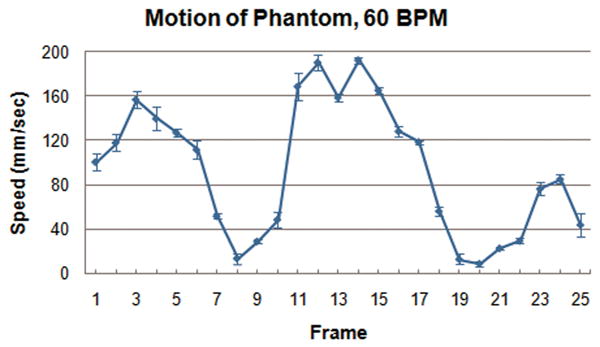
(A) Calculated flow over the heart cycle for the interleaved and non-interleaved scans, shown with the actual flow pump waveform. (B) Motion of the phantom in the scanner over the heart cycle. (C) Measured fluid velocity for the interleaved and non-interleaved scans. (D) Vessel area for the interleaved and non-interleaved scans. The velocity is underestimated, but the area is overestimated to a greater extent resulting in an overestimation of the flow. Non-interleaved acquisition reduces this overestimation by approximately a factor of two.
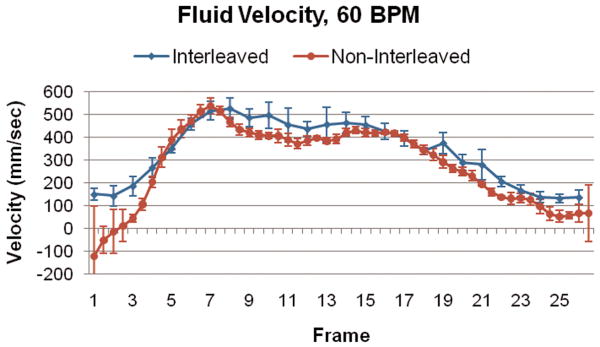
(A) Calculated flow over the heart cycle for the interleaved and non-interleaved scans, shown with the actual flow pump waveform. (B) Motion of the phantom in the scanner over the heart cycle. (C) Measured fluid velocity for the interleaved and non-interleaved scans. (D) Vessel area for the interleaved and non-interleaved scans. The velocity is underestimated, but the area is overestimated to a greater extent resulting in an overestimation of the flow. Non-interleaved acquisition reduces this overestimation by approximately a factor of two.
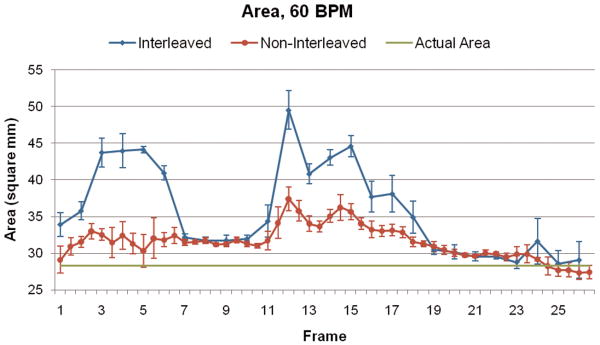
(A) Calculated flow over the heart cycle for the interleaved and non-interleaved scans, shown with the actual flow pump waveform. (B) Motion of the phantom in the scanner over the heart cycle. (C) Measured fluid velocity for the interleaved and non-interleaved scans. (D) Vessel area for the interleaved and non-interleaved scans. The velocity is underestimated, but the area is overestimated to a greater extent resulting in an overestimation of the flow. Non-interleaved acquisition reduces this overestimation by approximately a factor of two.
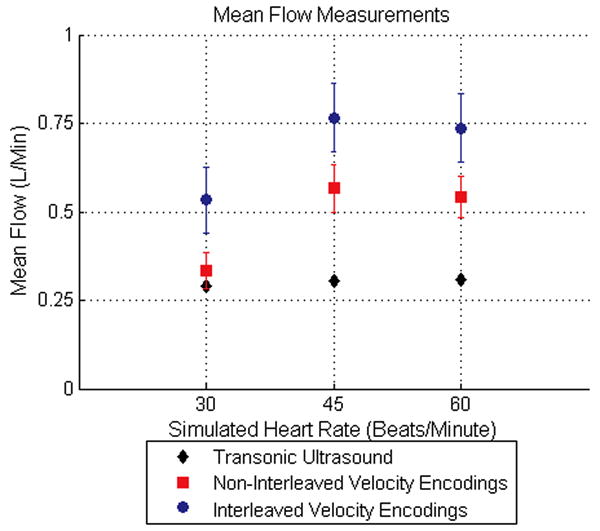
Mean flow measurements across all frames for the three heart rates simulated during the experiment are shown. The mean flow measured using non-interleaved velocity encodings reduces the error of the interleaved velocity encodings by approximately a factor of two.
References
-
- Hundley WG, Lange RA, Clarke GD, et al. Assessment of coronary arterial flow and flow reserve in humans with magnetic resonance imaging. Circulation. 1996 April 15;93(8):1502–8. - PubMed
-
- Davis CP, Liu PF, Hauser M, Gohde SC, von Schulthess GK, Debatin JF. Coronary flow and coronary flow reserve measurements in humans with breath-held magnetic resonance phase contrast velocity mapping. Magn Reson Med. 1997 April;37(4):537–44. - PubMed
-
- Hofman MB, Wickline SA, Lorenz CH. Quantification of in-plane motion of the coronary arteries during the cardiac cycle: implications for acquisition window duration for MR flow quantification. J Magn Reson Imaging. 1998 May;8(3):568–76. - PubMed
-
- Moran PR. A flow velocity zeugmatographic interlace for NMR imaging in humans. Magn Reson Imaging. 1982;1(4):197–203. - PubMed
-
- Haacke EM, Bearden FH, Clayton JR, Linga NR. Reduction of MR imaging time by the hybrid fast-scan technique. Radiology. 1986 February;158(2):521–9. - PubMed
Publication types
MeSH terms
Grants and funding
LinkOut - more resources
Full Text Sources
Medical
