. 2010 Jul 15;5(7):e11610.
doi: 10.1371/journal.pone.0011610.

Pharmacologic inhibition of COX-1 and COX-2 in influenza A viral infection in mice

Affiliations

Pharmacologic inhibition of COX-1 and COX-2 in influenza A viral infection in mice

Michelle A Carey et al. PLoS One. .

Abstract

Background: We previously demonstrated that cyclooxygenase (COX)-1 deficiency results in greater morbidity and inflammation, whereas COX-2 deficiency leads to reduced morbidity, inflammation and mortality in influenza infected mice.

Methodology/principal findings: We investigated the effects of COX-1 and COX-2 inhibitors in influenza A viral infection. Mice were given a COX-1 inhibitor (SC-560), a COX-2 inhibitor (celecoxib) or no inhibitor beginning 2 weeks prior to influenza A viral infection (200 PFU) and throughout the course of the experiment. Body weight and temperature were measured daily as indicators of morbidity. Animals were sacrificed on days 1 and 4 post-infection and bronchoalveolar lavage (BAL) fluid was collected or daily mortality was recorded up to 2 weeks post-infection. Treatment with SC-560 significantly increased mortality and was associated with profound hypothermia and greater weight loss compared to celecoxib or control groups. On day 4 of infection, BAL fluid cells were modestly elevated in celecoxib treated mice compared to SC-560 or control groups. Viral titres were similar between treatment groups. Levels of TNF-alpha and G-CSF were significantly attenuated in the SC-560 and celecoxib groups versus control and IL-6 levels were significantly lower in BAL fluid of celecoxib treated mice versus control and versus the SC-560 group. The chemokine KC was significantly lower in SC-560 group versus control.

Conclusions/significance: Treatment with a COX-1 inhibitor during influenza A viral infection is detrimental to the host whereas inhibition of COX-2 does not significantly modulate disease severity. COX-1 plays a critical role in controlling the thermoregulatory response to influenza A viral infection in mice.


Conflict of interest statement

Competing Interests: The authors have declared that no competing interests exist.

Figures

Figure 1
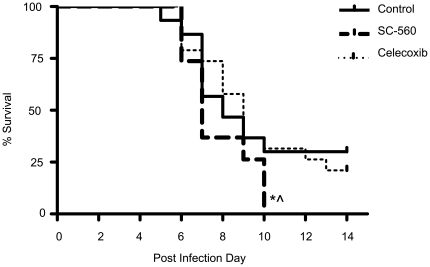
Figure 1. Mortality following influenza A viral infection in control (n = 30), SC-560 (n = 19) and celecoxib (n = 19) treatment groups; *p<0.05 versus control, ∧ p<0.05 versus celecoxib.
Figure 2
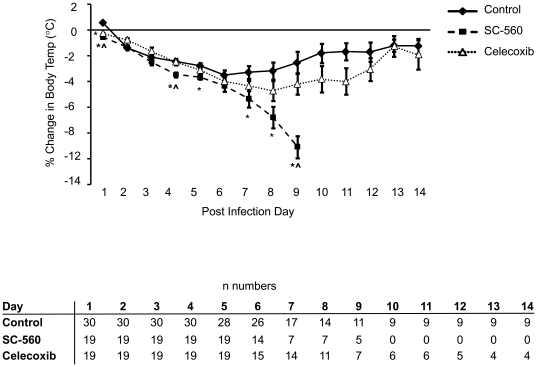
Figure 2. Time course of body temperature changes following influenza A viral infection in control, SC-560 and celecoxib treatment groups.
Numbers of mice in each group and timepoint are shown in the table. Data represent mean ± SEM; *p<0.05 versus control.
Figure 3
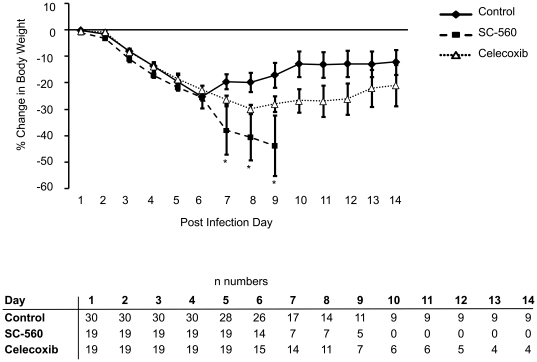
Figure 3. Time course of body weight changes following influenza A viral infection in control, SC-560 and celecoxib treatment groups.
Numbers of mice in each group and timepoint are shown in the table. Data represent mean ± SEM; *p<0.05 versus control.
Figure 4
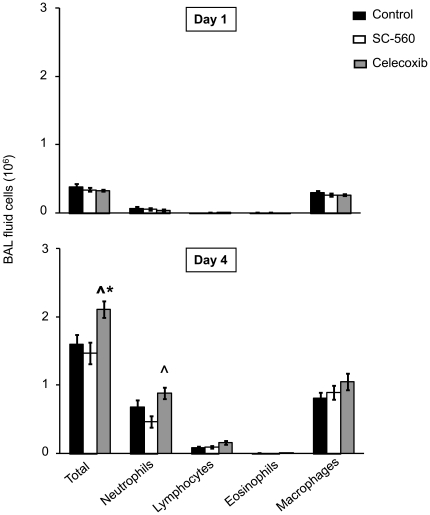
Figure 4. BAL fluid cellularity on days 1 and 4 of infection in control, SC-560 and celecoxib treatment groups.
Data represent mean ± SEM (n = 16–17 per group and timepoint). *p<0.05 versus control, ∧ p<0.05 versus SC-560.
Figure 5
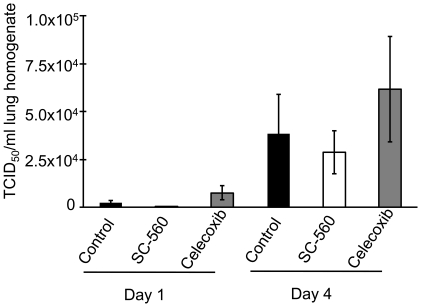
Figure 5. Lung viral titres on days 1 and 4 of infection.
Data represent mean ± SEM (n = 8–10 per group and timepoint). Differences between the three treatment groups are not statistically significant; however, viral titres on day 4 are significantly higher than on day 1 for each group.
Figure 6
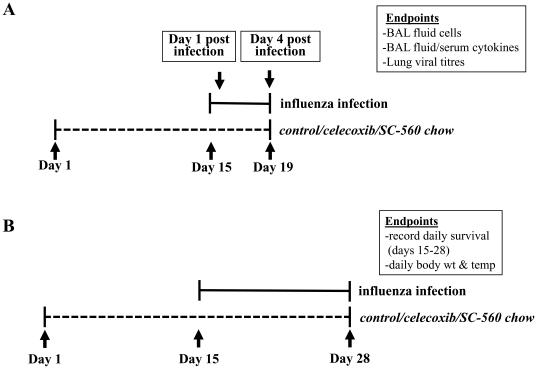
Figure 6. Overview of study design.
(A) Inflammatory endpoints. (B) Clinical endpoints.

References

    1. Mossad SB. The resurgence of swine-origin influenza A (H1N1). Cleve Clin J Med. 2009;76:337–343. - PubMed
    1. Carrat F, Flahault A. Influenza vaccine: the challenge of antigenic drift. Vaccine. 2007;25:6852–6862. - PubMed
    1. Chen J, Deng YM. Influenza virus antigenic variation, host antibody production and new approach to control epidemics. Virol J. 2009;6:30. - PMC - PubMed
    1. de Jong MD, Simmons CP, Thanh TT, Hien VM, Smith GJ, et al. Fatal outcome of human influenza A (H5N1) is associated with high viral load and hypercytokinemia. Nat Med. 2006;12:1203–1207. - PMC - PubMed
    1. Kash JC, Tumpey TM, Proll SC, Carter V, Perwitasari O, et al. Genomic analysis of increased host immune and cell death responses induced by 1918 influenza virus. Nature. 2006;443:578–581. - PMC - PubMed

Publication types

MeSH terms