. 2009 Dec 23;2(3):287-298.
doi: 10.3390/ph2030287.

Mitochondrial Drugs for Alzheimer Disease

Affiliations

Mitochondrial Drugs for Alzheimer Disease

David J Bonda et al. Pharmaceuticals (Basel). .

Abstract

Therapeutic strategies for Alzheimer disease (AD) have yet to offer a disease-modifying effect to stop the debilitating progression of neurodegeneration and cognitive decline. Rather, treatments thus far are limited to agents that slow disease progression without halting it, and although much work towards a cure is underway, a greater understanding of disease etiology is certainly necessary for any such achievement. Mitochondria, as the centers of cellular metabolic activity and the primary generators of reactive oxidative species in the cell, received particular attention especially given that mitochondrial defects are known to contribute to cellular damage. Furthermore, as oxidative stress has come to the forefront of AD as a causal theory, and as mitochondrial damage is known to precede much of the hallmark pathologies of AD, it seems increasingly apparent that this metabolic organelle is ultimately responsible for much, if not all of disease pathogenesis. In this review, we review the role of neuronal mitochondria in the pathogenesis of AD and critically assess treatment strategies that utilize this upstream access point as a method for disease prevention. We suspect that, with a revived focus on mitochondrial repair and protection, an effective and realistic therapeutic agent can be successfully developed.


Figures
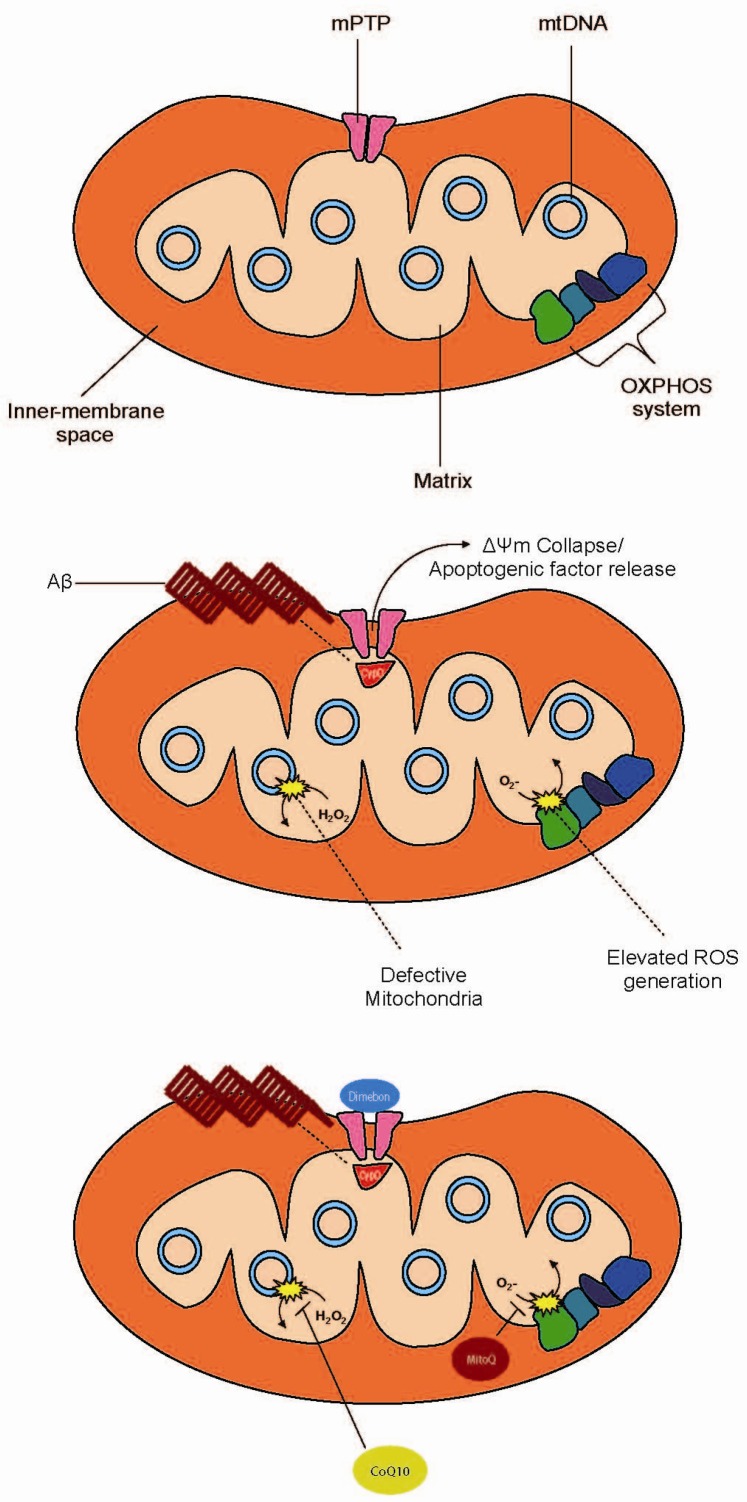
Figure 1
Figure 1
(A) A mitochondrion with intact components typical of healthy brain: functional oxidative phosphorylation (OXPHOS) system, non-mutated mtDNA, closed, impermeable mPTP. (B) In an aging, AD-prone brain, mitochondrial dysfunction mediates much of the characteristic neurodegeneration. Free radical accumulation produces damages to mtDNA and the OXPHOS system, eliciting further oxidative stress; As Aβ aggregates, it promotes cycliphilin D (cypD)-induced mitochondrial permeability transition pore (mPTP) opening (shown by the dotted line connecting them), collapsing mitochondrial membrane potential (Δψm) and releasing apoptogenic factors. (C) Mitochondrial intervention thus provides an adequate therapeutic access point to AD prevention and control: the antioxidants MitoQ and CoQ10 are under investigation as is the mPTP protector Dimebon.

References

    1. Wang X., Su B., Siedlak S.L., Moreira P.I., Fujioka H., Wang Y., Casadesus G., Zhu X. Amyloid-betaoverproduction causes abnormal mitochondrial dynamics via differential modulation of mitochondrial fission/fusion proteins. Proc. Natl. Acad. Sci. USA. 2008;105:19318–19323. - PMC - PubMed
    1. Knott A.B., Perkins G., Schwarzenbacher R., Bossy-Wetzel E. Mitochondrial fragmentation in neurodegeneration. Nat. Rev. Neurosci. 2008;9:505–518. - PMC - PubMed
    1. Lee J., Boo J.H., Ryu H. The failure of mitochondria leads to neurodegeneration: Do mitochondria need a jump start? Adv. Drug Deliv. Rev. 2009;61:1316–1323. doi: 10.1016/j.addr.2009.07.016. - DOI - PMC - PubMed
    1. Lin M.T., Beal M.F. Mitochondrial dysfunction and oxidative stress in neurodegenerative diseases. Nature. 2006;443:787–795. - PubMed
    1. Su B., Wang X., Perry G., Smith M.A., Zhu X. Abnormal mitochondrial dynamics and neurodegenerative diseases. Biochim. Biophys. Acta. 2010;1802:135–142. - PMC - PubMed

LinkOut - more resources