


Screening, brief intervention, and referral to treatment (SBIRT): 12-month outcomes of a randomized controlled clinical trial in a Polish emergency department
- PMID: 20659072
- PMCID: PMC2965307
- DOI: 10.1111/j.1530-0277.2010.01281.x
Screening, brief intervention, and referral to treatment (SBIRT): 12-month outcomes of a randomized controlled clinical trial in a Polish emergency department
Abstract
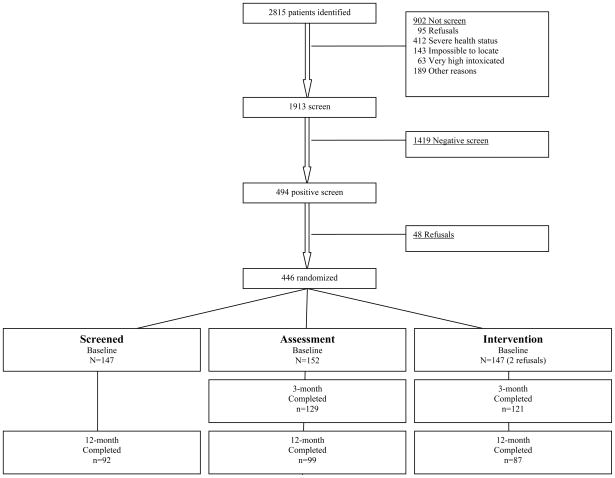
Background: A randomized controlled trial of screening, brief intervention, and referral to treatment (SBIRT) among at-risk (based on average number of drinks per week and drinks per drinking day) and dependent drinkers was conducted in an emergency department (ED) among 446 patients 18 and older in Sosnowiec, Poland.
Methods: Patients were recruited over a 23-week period (4:00 pm to 12:00 midnight) and randomized to 1 of 3 conditions: screened-only (n = 147), assessed (n = 152), and intervention (n = 147). Patients in the assessed and intervention conditions were blindly reassessed via a telephone interview at 3 months, and all 3 groups were assessed at 12 months (screened-only = 92, assessed = 99, and intervention = 87).
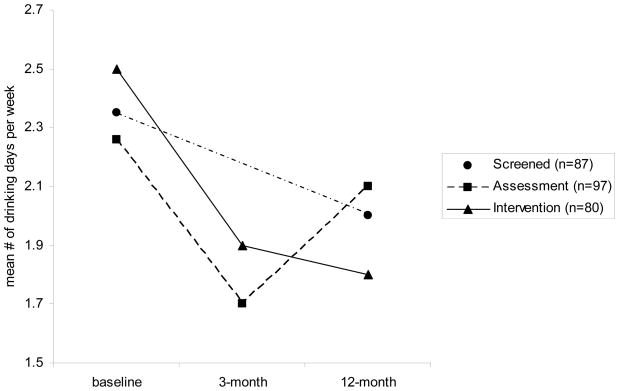
Results: No difference was found across the 3 conditions in at-risk drinking at 12 months, as the primary outcome variable, or in decrease in the number of drinks per drinking day, with all 3 groups showing a significant reduction in both. Significant declines between baseline and 12 months in secondary outcomes of the RAPS4, number of drinking days per week, and the maximum number of drinks on an occasion were seen only for the intervention condition, and in negative consequences for both the assessment and intervention conditions.
Conclusions: Data suggest that improvements in drinking outcomes found in the assessment condition were not because of assessment reactivity, with both the screened and intervention conditions demonstrating greater (although nonsignificant) improvement than the assessed condition. Only those in the intervention condition showed significant improvement in all outcome variables from baseline to 12-month follow-up. Although group by time interaction effects were not found to be significant, these findings suggest that declines in drinking measures for those receiving a brief intervention can be maintained at long-term follow-up.
Copyright © 2010 by the Research Society on Alcoholism.
Figures




References
-
- Academic ED SBIRT Research Collaborative. The impact of screening, brief intervention, and referral for treatment on Emergency Department patients' alcohol use. Ann Emerg Med. 2007;50:699–710. - PubMed
-
- Bernstein E, Bernstein J. Effectiveness of alcohol screening and brief motivational intervention in the emergency department setting. Ann Emerg Med. 2008;51:751–754. - PubMed
-
- Bernstein E, Bernstein J, Levenson S. Project ASSERT: an ED-based intervention to increase access to primary care, preventive services, and the substance abuse treatment system. Ann Emerg Med. 1997;30:181–189. - PubMed
-
- Breslin RW. The wording and translation of research instruments. In: Lonner WJ, Berry JW, editors. Field methods in cross-cultural research. Vol. 8. SAGE Publications; Newbury Park, CA: 1986. pp. 137–165.
-
- Cherpitel CJ. Alcohol, injury and risk taking behavior: data from a national sample. Alcohol Clin Exp Res. 1993;17:762–766. - PubMed
Publication types
MeSH terms
Grants and funding
LinkOut - more resources
Full Text Sources
Medical
