


Additive contribution of HLA class I alleles in the immune control of HIV-1 infection
- PMID: 20660184
- PMCID: PMC2937780
- DOI: 10.1128/JVI.00320-10
Additive contribution of HLA class I alleles in the immune control of HIV-1 infection
Abstract
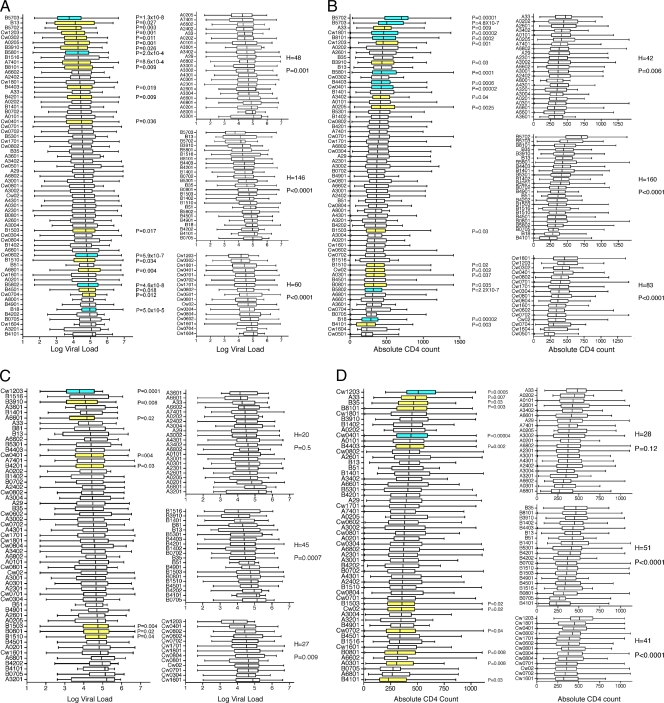
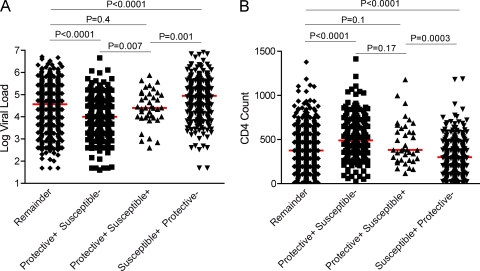
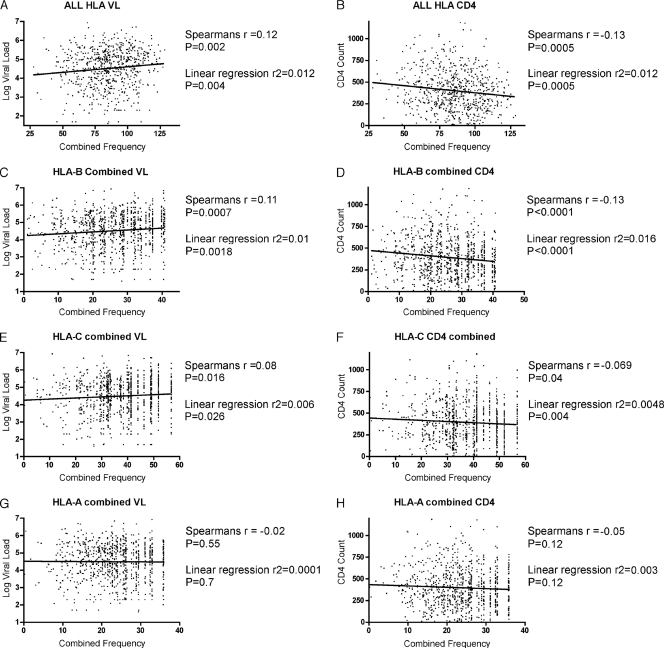
Previous studies have identified a central role for HLA-B alleles in influencing control of HIV infection. An alternative possibility is that a small number of HLA-B alleles may have a very strong impact on HIV disease outcome, dominating the contribution of other HLA alleles. Here, we find that even following the exclusion of subjects expressing any of the HLA-B class I alleles (B*57, B*58, and B*18) identified to have the strongest influence on control, the dominant impact of HLA-B alleles on virus set point and absolute CD4 count variation remains significant. However, we also find that the influence of HLA on HIV control in this C-clade-infected cohort from South Africa extends beyond HLA-B as HLA-Cw type remains a significant predictor of virus and CD4 count following exclusion of the strongest HLA-B associations. Furthermore, there is evidence of interdependent protective effects of the HLA-Cw*0401-B*8101, HLA-Cw*1203-B*3910, and HLA-A*7401-B*5703 haplotypes that cannot be explained solely by linkage to a protective HLA-B allele. Analysis of individuals expressing both protective and detrimental alleles shows that even the strongest HLA alleles appear to have an additive rather than dominant effect on HIV control at the individual level. Finally, weak but significant frequency-dependent effects in this cohort can be detected only by looking at an individual's combined HLA allele frequencies. Taken together, these data suggest that although individual HLA alleles, particularly HLA-B, can have a strong impact, HIV control overall is likely to be influenced by the additive effect of some or all of the other HLA alleles present.
Figures


References
-
- Altfeld, M., M. M. Addo, E. S. Rosenberg, F. M. Hecht, P. K. Lee, M. Vogel, X. G. Yu, R. Draenert, M. N. Johnston, D. Strick, T. M. Allen, M. E. Feeney, J. O. Kahn, R. P. Sekaly, J. A. Levy, J. K. Rockstroh, P. J. Goulder, and B. D. Walker. 2003. Influence of HLA-B57 on clinical presentation and viral control during acute HIV-1 infection. AIDS 17:2581-2591. - PubMed
-
- Badri, M., L. G. Bekker, C. Orrell, J. Pitt, F. Cilliers, and R. Wood. 2004. Initiating highly active antiretroviral therapy in sub-Saharan Africa: an assessment of the revised World Health Organization scaling-up guidelines. AIDS 18:1159-1168. - PubMed
-
- Bihl, F., N. Frahm, L. Di Giammarino, J. Sidney, M. John, K. Yusim, T. Woodberry, K. Sango, H. S. Hewitt, L. Henry, C. H. Linde, J. V. Chisholm, 3rd, T. M. Zaman, E. Pae, S. Mallal, B. D. Walker, A. Sette, B. T. Korber, D. Heckerman, and C. Brander. 2006. Impact of HLA-B alleles, epitope binding affinity, functional avidity, and viral coinfection on the immunodominance of virus-specific CTL responses. J. Immunol. 176:4094-4101. - PubMed
-
- Bunce, M. 2003. PCR-sequence-specific primer typing of HLA class I and class II alleles. Methods Mol. Biol. 210:143-171. - PubMed
-
- Carrington, M., G. W. Nelson, M. P. Martin, T. Kissner, D. Vlahov, J. J. Goedert, R. Kaslow, S. Buchbinder, K. Hoots, and S. J. O'Brien. 1999. HLA and HIV-1: heterozygote advantage and B*35-Cw*04 disadvantage. Science 283:1748-1752. - PubMed
Publication types
MeSH terms
Substances
Grants and funding
LinkOut - more resources
Full Text Sources
Other Literature Sources
Medical
Research Materials
