


Inhibition of superinfection and the evolution of viral latency
- PMID: 20660193
- PMCID: PMC2937782
- DOI: 10.1128/JVI.00865-10
Inhibition of superinfection and the evolution of viral latency
Abstract
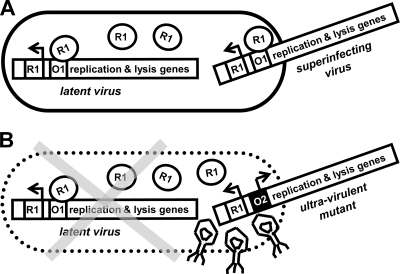
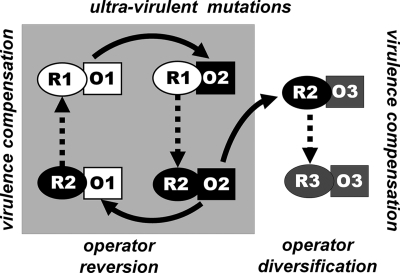
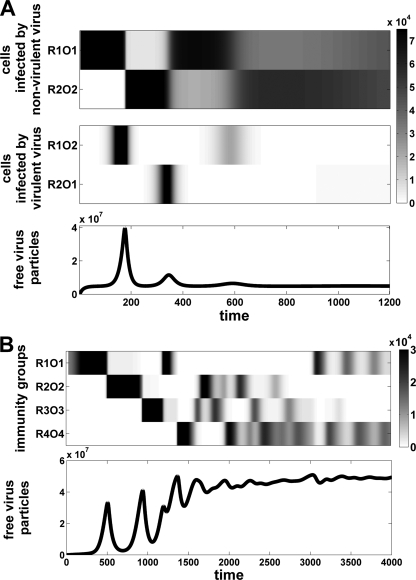
Latent viruses generally defend their host cell against superinfection by nonlatent virulent mutants that could destroy the host cell. Superinfection inhibition thus seems to be a prerequisite for the maintenance of viral latency. Yet viral latency can break down when resistance to superinfection inhibition, known as ultravirulence, occurs. To understand the evolution of viral latency, we have developed a model that analyzes the epidemiology of latent infection in the face of ultravirulence. We show that latency can be maintained when superinfection inhibition and resistance against it coevolve in an arms race, which can result in large fluctuations in virulence. An example is the coevolution of the virulence and superinfection repressor protein of phage lambda (cI) and its binding target, the lambda oLoR operator. We show that this repressor/operator coevolution is the driving force for the evolution of superinfection immunity groups. Beyond latent phages, we predict analogous dynamics for any latent virus that uses a single repressor for the simultaneous control of virulence and superinfection.
Figures
References
-
- Allison, H. E., M. J. Sergeant, C. E. James, J. R. Saunders, D. L. Smith, R. J. Sharp, T. S. Marks, and A. J. McCarthy. 2003. Immunity profiles of wild-type and recombinant shiga-like toxin-encoding bacteriophages and characterization of novel double lysogens. Infect. Immun. 71:3409-3418. - PMC - PubMed
-
- Anderson, R., and R. May. 1982. Coevolution of hosts and parasites. Parasitology 85:411-426. - PubMed
-
- van Baalen, M. V., and M. W. Sabelis. 1995. The milker-killer dilemma in spatially structured predator-prey interactions. Oikos 74:391-400.
-
- van Baalen, M. V., and M. W. Sabelis. 1995. The dynamics of multiple infection and the evolution of virulence. Am. Nat. 146:881-910. - PubMed
Publication types
MeSH terms
Substances
LinkOut - more resources
Full Text Sources
