


doi: 10.1128/JCM.00921-10.
Epub 2010 Jul 21.
Ability of Bacillus cereus group strains to cause food poisoning varies according to phylogenetic affiliation (groups I to VII) rather than species affiliation
Affiliations
- PMID: 20660215
- PMCID: PMC2937725
- DOI: 10.1128/JCM.00921-10
Item in Clipboard
Ability of Bacillus cereus group strains to cause food poisoning varies according to phylogenetic affiliation (groups I to VII) rather than species affiliation
J Clin Microbiol.
2010 Sep.
Abstract
Cytotoxic activity levels of culture filtrates and toxin distributions varied according to the phylogenetic group (I to VII) within the Bacillus cereus group, suggesting that these groups are of different clinical significance and are more suitable than species affiliations for determining food poisoning risk. A first-line, simple online tool (https://www.tools.symprevius.org/Bcereus/english.php) to assign strains to the different phylogenetic groups is presented.
Figures
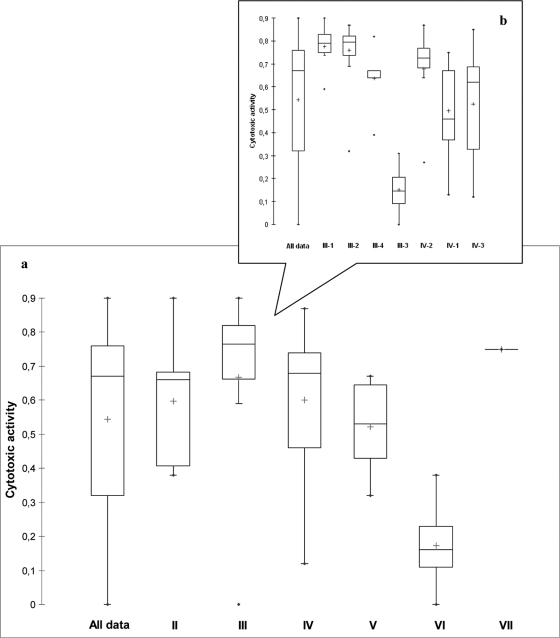
Cytotoxic activity of B. cereus culture filtrates against Caco2 cells. (a) Data distribution of the global population (B. cereus group) is represented by the first box plot (all data), whereas that of each subpopulation (phylogenetic groups II to VII) is shown by the next box plots. In the boxplot representation, 50% of data values are within the central box and 25% are more (upper whiskers) and 25% are less (lower whiskers) than the values within the central box. Horizontal line within the central box, median value; plus sign within the central box, mean value; upper and lower boundaries of whiskers, maximum and minimum values; •, extreme value (outlier). (b) Detailed results for subgroups in phylogenetic groups III and IV.
References
-
- Agata, N., M. Ohta, M. Mori, and M. Isobe. 1995. A novel dodecadepsipeptide, cereulide, is an emetic toxin of Bacillus cereus. FEMS Microbiol. Lett. 129:17-20. - PubMed
-
- Cadot, C., S. Tran, M. L. Vignaud, M. L. Debuyser, A. B. Kolsto, A. Brisabois, C. Nguyen-The, D. Lereclus, M. H. Guinebretière, and N. Ramarao. 2010. InhA1, NprA, and HlyII as candidates for markers to differentiate pathogenic from nonpathogenic Bacillus cereus strains. J. Clin. Microbiol. 48:1358-1365. - PMC - PubMed
-
- Choma, C., M. H. Guinebretiere, F. Carlin, P. Schmitt, P. Velge, P. E. Granum, and C. Nguyen-The. 2000. Prevalence, characterization and growth of Bacillus cereus in commercial cooked chilled foods containing vegetables. J. Appl. Microbiol. 88:617-625. - PubMed
Publication types
MeSH terms
Substances
LinkOut - more resources
Full Text Sources
Medical
