doi: 10.1085/jgp.201010416.
Deciphering ryanodine receptor array operation in cardiac myocytes
Affiliations
- PMID: 20660655
- PMCID: PMC2912071
- DOI: 10.1085/jgp.201010416
Item in Clipboard
Deciphering ryanodine receptor array operation in cardiac myocytes
J Gen Physiol.
2010 Aug.
No abstract available
Figures
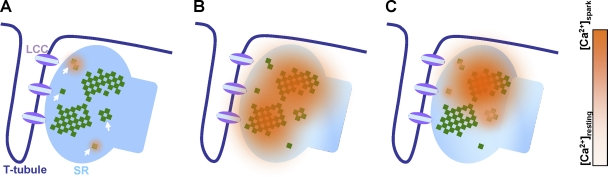
Distinct modes of elemental calcium release. On a terminal cistern, a main RYR cluster consists of two subdomains with an isthmic connection and is surrounded by a few rogue RYR groups (indicated by arrows in A). (A) Quarky calcium release from rogue RYRs only. (B) Calcium spark with two quantal units. Either or both of the subdomains of the main cluster can be activated in a spark. (C) Calcium spark with quarky substructure. During sparks, the neighbor rogue RYRs are also activated in succession, resulting in prolonging calcium release. Cytosol calcium concentration gradients are roughly displayed by colors (top to bottom of the look-up table corresponds to the calcium concentration from resting to sparked). LCC, L-type calcium channel; SR, sarcoplasmic reticulum.
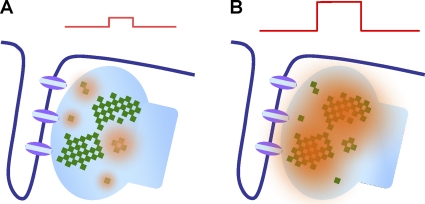
Stimulus intensity dependence of elemental calcium release mode. A weak stimulus preferentially activates rogue RYRs to produce quarky calcium release (A), whereas a strong stimulus activates the main cluster as well as the rogue RYRs (B).
References
Publication types
MeSH terms
Substances
LinkOut - more resources
Full Text Sources