. 2010 Sep 1;185(5):2989-97.
doi: 10.4049/jimmunol.1000768. Epub 2010 Jul 26.

TLR9-targeted biodegradable nanoparticles as immunization vectors protect against West Nile encephalitis

Affiliations

TLR9-targeted biodegradable nanoparticles as immunization vectors protect against West Nile encephalitis

Stacey L Demento et al. J Immunol. .

Abstract

Vaccines that activate humoral and cell-mediated immune responses are urgently needed for many infectious agents, including the flaviviruses dengue and West Nile (WN) virus. Vaccine development would be greatly facilitated by a new approach, in which nanoscale modules (Ag, adjuvant, and carrier) are assembled into units that are optimized for stimulating immune responses to a specific pathogen. Toward that goal, we formulated biodegradable nanoparticles loaded with Ag and surface modified with the pathogen-associated molecular pattern CpG oligodeoxynucleotides. We chose to evaluate our construct using a recombinant envelope protein Ag from the WN virus and tested the efficiency of this system in eliciting humoral and cellular responses and providing protection against the live virus. Animals immunized with this system showed robust humoral responses polarized toward Th1 immune responses compared with predominately Th2-biased responses with the adjuvant aluminum hydroxide. Immunization with CpG oligodeoxynucleotide-modified nanoparticles resulted in a greater number of circulating effector T cells and greater activity of Ag-specific lymphocytes than unmodified nanoparticles or aluminum hydroxide. Ultimately, compared with alum, this system offered superior protection in a mouse model of WN virus encephalitis.


Figures

FIGURE 1
FIGURE 1
Nanoparticle characterization. A, PLGA nanoparticles were formulated to encapsulate rWNVE and were surface modified with an avidin-palmitate linker and biotinylated CpG ODN. Nanoparticles were characterized by measuring rWNVE release in triplicate over a 5-wk period (B), determining size distribution using the NanoSight system (C), and visualization by scanning electron microscopy (D). Scale bar, 500 nm. Original magnification × 51,200. E, NR was loaded into nanoparticles to confirm internalization of particlesbyBMDCs, visualized by fluorescent microscopy. Free NR was used as a control. Scale bar, 20 μm. Original magnification × 400. NR, Nile red.
FIGURE 2
FIGURE 2
BMDC surface marker expression. BMDCs in triplicate were pulsed with CpG ODN/rWNVE, −/rWNVE, or rWNVE adsorbed to Alhydrogel for 24 h and then stained with fluorescent Abs for CD80 (A) and CD86 (B) and analyzed by flow cytometry. CD11c+ live cells were gated, and the percentage of these cells positive for surface markers was enumerated. *p < 0.01 by ANOVA. Data shown are from a single experiment that was repeated three times with the same result.
FIGURE 3
FIGURE 3
BMDC activation. BMDCs in triplicate were pulsed with CpG ODN/rWNVE, −/rWNVE, or rWNVE adsorbed to Alhydrogel for 24 h. Supernatant was analyzed for IL-6 (A) and IL-12 (B) by ELISA. C, Inflammasomeactivity.BMDCswere pretreated with 50 ng/ml of LPS overnight. Cells were then incubated with LPS-modified, CpG-modified, or unmodified rWNVE-loaded nanoparticles; rWNVE adsorbed to Alhydrogel; or rWNVE alone for 24 h. Supernatant was collected and analyzed for IL-1β by ELISA. *p < 0.001 by ANOVA. Data shown are from a single experiment that was repeated three times with the same result.
FIGURE 4
FIGURE 4
Ag-specific Ab isotype titers after vaccination. Groups of four C3H/HeN mice were immunized twice with 10 μg of rWNVE in different formulations at 0 and 2 wk. Serum was isolated at 4 wk and analyzed for rWNVE-specific titers of total IgG (A), IgG1 (B), IgG2a (C), and IgG2b (D) by ELISA. E, Serum samples from mice given rWNVE encapsulated in nanoparticles or adsorbed to Alhydrogel were pooled into two groups and were analyzed for PRNTs that decreased plaque formation by 50% (PRNT 50). *p < 0.02 by ANOVA. Data shown are from a single experiment that was repeated twice with the same results.
FIGURE 5
FIGURE 5
Ag-specific Ab titers in mice deficient for TLR 9. Groups of WT C57BL/6 or TLR9−/− mice (n = 3) were vaccinated s.c. with 10 μg of CpG/rWNVE, LPS/rWNVE, or −/rWNVE nanoparticles. After 4 wk, mice were bled retro-orbitally, and serum was analyzed for rWNVE-specific 1gG1 (A) and IgG2b (B) by ELISA. *p < 0.05. CpG/rWNVE, recombinant West Nile virus envelope protein encapsulated in CpG-modified nanoparticles; LPS/rWNVE, recombinant West Nile virus envelope protein encapsulated in LPS-modified nanoparticles. WT, wild-type.
FIGURE 6
FIGURE 6
Indicators of cellular immunity. Ag-specific lymphocyte ex vivo activity. Splenocytes were harvested from immunized mice at week 6 and pulsed with 25 μg/ml of rWNVE for 48 h. Supernatant was collected and assayed for IFN-γ (A) and IL-2 (B) by ELISA. C, Effector cell phenotype. Mice were bled retro-orbitally 1 wk postimmunization, and lymphocytes were stained with fluorescent Abs for CD8, CD44, CD127, and KLRG1. Cells were gated for the CD8+CD44+ population, and the percentage of KLRG1+CD127 cells was determined.*p < 0.0001. Data shown are from single experiments that were repeated twice with the same results.
FIGURE 7
FIGURE 7
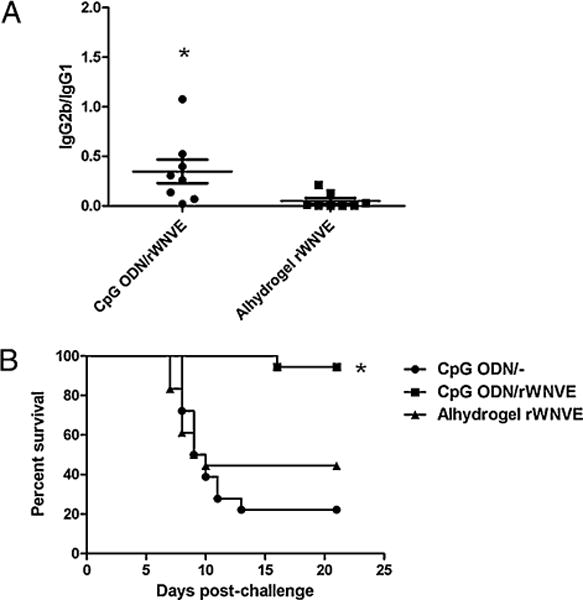
Survival analysis. A, Two weeks after a single immunization, serum samples were collected and analyzed for IgG2b and IgG1 titers by ELISA. Ratio of IgG2b to IgG1 is shown. *p < 0.05; unpaired t test. B, Mice were challenged i.p. with 1000 PFU of WN virus isolate 2741 and were monitored daily. At 21 d postchallenge, the percentage survival for each group was determined. Survival curves are the combined curves from two separate experiments (n = 8 and n = 10), with a combined N of 18 per group. *p < 0.001; log rank test.

References

    1. Tsai TF. Flaviviruses. In: Mandell GL, Bennett JE, Dolin R, editors. Principles and Practice of Infectious Diseases. Churchill Livingstone; Philadelphia, PA: 2000. pp. 1196–1206.
    1. Granwehr BP, Lillibridge KM, Higgs S, Mason PW, Aronson JF, Campbell GA, Barrett AD. West Nile virus: where are we now? Lancet Infect Dis. 2004;4:547–556. - PubMed
    1. Ng T, Hathaway D, Jennings N, Champ D, Chiang YW, Chu HJ. Equine vaccine for West Nile virus. Dev Biol (Basel) 2003;114:221–227. - PubMed
    1. Robert Putnak JBA, Coller G, Voss DW, Vaughn D, Clements I, Peters G, Bignami HS, Houng RC, Chen DA, Barvir, et al. An evaluation of dengue type-2 inactivated, recombinant subunit, and live-attenuated vaccine candidates in the rhesus macaque model. Vaccine. 2005;23:4442–4452. - PubMed
    1. Tesh RB, Arroyo J, Travassos Da Rosa AP, Guzman H, Xiao SY, Monath TP. Efficacy of killed virus vaccine, live attenuated chimeric virus vaccine, and passive immunization for prevention of West Nile virus encephalitis in hamster model. Emerg Infect Dis. 2002;8:1392–1397. - PMC - PubMed

Publication types

MeSH terms