


Exogenous fms-like tyrosine kinase 3 ligand overrides brain immune privilege and facilitates recognition of a neo-antigen without causing autoimmune neuropathology
- PMID: 20660723
- PMCID: PMC2922551
- DOI: 10.1073/pnas.0913496107
Exogenous fms-like tyrosine kinase 3 ligand overrides brain immune privilege and facilitates recognition of a neo-antigen without causing autoimmune neuropathology
Abstract
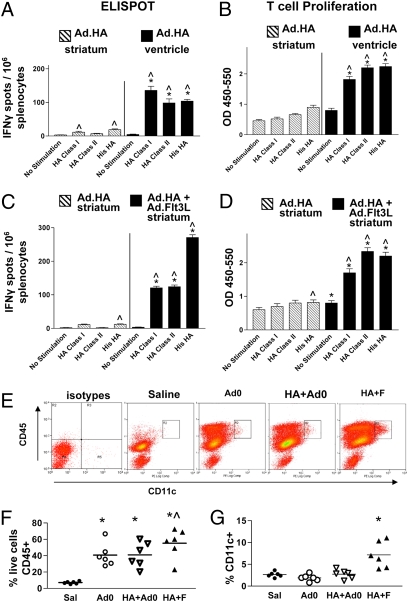
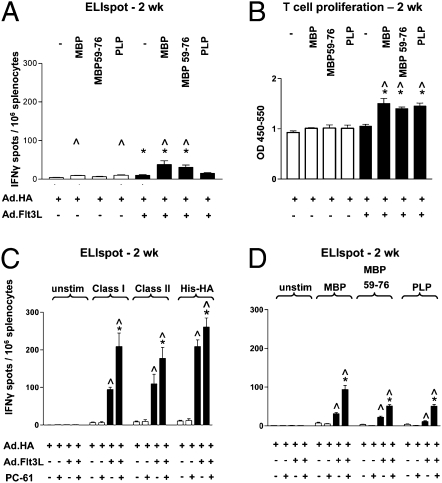
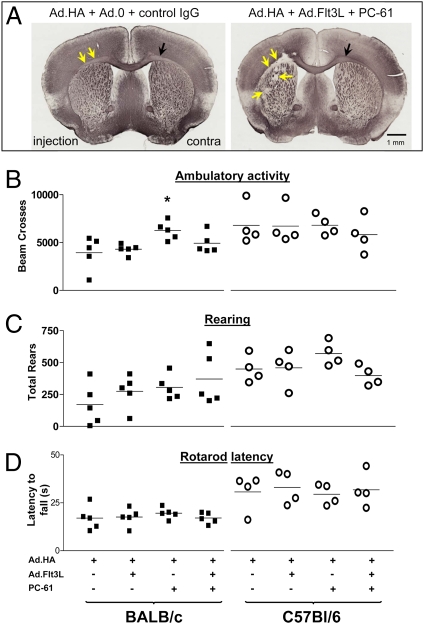
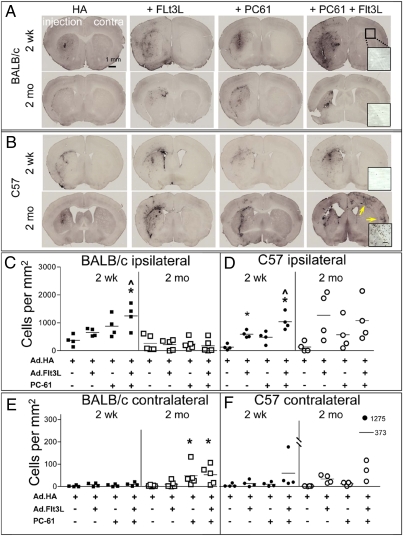
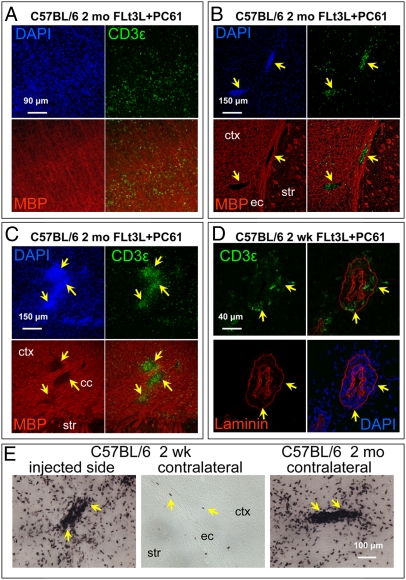
Soluble antigens diffuse out of the brain and can thus stimulate a systemic immune response, whereas particulate antigens (from infectious agents or tumor cells) remain within brain tissue, thus failing to stimulate a systemic immune response. Immune privilege describes how the immune system responds to particulate antigens localized selectively within the brain parenchyma. We believe this immune privilege is caused by the absence of antigen presenting dendritic cells from the brain. We tested the prediction that expression of fms-like tyrosine kinase ligand 3 (Flt3L) in the brain will recruit dendritic cells and induce a systemic immune response against exogenous influenza hemagglutinin in BALB/c mice. Coexpression of Flt3L with HA in the brain parenchyma induced a robust systemic anti-HA immune response, and a small response against myelin basic protein and proteolipid protein epitopes. Depletion of CD4(+)CD25+ regulatory T cells (Tregs) enhanced both responses. To investigate the autoimmune impact of these immune responses, we characterized the neuropathological and behavioral consequences of intraparenchymal injections of Flt3L and HA in BALB/c and C57BL/6 mice. T cell infiltration in the forebrain was time and strain dependent, and increased in animals treated with Flt3L and depleted of Tregs; however, we failed to detect widespread defects in myelination throughout the forebrain or spinal cord. Results of behavioral tests were all normal. These results demonstrate that Flt3L overcomes the brain's immune privilege, and supports the clinical development of Flt3L as an adjuvant to stimulate clinically effective immune responses against brain neo-antigens, for example, those associated with brain tumors.
Conflict of interest statement
The authors declare no conflict of interest.
Figures
References
-
- Mrass P, Weninger W. Immune cell migration as a means to control immune privilege: Lessons from the CNS and tumors. Immunol Rev. 2006;213:195–212. - PubMed
-
- Arck PC, Gilhar A, Bienenstock J, Paus R. The alchemy of immune privilege explored from a neuroimmunological perspective. Curr Opin Pharmacol. 2008;8:480–489. - PubMed
-
- Galea I, Bechmann I, Perry VH. What is immune privilege (not)? Trends Immunol. 2007;28:12–18. - PubMed
-
- Lowenstein PR. Immunology of viral-vector-mediated gene transfer into the brain: An evolutionary and developmental perspective. Trends Immunol. 2002;23:23–30. - PubMed
-
- Perry VH. A revised view of the central nervous system microenvironment and major histocompatibility complex class II antigen presentation. J Neuroimmunol. 1998;90:113–121. - PubMed
Publication types
MeSH terms
Substances
Grants and funding
LinkOut - more resources
Full Text Sources
Medical
Molecular Biology Databases
Research Materials
Miscellaneous
