. 2010 Aug 10;107(32):14280-5.
doi: 10.1073/pnas.1009559107. Epub 2010 Jul 26.

Polybromo-associated BRG1-associated factor components BRD7 and BAF180 are critical regulators of p53 required for induction of replicative senescence

Affiliations

Polybromo-associated BRG1-associated factor components BRD7 and BAF180 are critical regulators of p53 required for induction of replicative senescence

Anna E Burrows et al. Proc Natl Acad Sci U S A. .

Abstract

A variety of tumor-suppressor mechanisms exist to promote genome integrity and organismal survival. One such mechanism is cellular senescence. In response to replicative aging, DNA damage, and oncogenic stimuli, the p53 and Rb pathways are activated to prevent the proliferation of damaged cells by inducing senescence or apoptosis. We have performed a loss-of-function genetic screen in primary human cells to identify components of the senescence machinery. Here we describe BRD7 and BAF180 as unique regulators of replicative senescence in human cells. Both regulate p53 transcriptional activity toward a subset of its target genes required for replicative and oncogenic stress senescence induction, and BRD7 physically interacts with p53. BRD7 is a deletion target in human cancer, suggesting that loss of BRD7 may provide an additional mechanism to antagonize p53 function in cancer cells.


Conflict of interest statement

The authors declare no conflict of interest.

Figures

Fig. 1.
Fig. 1.
BRD7 depletion increases proliferation and delays senescence in primary fibroblasts. (A) Population-doubling (PD) curves in primary BJ fibroblasts (Upper) and BJs expressing the HPV E7 oncoprotein (Lower) and the indicated shRNAs. (B) Senescence-associated β-galactosidase staining quantification with error bars indicating SEM in primary human BJ fibroblasts infected with retroviruses expressing the indicated shRNAs. (C) BRD7 depletion measured by Western blot in primary human BJ fibroblasts infected with retroviruses expressing the indicated shRNAs. (D) Senescence-associated β-galactosidase staining quantification on day 16 posttransduction with RasV12D or vector alone; error bars indicate SEM. Population doublings in human BJ fibroblasts were measured on day 15 posttransduction with RasV12D or vector alone in primary BJ fibroblasts expressing the indicated shRNAs.
Fig. 2.
Fig. 2.
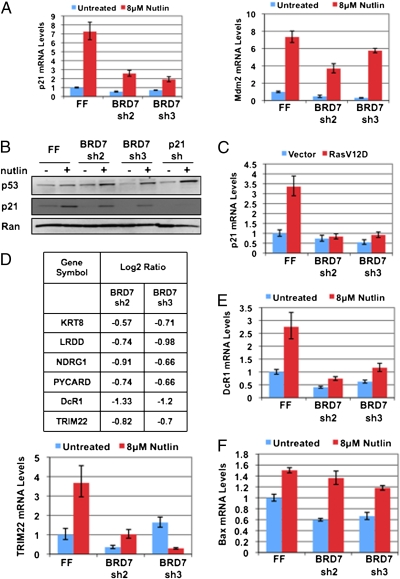
BRD7 regulates p53 activity toward a subset of its target genes. (A) Quantitative RT-PCR analysis of p21 and Mdm2 expression upon BRD7 depletion with and without 8 μM nutlin-3a treatment for 6 h. Error bars indicate SEM. The mRNA levels are normalized to β-actin and relative to an FF control shRNA. (B) Western blot analysis of p53 and p21 protein levels following treatment with 8 μM nutlin-3a for 6 h in cells expressing the indicated shRNAs. (C) Analysis of the effects of the indicated shRNAs on p21 expression by qRT-PCR in response to RasV12D transduction. (D) Gene-expression profiling in BJ fibroblasts in the presence and absence of 8 μM nutlin-3a treatment for 6 h and BRD7 depletion with two independent shRNAs. Additional p53 target genes that were down-regulated upon BRD7 depletion are listed as indicated in the table. (E and F) Quantitative RT-PCR analysis of the indicated p53 target genes expression upon BRD7 depletion with and without 8 μM nutlin-3a treatment for 6 h. Error bars indicate SEM. The mRNA levels are normalized to β-actin and are relative to an FF control shRNA.
Fig. 3.
Fig. 3.
BRD7 coimmunoprecipitates with p53, and BAF180 is also required for replicative senescence and p21 expression. (A) Coimmunoprecipitation of HA-tagged BRD7 and endogenous p53 from primary BJs expressing HA-tagged BRD7 using anti-p53 antibodies, with 15% input loaded. (B) Schematic showing structure of BRD7 and the bromodomain deletion mutant. Coimmunoprecipitation of HA-tagged BRD7 ΔB and p53 from primary BJs expressing HA-tagged BRD7 ΔB, with 15% input loaded. (C) Population-doubling curves and senescence-associated β-galactosidase staining quantification with error bars indicating SEM in primary human BJ fibroblasts with three independent shRNAs against BAF180. (D) Quantitative RT-PCR for p21 and Mdm2 expression in BAF180 depleted cells in response to 8 μM nutlin-3a treatment for 6 h, with error bars indicating SEM. The mRNA levels are normalized to β-actin and are relative to an FF control shRNA.
Fig. 4.
Fig. 4.
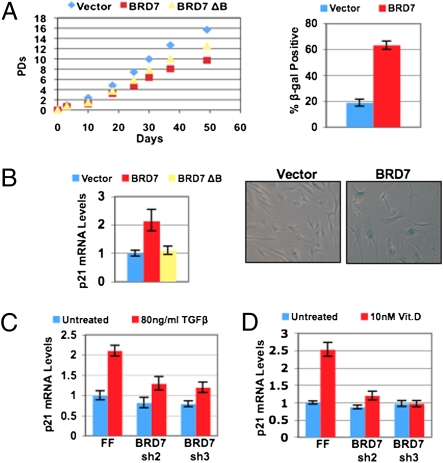
Forced expression of BRD7 induces premature senescence in primary fibroblasts, and BRD7 regulates p21 in both p53-dependent and -independent contexts. (A) Population-doubling curves in BJ fibroblasts expressing vector alone, BRD7 and BRD7 ΔBromo, and senescence-associated β-galactosidase staining of vector alone and BRD7 expressing BJ fibroblasts. (B) Quantitative RT-PCR analysis of p21 expression in BJ fibroblasts infected with the indicated retroviruses. Error bars indicate SEM. The mRNA levels are normalized to β-actin and are relative to vector alone containing control cells. (C) Quantitative RT-PCR for p21 expression in HCT116 p53−/− colon cancer cells, in response to 80 ng/mL TGF-β for 24 h. (D) Quantitative RT-PCR for p21 expression in human mammary epithelial cells in response to 10 nM 1α,25(OH)2D3 (calcitriol, the biologically active form of vitamin D) for 24 h. Error bars indicate SEM. The mRNA levels are normalized to β-actin and relative to an FF control shRNA.

References

    1. Di Micco R, et al. Oncogene-induced senescence is a DNA damage response triggered by DNA hyper-replication. Nature. 2006;444:638–642. - PubMed
    1. Bartkova J, et al. Oncogene-induced senescence is part of the tumorigenesis barrier imposed by DNA damage checkpoints. Nature. 2006;444:633–637. - PubMed
    1. Noda A, Ning Y, Venable SF, Pereira-Smith OM, Smith JR. Cloning of senescent cell-derived inhibitors of DNA synthesis using an expression screen. Exp Cell Res. 1994;211(1):90–98. - PubMed
    1. Harper JW, Adami GR, Wei N, Keyomarsi K, Elledge SJ. The p21 Cdk-interacting protein Cip1 is a potent inhibitor of G1 cyclin-dependent kinases. Cell. 1993;75:805–816. - PubMed
    1. el-Deiry WS, et al. WAF1, a potential mediator of p53 tumor suppression. Cell. 1993;75:817–825. - PubMed

Publication types

MeSH terms

Associated data