


Protein damage and death by radiation in Escherichia coli and Deinococcus radiodurans
- PMID: 20660760
- PMCID: PMC2922536
- DOI: 10.1073/pnas.1009312107
Protein damage and death by radiation in Escherichia coli and Deinococcus radiodurans
Abstract
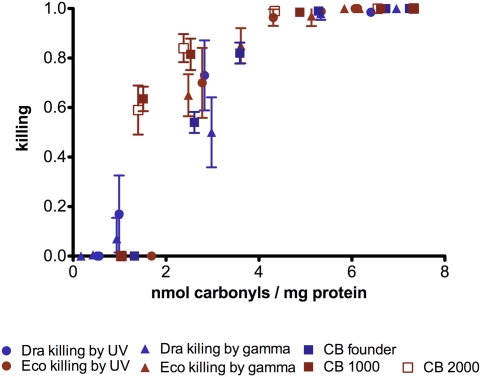
Deinococcus radiodurans is among a small number of bacterial species that are extremely resistant to ionizing radiation, UV light, toxic chemicals, and desiccation. We measured proteome oxidation (i.e., protein carbonylation, PC) in D. radiodurans as well as in standard and evolved resistant strains of Escherichia coli exposed to ionizing radiation or UVC light and found a consistent correlation with cell killing. The unique quantitative relationship between incurred PC and cell death holds over the entire range of killing for all tested bacteria and for both lethal agents, meaning that both bacterial species are equally sensitive to PC. We show that the extraordinary robustness of D. radiodurans depends on efficient proteome protection (but not DNA protection) against constitutive and radiation-induced PC consisting of low molecular weight cytosolic compounds. Remarkably, experimental evolution of resistance to ionizing radiation in E. coli coevolves with protection against PC. The decline in biosynthetic efficacy of the cellular proteome, as measured by the loss of reproduction of undamaged bacteriophage lambda in irradiated standard and evolved ionizing radiation-resistant E. coli, correlates with radiation-induced oxidative damage to host cells and their sensitivity to ionizing radiation. This correlation suggests that cell death by radiation is caused primarily by oxidative damage with consequential loss of maintenance activities including DNA repair.
Conflict of interest statement
The authors declare no conflict of interest.
Figures



References
-
- Cox MM, Battista JR. Deinococcus radiodurans—the consummate survivor. Nat Rev Microbiol. 2005;3:882–892. - PubMed
-
- Daly MJ. A new perspective on radiation resistance based on Deinococcus radiodurans. Nat Rev Microbiol. 2009;7:237–245. - PubMed
-
- Blasius M, Sommer S, Hübscher U. Deinococcus radiodurans: What belongs to the survival kit? Crit Rev Biochem Mol Biol. 2008;43:221–238. - PubMed
-
- Bruce IN, McNally JA, Rea IM, Bell AL. Age-related changes in non-receptor dependent generation of reactive oxygen species from phagocytes of healthy adults. Mech Ageing Dev. 1997;94:135–144. - PubMed
Publication types
MeSH terms
Substances
LinkOut - more resources
Full Text Sources
Other Literature Sources
Molecular Biology Databases
