


Novelty seeking and introversion do not predict the long-term risk of Parkinson disease
- PMID: 20660865
- PMCID: PMC2918889
- DOI: 10.1212/WNL.0b013e3181ea15fd
Novelty seeking and introversion do not predict the long-term risk of Parkinson disease
Abstract
Objective: It has been suggested that people who develop Parkinson disease (PD) may have a characteristic premorbid personality. We tested this hypothesis using a large historical cohort study with long follow-up.
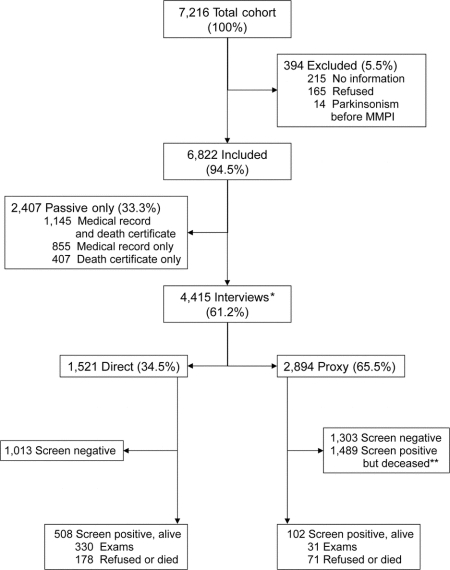
Methods: We conducted a historical cohort study in the region including the 120-mile radius centered in Rochester, MN. We recruited 7,216 subjects who completed the Minnesota Multiphasic Personality Inventory (MMPI) for research at the Mayo Clinic from 1962 through 1965 and we considered 5 MMPI scales to measure sensation seeking, hypomania, positive emotionality, social introversion, and constraint. A total of 6,822 subjects (94.5% of the baseline sample) were followed over 4 decades either actively (via interview and examination) or passively (via medical records).
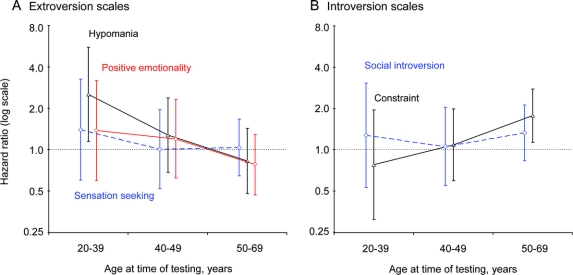
Results: During follow-up, 227 subjects developed parkinsonism (156 developed PD). The 3 MMPI scales that we selected to measure the extroverted personality construct (sensation seeking, hypomania, and positive emotionality) did not show the expected pattern of higher scores associated with reduced risk of PD. Similarly, the 2 MMPI scales that we selected to measure the introverted personality construct (social introversion and constraint) did not show the expected pattern of higher scores associated with increased risk of PD. However, higher scores for constraint were associated with an increased risk of all types of parkinsonism pooled together (hazard ratio 1.39; 95% CI 1.06-1.84; p = 0.02).
Conclusions: We suggest that personality traits related to introversion and extroversion do not predict the risk of PD.
Figures
References
-
- Eatough VM, Kempster PA, Stern GM, Lees AJ. Premorbid personality and idiopathic Parkinson's disease. Adv Neurol 1990;53:335–337. - PubMed
-
- Poewe W, Karamat E, Kemmler GW, Gerstenbrand F. The premorbid personality of patients with Parkinson's disease: a comparative study with healthy controls and patients with essential tremor. Adv Neurol 1990;53:339–342. - PubMed
-
- Menza MA, Golbe LI, Cody RA, Forman NE. Dopamine-related personality traits in Parkinson's disease. Neurology 1993;43:505–508. - PubMed
-
- Menza M. The personality associated with Parkinson's disease. Curr Psychiatry Rep 2000;2:421–426. - PubMed
-
- Menza MA, Forman NE, Goldstein HS, Golbe LI. Parkinson's disease, personality, and dopamine. J Neuropsychiatry Clin Neurosci 1990;2:282–287. - PubMed
Publication types
MeSH terms
Grants and funding
LinkOut - more resources
Full Text Sources
Medical
Molecular Biology Databases
