


How do children at special schools and their parents perceive their HRQoL compared to children at open schools?
- PMID: 20663151
- PMCID: PMC2919454
- DOI: 10.1186/1477-7525-8-72
How do children at special schools and their parents perceive their HRQoL compared to children at open schools?
Abstract
Background: There has been some debate in the past as to who should determine values for different health states for economic evaluation. The aim of this study was to compare the Health Related Quality of Life (HRQoL) in children attending open schools (OS) and children with disabilities attending a special school (SS) and their parents in Cape Town South Africa.
Methods: The EQ-5D-Y and a proxy version were administered to the children and their parents were requested to fill in the EQ-5D-Y proxy version without consultation with their children on the same day.
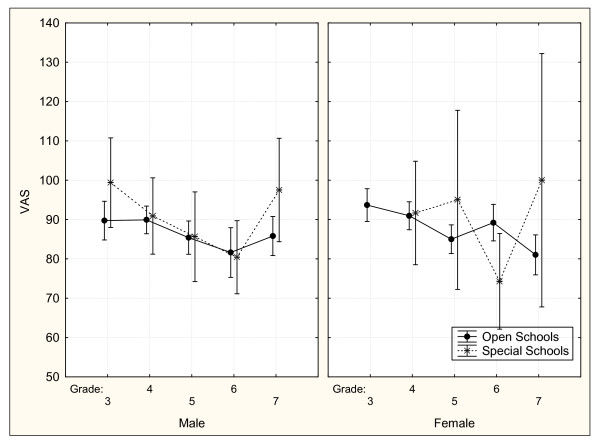
Results: A response rate of over 20% resulted in 567 sets of child/adult responses from OS children and 61 responses from SS children. Children with special needs reported more problems in the "Mobility" and "Looking after myself" domains but their scores with regard to "Doing usual activities", "Pain or discomfort" and "Worried, sad or unhappy" were similar to their typically developing counterparts. The mean Visual Analogue Scale (VAS) score of SS children was (88.4, SD18.3, range 40-100) which was not different to the mean score of the OS respondents (87.9, SD16.5, range 5-100).The association between adult and child scores was fair to moderate in the domains. The correlations in VAS scores between Open Schools children and female care-givers' scores significant but low (r = .33, p < .001) and insignificant between Special School children and adult (r = .16, p = .24).
Discussion: It would appear that children with disabilities do not perceive their HRQoL to be worse than their able bodied counterparts, although they do recognise their limitations in the domains of "Mobility" and "Doing usual activities".
Conclusions: This finding lends weight to the argument that valuation of health states by children affected by these health states should not be included for the purpose of economic analysis as the child's resilience might result in better values for health states and possibly a correspondingly smaller resource allocation. Conversely, if HRQoL is to be used as a clinical outcome, then it is preferable to include the children's values as proxy report does not appear to be highly correlated with the child's own perceptions.
Figures
References
-
- Fava L, Muehlan H, Bullinger M. Linking the DISABKIDS modules for health-related quality of life assessment with the International Classification of Functioning, Disability and Health (ICF) Disability & Rehabilitation. 2009;31(23):1943–1954. - PubMed
-
- MacNeily AE, Jafari S, Scott H, Dalgetty A, Afshar K. Health Related Quality of Life in Patients With Spina Bifida: A Prospective Assessment Before and After Lower Urinary Tract Reconstruction. The Journal of Urology. 2009;182(4, Supplement 1):1984–1992. doi: 10.1016/j.juro.2009.02.060. - DOI - PubMed
-
- Wille N, Bullinger M, Holl R, Hoffmeister U, Mann R, Goldapp C, Reinehr T, Westenhofer J, van Egmond-Frohlich A, Ravens-Sieberer U. Health-related quality of life in overweight and obese youths: Results of a multicenter study. Health and Quality of Life Outcomes. 2010;8(1):36.. doi: 10.1186/1477-7525-8-36. - DOI - PMC - PubMed
Publication types
MeSH terms
LinkOut - more resources
Full Text Sources
Medical
Miscellaneous
