


Positive end-expiratory pressure affects the value of intra-abdominal pressure in acute lung injury/acute respiratory distress syndrome patients: a pilot study
- PMID: 20663183
- PMCID: PMC2945111
- DOI: 10.1186/cc9193
Positive end-expiratory pressure affects the value of intra-abdominal pressure in acute lung injury/acute respiratory distress syndrome patients: a pilot study
Abstract
Introduction: To examine the effects of positive end-expiratory pressure (PEEP) on intra-abdominal pressure (IAP) in patients with acute lung injury (ALI).
Methods: Thirty sedated and mechanically ventilated patients with ALI or acute respiratory distress syndrome (ARDS) admitted to a sixteen-bed surgical medical ICU were included. All patients were studied with sequentially increasing PEEP (0, 6 and 12 cmH2O) during a PEEP-trial.
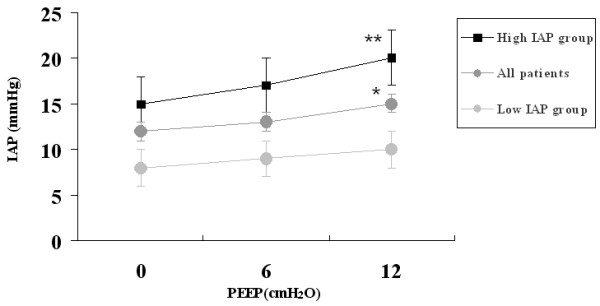
Results: Age was 55 ± 17 years, weight was 70 ± 17 kg, SAPS II was 44 ± 14 and PaO2/FIO2 was 192 ± 53 mmHg. The IAP was 12 ± 5 mmHg at PEEP 0 (zero end-expiratory pressure, ZEEP), 13 ± 5 mmHg at PEEP 6 and 15 ± 6 mmHg at PEEP 12 (P < 0.05 vs ZEEP). In the patients with intra-abdominal hypertension defined as IAP ≥ 12 mmHg (n = 15), IAP significantly increased from 15 ± 3 mmHg at ZEEP to 20 ± 3 mmHg at PEEP 12 (P < 0.01). Whereas in the patients with IAP < 12 mmHg (n = 15), IAP did not significantly change from ZEEP to PEEP 12 (8 ± 2 vs 10 ± 3 mmHg). In the 13 patients in whom cardiac output was measured, increase in PEEP from 0 to 12 cmH2O did not significantly change cardiac output, nor in the 8 out of 15 patients of the high-IAP group. The observed effects were similar in both ALI (n = 17) and ARDS (n = 13) patients.
Conclusions: PEEP is a contributing factor that impacts IAP values. It seems necessary to take into account the level of PEEP whilst interpreting IAP values in patients under mechanical ventilation.
Figures
References
-
- Pelosi P, Quintel M, Malbrain ML. Effect of intra-abdominal pressure on respiratory mechanics. Acta Clin Belg Suppl. 2007. pp. 78–88. - PubMed
-
- Malbrain ML, Cheatham ML, Kirkpatrick A, Sugrue M, Parr M, De Waele J, Balogh Z, Leppaniemi A, Olvera C, Ivatury R, D'Amours S, Wendon J, Hillman K, Johansson K, Kolkman K, Wilmer A. Results from the International Conference of Experts on Intra-abdominal Hypertension and Abdominal Compartment Syndrome. I. Definitions. Intensive Care Med. 2006;32:1722–1732. doi: 10.1007/s00134-006-0349-5. - DOI - PubMed
MeSH terms
LinkOut - more resources
Full Text Sources
Medical
Research Materials
