Review
. 2010 Oct;33(10):435-45.
doi: 10.1016/j.tins.2010.05.006.

The molecular and gene regulatory signature of a neuron

Affiliations
Review

The molecular and gene regulatory signature of a neuron

Oliver Hobert et al. Trends Neurosci. 2010 Oct.

Abstract

Neuron-type specific gene batteries define the morphological and functional diversity of cell types in the nervous system. Here, we discuss the composition of neuron-type specific gene batteries and illustrate gene regulatory strategies which determine the unique gene expression profiles and molecular composition of individual neuronal cell types from C. elegans to higher vertebrates. Based on principles learned from prokaryotic gene regulation, we argue that neuronal terminal gene batteries are functionally grouped into parallel-acting 'regulons'. The theoretical concepts discussed here provide testable hypotheses for future experimental analysis of the exact gene-regulatory mechanisms employed in the generation of neuronal diversity and identity.


Figures

None
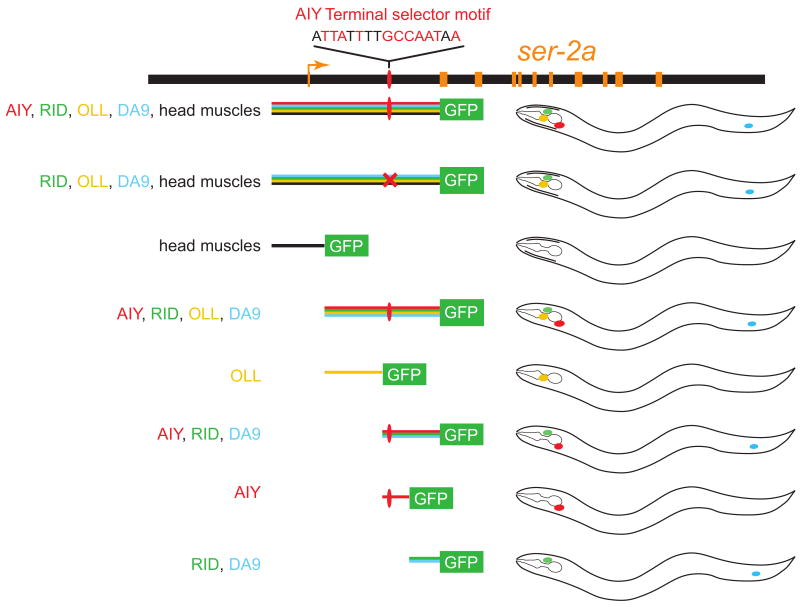
Analyzing of cis-regulatory control regions in transgenic animals
Fig.1
Fig.1. Common features of neurons
Schematic representations of three neuronal subtypes (spinal cord motor neuron, hippocampal pyramidal neuron and cerebellar Purkinje cell) with “generic” components of the pre- and postsynaptic apparatus highlighted. Proteins labeled in red are generally considered pan-neuronal (one argument, for example, being that they already are present in organisms that contain “proto-synapses”), while proteins in yellow are cell-type specific. For more details on these generic pre- and postsynaptic proteins, see [17, 19, 60-62] and Suppl. Table 1.
Fig.2
Fig.2. Terminal differentiation programs and the concept of combinatorial coding
The identity of a neuron is not determined by the expression of unique genes, but the specific combination of genes which themselves may be more broadly expressed. One example is shown here, yet there are many more examples from different invertebrate and vertebrate neuron types (e.g.[57]). Even with just the 5 genes shown (the sra-11 serpentine receptor, the secreted factors kal-1 and hen-1, the acetylcholine transporter unc-17 and the tyramine receptor ser-2), a theoretical diversity of 25 (= 32) cell specific batteries could be generated; yet, single neuron transcriptome studies have shown that even functionally related neurons express >1,000 genes in a differential manner [9]. Combinatorial coding is not just involved in defining specific terminal features of a neuron, but also brings about different transcription factor combinations in individual cell types. In the example shown, the two homeodomain proteins, TTX-3 and CEH-10, synergistically bind to a cis-regulatory element, the AIY motif (red circle), found in terminal differentiation genes that define the terminal identity of the AIY neuron type [23]. Note that individual genes, such as the G-protein coupled receptor-encoding (sra-11) gene shown here, are activated in other neuron types (e.g. the AIA neuron type and other neuronal cells) through separable regulatory elements (black and grey circles, respectively), which may constitute binding sites for other terminal selector genes. Other neurons types (egg. RID, CAN, ADL, AIZ, RMED, SIA and ASE) do not express the sra-11 gene. Components of the genetic signatures of individual neuron types are not restricted to the nervous system. In the example shown here, the ser-2 gene is also expressed in muscle cells. Adapted, with permission, from Ref. [63].
Fig.3
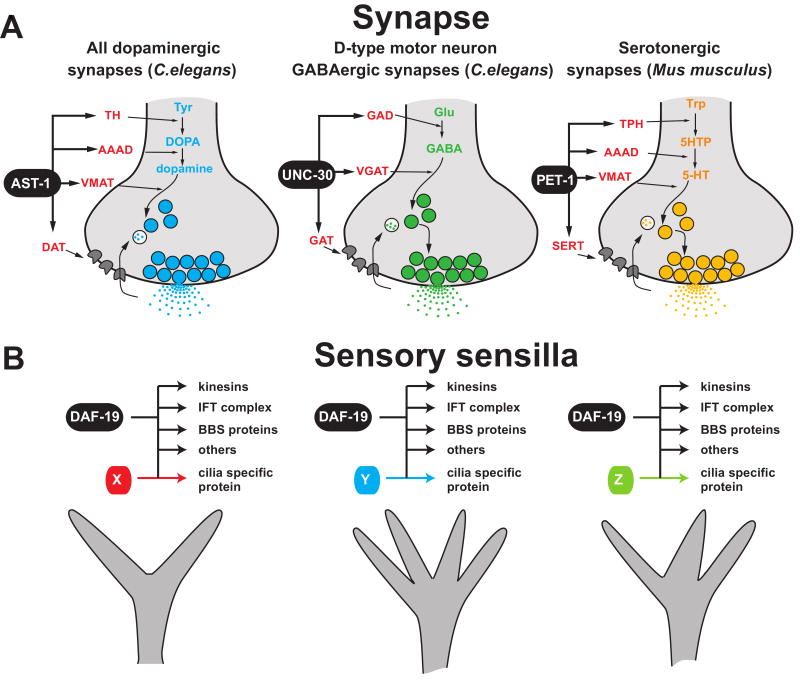
Fig.3. Neuronal subroutines are shared by many different neuron types
Two examples of group identities, shared by distinct neuron types are shown. These subroutines are controlled by a co-regulatory mechanism in which one transcription factor (or a combination of several transcription factors) control each individual feature. (A) Neurotransmitter identity is co-regulated. AST-1 (an ETS domain transcription factor) and UNC-30 (a homeodomain transcription factor) are examples of transcription factors that regulate the neurotransmitter synthesis machinery and uptake transporters in the presynaptic terminal of dopaminergic synapses and motor neuron GABAergic synapses of C.elegans, respectively [21, 22]. PET-1 (an ETS domain transcription factor) is an example of a transcription factor that controls the synthesis and reuptake machinery for serotonin (5-HT) in serotonergic synapses of mice [30]. Note that in the case of AST-1 and UNC-30, there are also other likely, as yet unknown specificity determinants of the neurotransmitter identity of these terminals, as those particular transcription factors are expressed more broadly than in just dopaminergic and GABAergic neurons, respectively. (B) Ciliated features of sensory neurons are co-regulated. Core features of cilia, such as kinesin motor proteins, the intraflagellar transport (IFT) complex, Bardet-Biedl syndrome (BBS) proteins, and cilia specific proteins, are regulated in all types of different ciliated sensory neurons by the phylogenetically conserved, RFX-type transcription factor, DAF-19 [34]. Sensory neuron-specific variations in ciliated structure are controlled by other transcription factors working possibly in combination with DAF-19.
Fig.4
Fig.4. Regulons and the terminal selector concept
(A) Bacterial regulons are constituted by functionally related “effector genes” that bacteria use to respond to specific stimuli [10]. The “effectors” within a regulon are controlled by “global regulators”, i.e. transcription factors that activate (or sometimes repress) the effector genes. As an example, the structure of the regulon involved in nitrogen metabolism in the soil microbe Bacillus subtilis, is shown (not all targets of the TnrA transcription factor are shown; also note that effector genes are usually organized into operons, as shown here) [14, 64, 65]. (B) Key features of the structure of a bacterial regulon are preserved in terminal selector genes of postmitotic neurons. Functionally related genes, i.e., the terminal gene battery of a neuron (analogous to the “effector” genes in bacteria), are co-regulated through shared cis-regulatory motifs and a common cognate transcription factor. Note that terminal selectors need not be single proteins, but combinations of transcription factors that may act together; for example TTX-3 and CEH-10, as shown in Figure 2). The architecture of gene regulation through terminal selectors encompass specific network motifs which are prominently found in many distinct systems (e.g. “autoregulatory loops”, “feedforward motifs” and “single input motifs”) [26]. Autoregulation is a feature shared by many transcription factors with a role in development [66]. Feedforward loops (composed of a terminal selector, a transcription factor (TF) target and a terminal target gene) have been characterized in terminal differentiation programs of C.elegans gustatory neurons and interneurons [27, 67, 68], postmitotic Drosophila neurons [44] as well as mammalian photoreceptors [45] and may endow gene regulation with specific kinetic properties [29]. For example, the terminal selector CHE-1 directly activates ceh-36, a homeobox gene. Both CHE-1 and CEH-36 then bind to the cis-regulatory region of the gcy-7 gene, which encodes a putative chemoreceptor [68]. Other TFs that are targets of terminal selectors may act alone to regulate the expression of small regulatory subroutine [9]. (C) Regulatory states of cells are defined by overlapping sets of genes. Gene expression programs in distinct neuronal cell types, or in bacterial cells under specific conditions, may operate by similar principles in the sense that (i) cell/ environmental state-defining genes are co-regulated and (ii) some of the genes may be shared by distinct cell types/ environmental states. Note that the some effector genes [e.g., X5 and X6, which are shared by several regulatory states (or cell types)], contain two binding sites for their upstream regulators in their cis-regulatory control region (as shown schematically also in Figure 2 for the sra-11 gene).
Fig.5
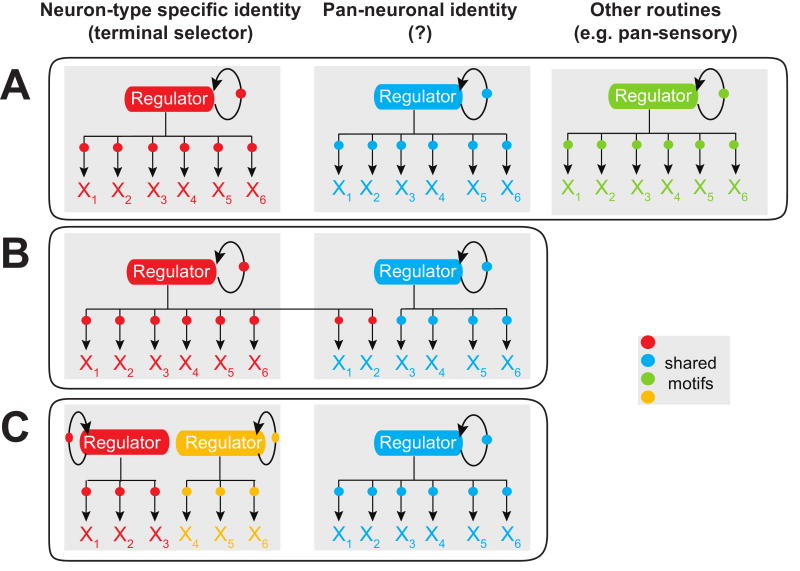
Fig.5. The abundance of regulons - a hypothesis
Terminal gene batteries of a neuron type may be characterized by a series of parallel acting regulons. The number and composition of regulons may differ in distinct neuron types, as illustrated in the examples shown in A-C. Circles indicate shared cis-regulatory motifs. (A) In the case of the ASE gustatory neurons, an extensively characterized C. elegans neuron type, a clear separation between the individual regulatory routines can be observed [9]. A terminal selector, the CHE-1 zinc finger transcription factor, appears to regulate neuron-identity defining features of ASE (see also Figure 4B), but not its pan-neuronal features (which are regulated by as yet unknown means), nor its pan-sensory features (which are regulated by the RFX-type transcription factor DAF-19, see Figure 3B). (B). In other neuron types, the separation between regulatory programs may be less tight in that pan-neuronal features may be controlled by regulators that control neuron-identity features (e.g. C.elegans UNC-86/MEC-3 regulating SNAP-25 [41]). (C) In some neurons, there may not be one selector gene for all identity features, but several ones (e.g. indicated as red and yellow gene differentiation programs) that regulate each distinct part of the neuron's specific identity. This notion is also supported by recent weighted gene co-expression network analysis in complex nervous systems, which revealed the existence of various distinct, co-regulated subroutines of gene expression programs that define individual aspects of a neuronal identity [15]. In addition to “hard-wired” regulatory programs that reproducibly and invariably define individual neuron types, neurons of course also respond to specific stimuli by adapting and changing gene expression programs, and these stimulus-dependent gene expression programs are also likely to be organized into regulons, with one example being the cAMP-regulated CREB regulon [69].

References

    1. Lopez-Munoz F, Boya J, Alamo C. Neuron theory, the cornerstone of neuroscience, on the centenary of the Nobel Prize award to Santiago Ramon y Cajal. Brain Res Bull. 2006;70:391–405. - PubMed
    1. Waldeyer W. Ueber einige neuere Forschungen im Gebiete der Anatomie des Centralnervensystems. Deutsche Medicinische Wochenschrift. 1891;50:1352–1356.
    1. Garcia-Bellido A. Genetic control of wing disc development in Drosophila. Ciba Found Symp. 1975;29:161–182. - PubMed
    1. Mann RS, Carroll SB. Molecular mechanisms of selector gene function and evolution. Curr Opin Genet Dev. 2002;12:592–600. - PubMed
    1. Tansey EM. Not committing barbarisms: Sherrington and the synapse, 1897. Brain Res Bull. 1997;44:211–212. - PubMed

Publication types