Review
. 2010 Oct;21(10):610-8.
doi: 10.1016/j.tem.2010.06.007. Epub 2010 Jul 19.

The proliferating role of insulin and insulin-like growth factors in cancer

Affiliations
Review

The proliferating role of insulin and insulin-like growth factors in cancer

Emily Jane Gallagher et al. Trends Endocrinol Metab. 2010 Oct.

Abstract

Epidemiological studies have reported an increased risk of cancer in people with type 2 diabetes (T2DM) and obesity, related in part to hyperinsulinemia, secondary to insulin resistance. Hyperinsulinemia leads to increased expression of insulin-like growth factor (IGF)-I expression. In fact, increased insulin, IGF-I and IGF-II levels are associated with tumor growth in vitro, in animal models, and in epidemiological studies in humans. In this paper, we discuss the roles of insulin, IGF-I and IGF-II, their interaction with the insulin receptor (IR) and IGF-I receptor (IGF-IR), and their signaling pathways and regulation as these pertain to tumor growth. We explain how these pathways have been deciphered by in vitro and in vivo studies, and how they are being exploited in the development of targeted cancer therapies.


Figures

Figure 1
Figure 1
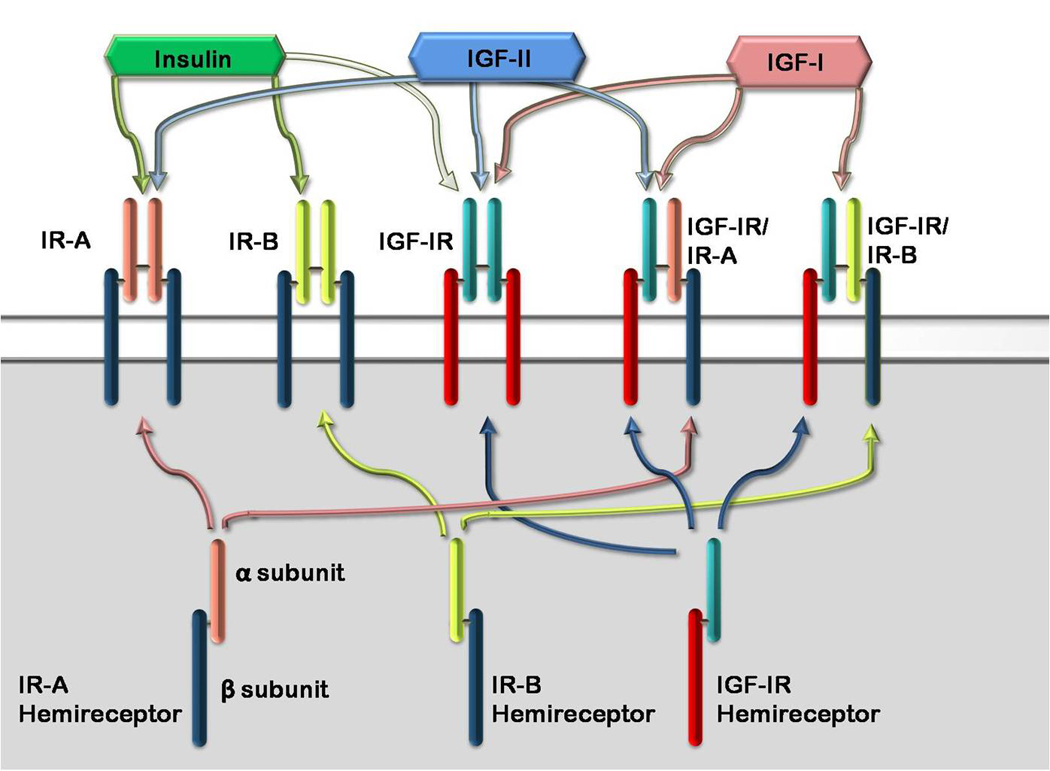
Insulin Receptor, IGF-IR and Hybrid Receptors. Insulin binds with greatest affinity to the insulin receptors (IR-A and IR-B). IR-A and IR-B are splice variants of the IR, with IR-A lacking exon 11. Insulin has low affinity for the IGF-IR. Each ‘hemireceptor’ made up of one α and one β subunit of the IR-A, IR-B or IGF-IR can form a hybrid with another hemireceptor, forming a hybrid receptor. IGF-I binds to the IGF-IR, and the IGF-IR/IR-A and IGF-IR/IR-B hybrid receptors. IGF-II can bind with the IGF-IR, IR-A and IGF-IR/IR-A hybrid receptor. Insulin does not bind with the hybrid receptors.
Figure 2
Figure 2
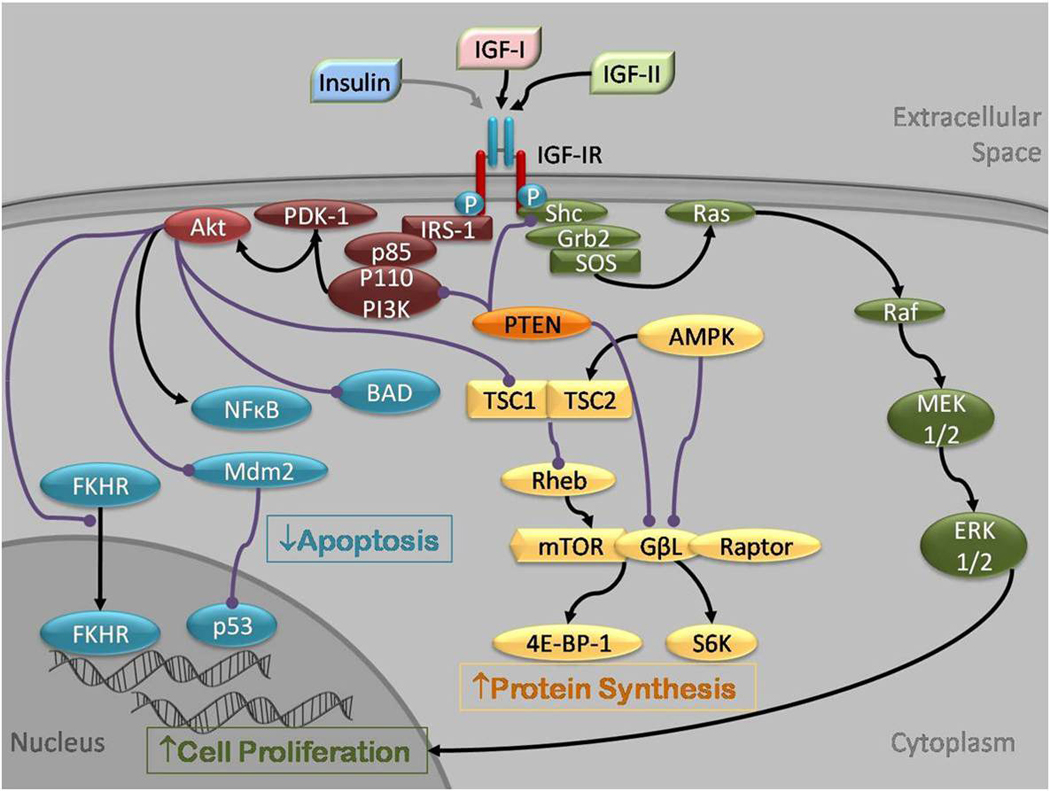
Insulin, IGF-I and IGF-II signaling through the IGF-IR. IGF-I, IGF-II and, to a lesser extent insulin, bind IGF-IR at the α subunit, leading to autophosphorylation of β subunit residues, which then act as docking sites for the insulin receptor substrates (IRS)1–4 and other signaling proteins, such as Shc, phospholipase C γ1 (PLCγ1) and Gab1. IRS-1 recruits the p85 regulatory subunit of phosphatidylinositol 3-kinase (PI3K) which through the catalytic effects of its p110 subunit, phosphorylates to activate protein kinase B (Akt), S6 kinase (S6K) and the mitogen activated protein kinase/ extracellular signal regulated kinase (MAP/ERK) pathway. Akt is recruited to the cell membrane and is phosphorylated by phosphoinositide-dependent protein kinase (PDK)-1. Activated Akt has many substrates, including the forkhead transcription factors (FKHR), Mouse double minute 2 (Mdm2), Bcl2-antagonist of cell death (BAD), NFκB and p53. These factors are chiefly involved in the regulation of apoptosis. Akt also regulates protein synthesis by phosphorylating tuberous sclerosis protein (TSC2), releasing its inhibition of Rheb to activate the mammalian target of rapamycin (mTOR). mTOR targets S6 kinase (S6K) and eukaryotic initiation factor 4E binding protein-1 (4E-BP-1). The phosphorylation of IRS-1 and Shc can also lead to recruitment of growth factor receptor bound protein 2 (Grb2), Son of Sevenless (SOS) and Ras, with subsequent activation of Raf-1, MEK1/2 (MAP/ERK kinase 1/2) and ERK 1/2 by phosphorylation. Activation of this pathway leads to cell proliferation. The tumor suppressor gene PTEN inhibits mTOR, PI3K and Shc. AMPK also inhibits mTOR, by activating the TSC1/2 complex in addition to directly inhibiting mTOR.
Figure 3
Figure 3
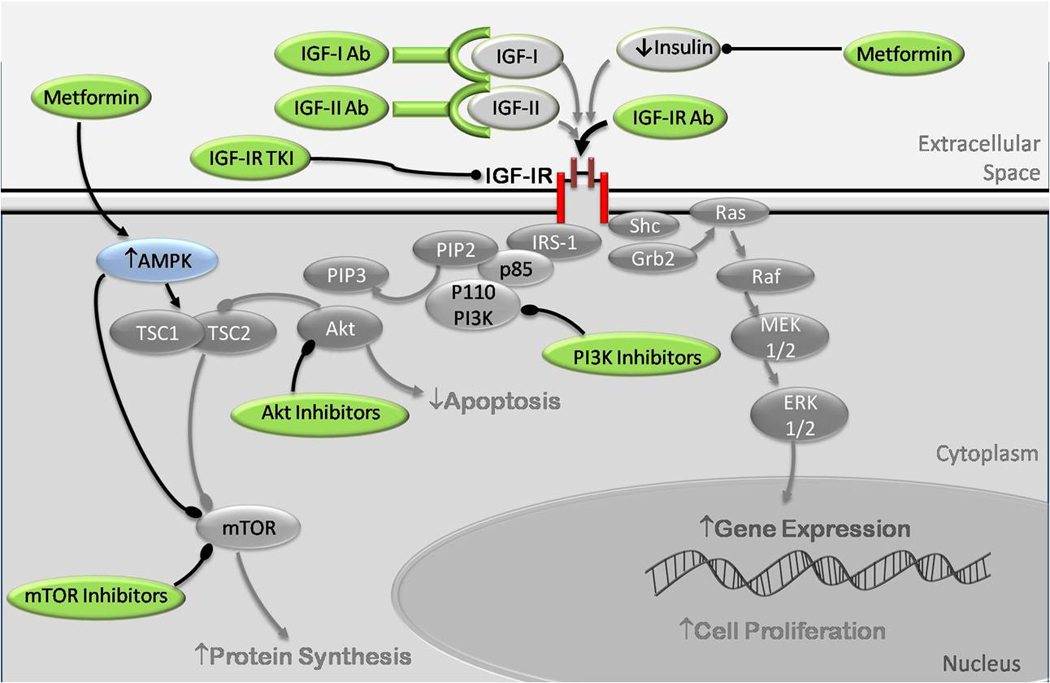
Anti-Cancer therapy targeting the insulin, IGF-I and IGF-II signaling. Monoclonal antibodies (Ab) have been developed to target IGF-I and IGF-II, preventing their interaction with the IR and IGF-IR. Antibodies have also been developed that bind to the IGF-IR, preventing binding of insulin, IGF-I or IGF-II. Tyrosine kinase inhibitors (TKI) bind to the IGF-IR and prevent phosphorylation and activation of the receptor. These TKI may also cross react with the IR. Inhibitors of PI3K, Akt and mTOR have also been developed that inhibit downstream signaling. Metformin acts in two ways. Firstly it decreases hepatic gluconeogenesis, thus decreasing circulating insulin levels. Secondly, it is an activator of AMP kinase (AMPK), resulting in inhibition of mTOR by direct phosphorylation and also by activation of the TSC1/TSC2 complex, leading to decreased protein synthesis.

References

    1. Vigneri P, et al. Diabetes and cancer. Endocr Relat Cancer. 2009;16(4):1103–1123. - PubMed
    1. Calle EE, et al. Overweight, Obesity, and Mortality from Cancer in a Prospectively Studied Cohort of U.S. Adults. N Engl J Med. 2003;348(17):1625–1638. - PubMed
    1. Flegal KM, et al. Prevalence and Trends in Obesity Among US Adults, 1999–2008. JAMA. 2010;303(3):235–241. - PubMed
    1. Hemkens L, et al. Risk of malignancies in patients with diabetes treated with human insulin or insulin analogues: a cohort study. Diabetologia. 2009;52(9):1732–1744. - PMC - PubMed
    1. Currie C, Poole C, Gale E. The influence of glucose-lowering therapies on cancer risk in type 2 diabetes. Diabetologia. 2009;52(9):1766–1777. - PubMed

MeSH terms