


Complex hyperplasia with and without atypia: clinical outcomes and implications of progestin therapy
- PMID: 20664397
- PMCID: PMC2949551
- DOI: 10.1097/AOG.0b013e3181e93330
Complex hyperplasia with and without atypia: clinical outcomes and implications of progestin therapy
Abstract
Objective: Limited data exist to inform clinicians and patients as to the likelihood of long-term endometrial hyperplasia response to progestin therapy, especially for atypical hyperplasia. We evaluated women with complex and atypical endometrial hyperplasia, comparing those prescribed progestin with those not prescribed progestin.
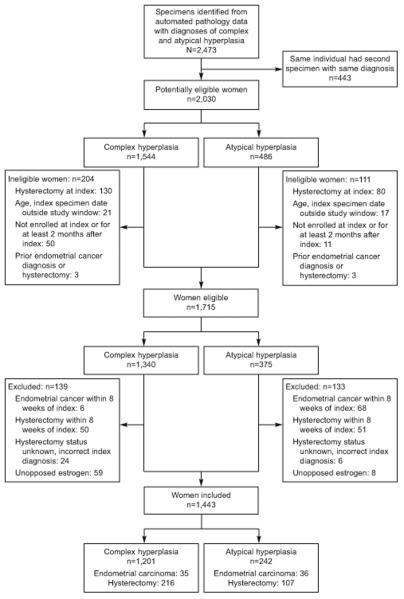
Methods: This retrospective cohort study was conducted in 1985-2005 among women aged 18-88 years at an integrated health plan in Washington State. Women were ineligible if they achieved an outcome (endometrial carcinoma, hysterectomy, or both) within 8 weeks of hyperplasia diagnosis. Exposure was progestin use for at least 14 days by duration and recency. Outcomes included rate of 1) endometrial carcinoma, 2) hysterectomy, or 3) both. Analyses performed included Kaplan-Meier, incident rate ratios, and Cox proportional hazard ratios.
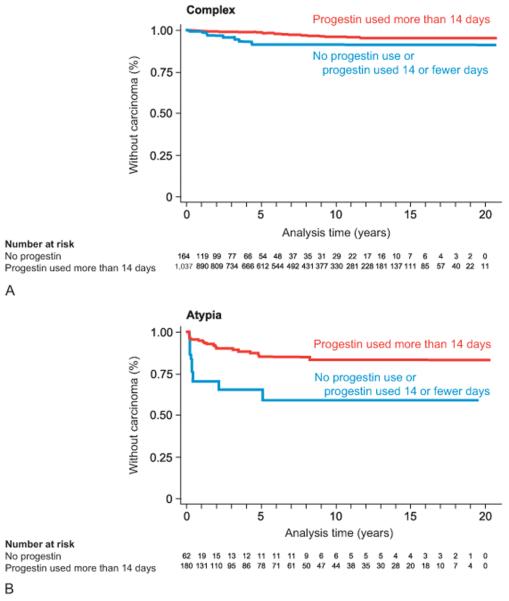
Results: One thousand four hundred forty-three eligible women were identified. One thousand two hundred one had complex (n=164 no progestin) and 242 had atypical (n=62 no progestin) hyperplasia. During follow-up, a median of 5.3 years (range 8 weeks to 20.8 years), 71 women were diagnosed with endometrial carcinoma (35 complex, 36 atypia) and 323 underwent hysterectomy (216 complex, 107 atypia). Among women with complex and atypical hyperplasia, rates of endometrial carcinoma among progestin users were 3.6 and 20.5 per 1,000 woman-years, respectively (compared with women who did not use progestin, 10.8 and 101.4). Among women with complex and atypical hyperplasia, rates of hysterectomy among progestin users were 23.3 and 61.4 per 1,000 woman-years, respectively (compared with women who did not use progestin, 55.1 and 297.3).
Conclusion: Endometrial carcinoma risk is diminished approximately threefold to fivefold in women diagnosed with complex or atypical endometrial hyperplasia and dispensed progestin; hysterectomy risk is also decreased.
Level of evidence: II.
Figures
References
-
- Kurman RJ, Kaminski PF, Norris HJ. The behavior of endometrial hyperplasia. A long-term study of “untreated” hyperplasia in 170 patients. Cancer. 1985;56:403–12. - PubMed
-
- Ferenczy A, Gelfand M. The biologic significance of cytologic atypia in progestogen-treated endometrial hyperplasia. Am J Obstet Gynecol. 1989;160:126–31. - PubMed
-
- Tavassoli FA, Devilee P. Pathology and Genetics: Tumours of the Breast and Female Genital Organs. IARC Press; Lyon, France: 2003.
Publication types
MeSH terms
Substances
Grants and funding
LinkOut - more resources
Full Text Sources
Research Materials
