


Community-level spatial heterogeneity of chemical constituent levels of fine particulates and implications for epidemiological research
- PMID: 20664652
- PMCID: PMC3176331
- DOI: 10.1038/jes.2010.24
Community-level spatial heterogeneity of chemical constituent levels of fine particulates and implications for epidemiological research
Abstract
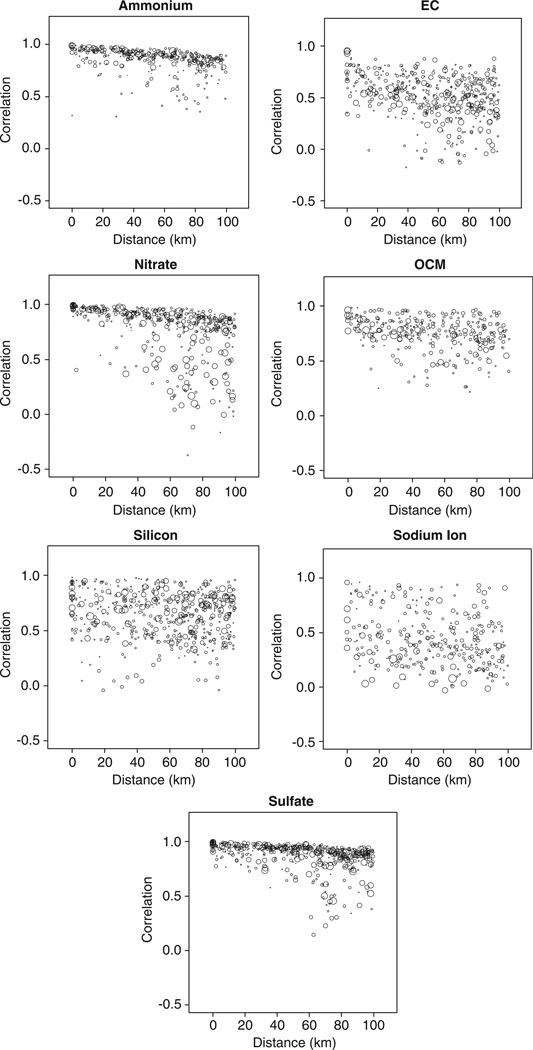
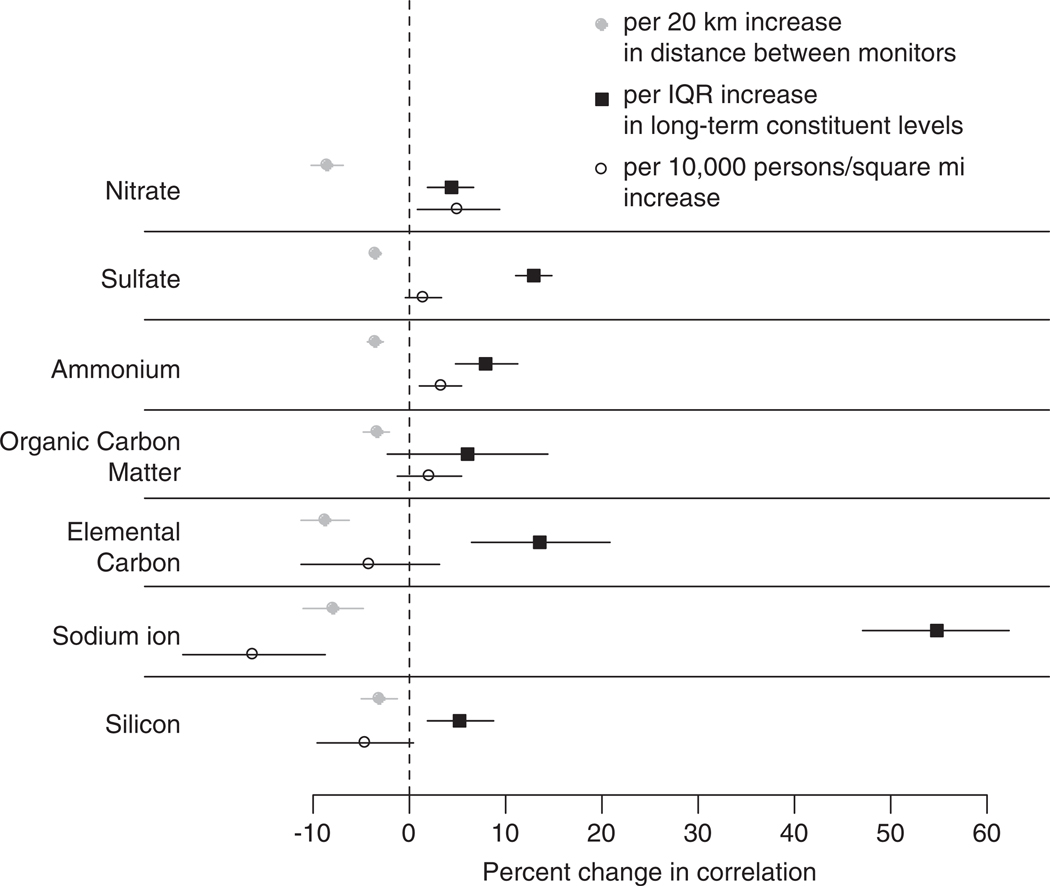
Studies of the health impacts of airborne particulates' chemical constituents typically assume spatial homogeneity and estimate exposure from ambient monitors. However, factors such as local sources may cause spatially heterogeneous pollution levels. This work examines the degree to which constituent levels vary within communities and whether exposure misclassification is introduced by spatial homogeneity assumptions. Analysis considered PM(2.5) elemental carbon (EC), organic carbon matter, ammonium, sulfate, nitrate, silicon, and sodium ion (Na(+)) for the United States, 1999-2007. Pearson correlations and coefficients of divergence were calculated and compared to distances among monitors. Linear modeling related correlations to distance between monitors, long-term constituent levels, and population density. Spatial heterogeneity was present for all constituents, yet lower for ammonium, sulfate, and nitrate. Lower correlations were associated with higher distance between monitors, especially for nitrate and sulfate, and with lower long-term levels, especially for sulfate and Na(+). Analysis of colocated monitors revealed measurement error for all constituents, especially EC and Na(+). Exposure misclassification may be introduced into epidemiological studies of PM(2.5) constituents due to spatial variability, and is affected by constituent type and level. When assessing health effects of PM constituents, new methods are needed for estimating exposure and accounting for exposure error induced by spatial variability.
Conflict of interest statement
The authors declare no conflict of interest.
Figures
References
-
- Athanassiadis GA, Rao ST. Spatial and temporal variations in the trace elemental data over the northeastern United States. Environ Poll. 2003;123 439-339. - PubMed
Publication types
MeSH terms
Substances
Grants and funding
LinkOut - more resources
Full Text Sources
Medical
