


Energy expenditure in Japanese patients with severe or moderate ulcerative colitis
- PMID: 20664728
- PMCID: PMC2901761
- DOI: 10.3164/jcbn.10-07
Energy expenditure in Japanese patients with severe or moderate ulcerative colitis
Abstract
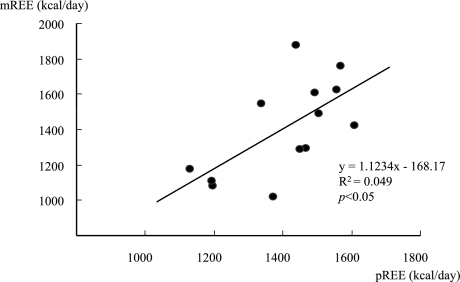
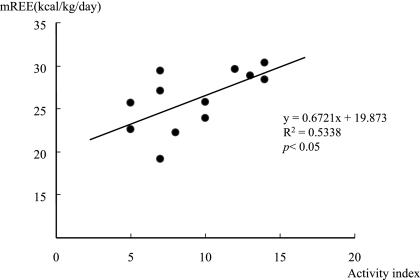
We investigated the energy expenditure in hospitalized patients with severe or moderate ulcerative colitis (UC), and compared them to healthy controls. Thirteen patients (5 women and 8 men; mean age 31.8 years; mean BMI 19.0 kg/m(2)) and 10 healthy volunteers were enrolled in this study. The resting energy expenditure (mREE) levels were determined by indirect calorimetry. The mREEs of the UC patients were significantly higher than those of healthy controls (26.4 +/- 3.6 vs 21.8 +/- 1.7 kcal/kg/day), although the mREEs of the UC patients were almost the same as the predicted REEs (pREEs) calculated by the Harris-Benedict equation (26.4 +/- 2.4 kcal/kg/day vs 26.5 +/- 2.6 kcal/kg/day). The mREE/pREE ratio, which reflects stress, was 1.0 +/- 0.15. In the UC patients, a significant correlation was observed between the mREEs and the clinical activity index. In conclusion, UC patients showed a hyper-metabolic status as evaluated by their mREE/body weight. Energy expenditure was significantly correlated with disease activity. From our observations, we recommend that nutritional management with more than 30-35 kcal/ideal body weight/day (calculated by the mREE x activity factor) may be optimal for active severe or moderate ulcerative colitis.
Keywords: indirect calorimetry; resting energy expenditure; ulcerative colitis.
Figures
References
-
- Baumgart D.C., Sandborn W.J. Inflammatory bowel disease: clinical aspects and established and evolving therapies. Lancet. 2007;369:1641–1657. - PubMed
-
- Baumgart D.C., Carding S.R. Inflammatory bowel disease: cause and immunobiology. Lancet. 2007;369:1627–1640. - PubMed
-
- Han P.D., Burke A., Baldassano R.N., Rombeau J.L., Lichtenstein G.R. Nutrition and inflammatory bowel disease. Gatroenterol. Clin. North Am. 1999;28:423–443. - PubMed
-
- Hrabovský V., Zadák Z., Bláha V., Hyspler R., Karlík T., Martínek A., Mendlová A. Cholesterol metabolism in active Crohn’s disease. Wien. Klin. Wochenschr. 2009;121:270–275. - PubMed
-
- Barot L.R., Rombeau J.L., Steinberg J.J., Crosby L.O., Feurer I.D., Mullen J.L. Energy expenditure in patients with inflammatory bowel disease. Ann. Surg. 1981;116:460–462. - PubMed
