


Within-Cluster Resampling for Analysis of Family Data: Ready for Prime-Time?
- PMID: 20664749
- PMCID: PMC2907179
- DOI: 10.4310/sii.2010.v3.n2.a4
Within-Cluster Resampling for Analysis of Family Data: Ready for Prime-Time?
Abstract
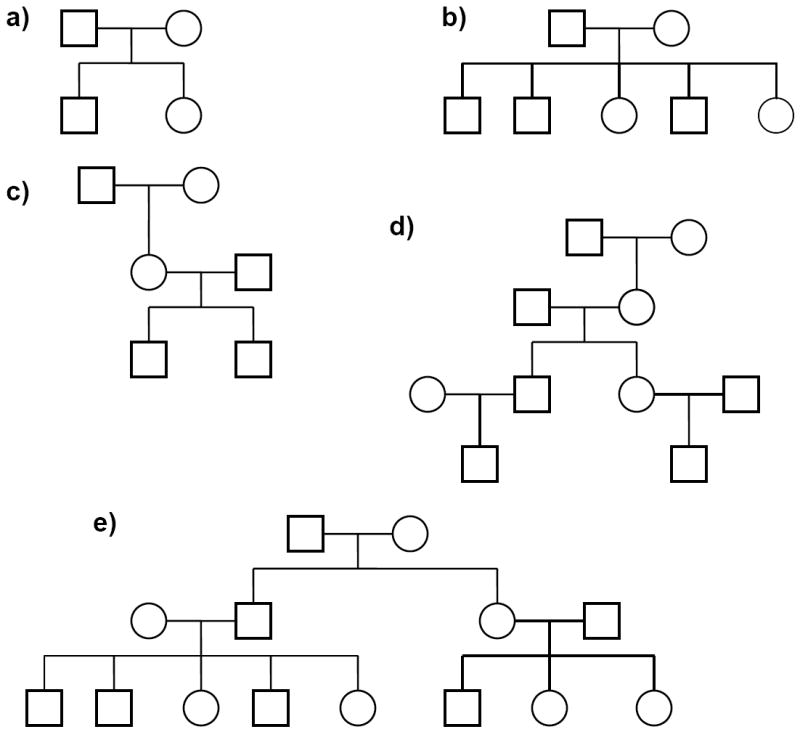
Hoffman et al. [1] proposed an elegant resampling method for analyzing clustered binary data. The focus of their paper was to perform association tests on clustered binary data using within-cluster-resampling (WCR) method. Follmann et al. [2] extended Hoffman et al.'s procedure more generally with applicability to angular data, combining of p-values, testing of vectors of parameters, and Bayesian inference. Follmann et al. [2] termed their procedure multiple outputation because all "excess" data within each cluster is thrown out multiple times. Herein, we refer to this procedure as WCR-MO. For any statistical test to be useful for a particular design, it must be robust, have adequate power, and be easy to implement and flexible. WCR-MO can be easily extended to continuous data and is a computationally intensive but simple and highly flexible method. Considering family as a cluster, one can apply WCR to familial data in genetic studies. Using simulations, we evaluated WCR-MO's robustness for analysis of a continuous trait in terms of type I error rates in genetic research. WCR-MO performed well at the 5% α-level. However, it provided inflated type I error rates for α-levels less than 5% implying the procedure is liberal and may not be ready for application to genetic studies where α levels used are typically much less than 0.05.
Figures

References
-
- Hoffman EB, Sen PK, Weinberg C. Within-cluster resampling. Biometrika. 2001;88:1121–1134.
-
- Follmann D, Proschan M, Leifer E. Multiple outputation: Inference for complex clustered data by averaging analyses from independent data. Biometrics. 2003;59(2):420–9. - PubMed
-
- Meester SG, MacKay J. A parametric model for cluster correlated categorical data. Biometrics. 1994;50(4):954–63. - PubMed
-
- Rieger RH, Weinberg CR. Analysis of clustered binary outcomes using within-cluster paired resampling. Biometrics. 2002;58(2):332–41. - PubMed
-
- Hanley JA, Negassa A, Edwardes MD, Forrester JE. Statistical analysis of correlated data using generalized estimating equations: an orientation. Am J Epidemiol. 2003;157(4):364–75. - PubMed
Grants and funding
LinkOut - more resources
Full Text Sources
Miscellaneous