Chondro/osteoblastic and cardiovascular gene modulation in human artery smooth muscle cells that calcify in the presence of phosphate and calcitriol or paricalcitol
- PMID: 20665672
- PMCID: PMC3470918
- DOI: 10.1002/jcb.22779
Chondro/osteoblastic and cardiovascular gene modulation in human artery smooth muscle cells that calcify in the presence of phosphate and calcitriol or paricalcitol
Abstract
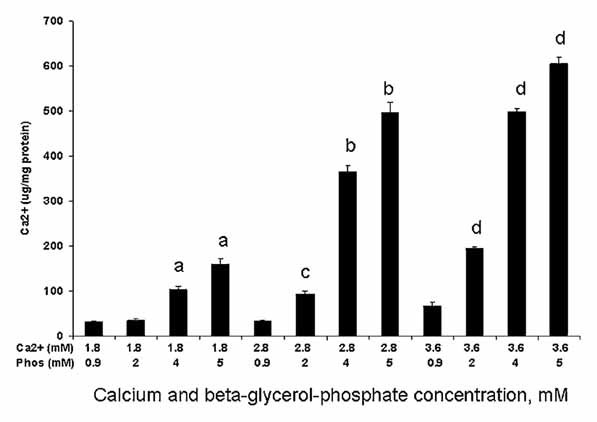
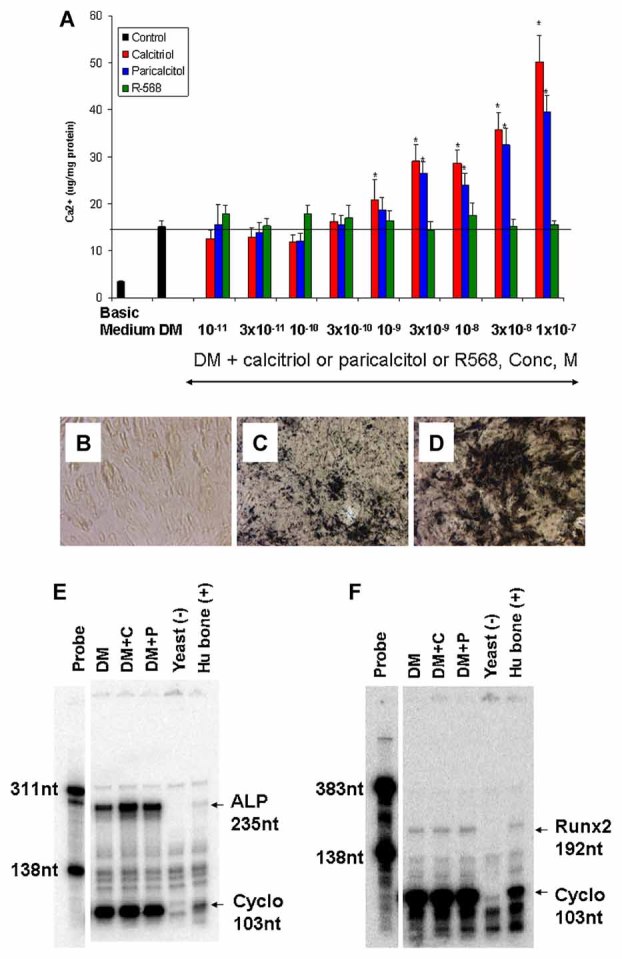
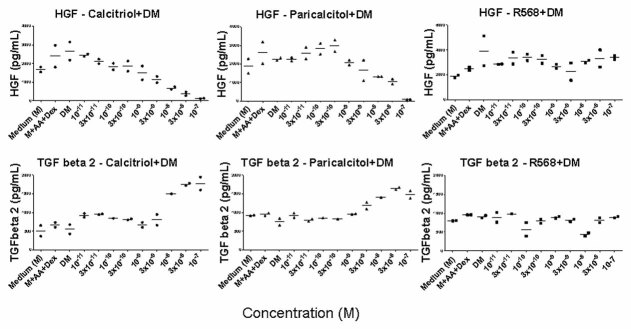
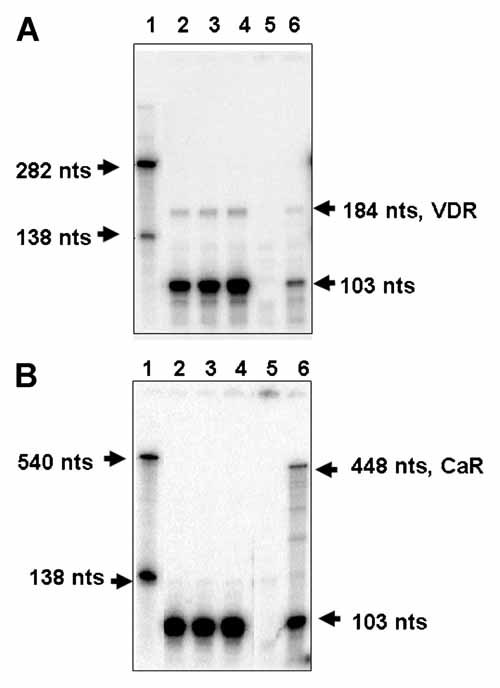
Vitamin D sterol administration, a traditional treatment for secondary hyperparathyroidism, may increase serum calcium and phosphorus, and has been associated with increased vascular calcification (VC). In vitro studies suggest that in the presence of uremic concentrations of phosphorus, vitamin D sterols regulate gene expression associated with trans-differentiation of smooth muscle cells (SMCs) to a chondro/osteoblastic cell type. This study examined effects of vitamin D sterols on gene expression profiles associated with phosphate-enhanced human coronary artery SMC (CASMC) calcification. Cultured CASMCs were exposed to phosphate-containing differentiation medium (DM) with and without calcitriol, paricalcitol, or the calcimimetic R-568 (10(-11)-10(-7) M) for 7 days. Calcification of CASMCs, determined using colorimetry following acid extraction, was dose dependently increased (1.6- to 1.9-fold) by vitamin D sterols + DM. In contrast, R-568 did not increase calcification. Microarray analysis demonstrated that, compared with DM, calcitriol (10(-8) M) + DM or paricalcitol (10(-8) M) + DM similarly and significantly (P < 0.05) regulated genes of various pathways including: metabolism, CYP24A1; mineralization, ENPP1; apoptosis, GIP3; osteo/chondrogenesis, OPG, TGFB2, Dkk1, BMP4, BMP6; cardiovascular, HGF, DSP1, TNC; cell cycle, MAPK13; and ion channels, SLC22A3 KCNK3. R-568 had no effect on CASMC gene expression. Thus, SMC calcification observed in response to vitamin D sterol + DM may be partially mediated through targeting mineralization, apoptotic, osteo/chondrocytic, and cardiovascular pathway genes, although some gene changes may protect against calcification. Further studies to determine precise roles of these genes in development of, or protection against VC and cardiovascular disease are required.
© 2010 Wiley-Liss, Inc.
Figures
References
-
- Alam MU, Kirton JP, Wilkinson FL, Towers E, Sinha S, Rouhi M, Vizard TN, Sage AP, Martin D, Ward DT, Alexander MY, Riccardi D, Canfield AE. Calcification is associated with loss of functional calcium-sensing receptor in vascular smooth muscle cells. Cardiovasc Res. 2009;81:260–268. - PubMed
-
- Blacher J, Guerin AP, Pannier B, Marchais SJ, London GM. Arterial calcifications, arterial stiffness, and cardiovascular risk in end-stage renal disease. Hypertension. 2001;38:938–942. - PubMed
-
- Block GA, Martin KJ, de Francisco AL, Turner SA, Avram MM, Suranyi MG, Hercz G, Cunningham J, Abu-Alfa AK, Messa P, Coyne DW, Locatelli F, Cohen RM, Evenepoel P, Moe SM, Fournier A, Braun J, McCary LC, Zani VJ, Olson KA, Drueke TB, Goodman WG. Cinacalcet for secondary hyperparathyroidism in patients receiving hemodialysis. N Engl J Med. 2004;350:1516–1525. - PubMed
-
- Cardus A, Panizo S, Parisi E, Fernandez E, Valdivielso JM. Differential effects of vitamin D analogs on vascular calcification. J Bone Miner Res. 2007;22:860–866. - PubMed
Publication types
MeSH terms
Substances
LinkOut - more resources
Full Text Sources
Molecular Biology Databases
Miscellaneous