. 2010 Sep;28(9):1541-9.
doi: 10.1002/stem.489.

Transplanted oligodendrocytes and motoneuron progenitors generated from human embryonic stem cells promote locomotor recovery after spinal cord transection

Affiliations
Free PMC article

Transplanted oligodendrocytes and motoneuron progenitors generated from human embryonic stem cells promote locomotor recovery after spinal cord transection

Slaven Erceg et al. Stem Cells. 2010 Sep.
Free PMC article

Abstract

Human embryonic stem cells (hESC) hold great promise for the treatment of patients with many neurodegenerative diseases particularly those arising from cell loss or neural dysfunction including spinal cord injury. This study evaluates the therapeutic effects of transplanted hESC-derived oligodendrocyte progenitors (OPC) and/or motoneuron progenitors (MP) on axonal remyelination and functional recovery of adult rats after complete spinal cord transection. OPC and/or MP were grafted into the site of injury in the acute phase. Based on Basso-Beattie-Bresnahan scores recovery of locomotor function was significantly enhanced in rats treated with OPC and/or MP when compared with control animals. When transplanted into the spinal cord immediately after complete transection, OPC and MP survived, migrated, and differentiated into mature oligodendrocytes and neurons showing in vivo electrophysiological activity. Taken together, these results indicate that OPC and MP derived from hESC could be a useful therapeutic strategy to repair injured spinal cord.


Figures
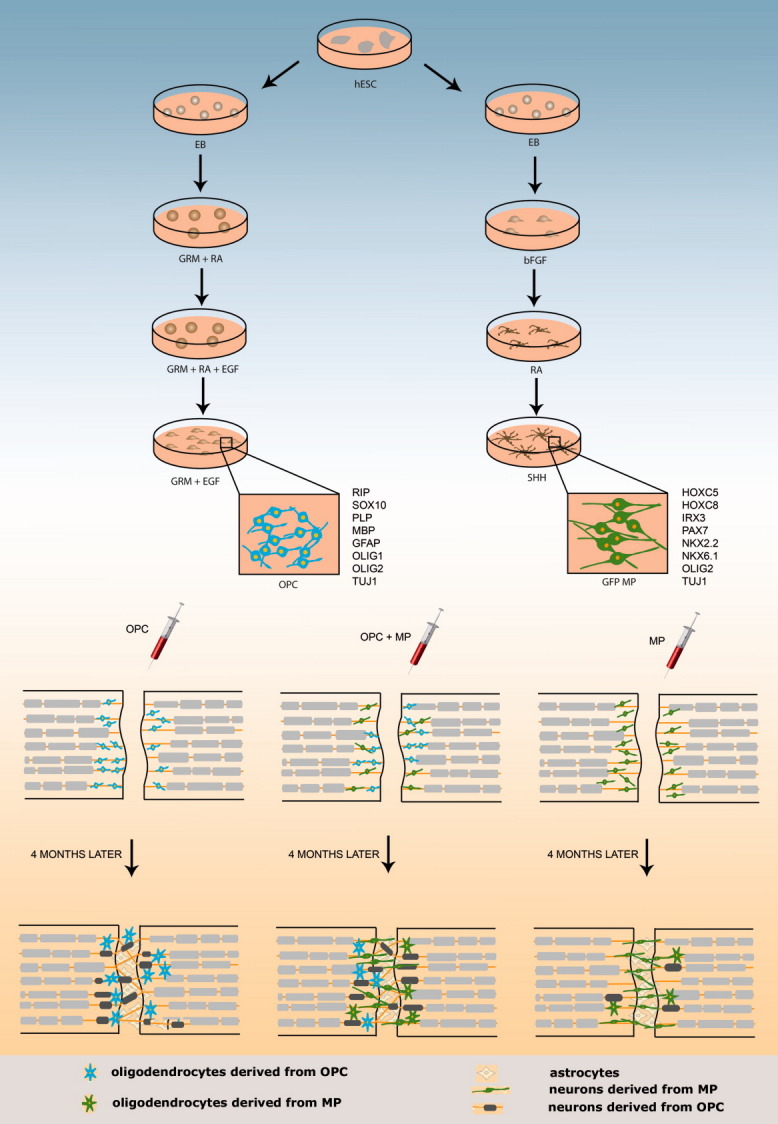
Figure 1
Figure 1
hESCs were differentiated toward OPC in hESC growth media and glial restriction media (GRM) supplemented with EGF and all-trans-RA. During 25 days, the EBs were exposed to GRM supplemented with EGF. Floating yellow spheres were plated for 1 week. Cell cultures were replated on Matrigel substrate, and cultured for 1 week in GRM supplemented with EGF. The duration of the protocol was 42 days. For transplantation, the cells were disaggregated mechanically using a glass pipette. For motoneuron differentiation, hESC were permanently transfected with a plasmid carrying GFP. Cell clumps were grown for an additional 4 days to form EBs. The EB were placed on a Matrigel substrate to attach in motor induction medium. From day 8, RA was added. At day 16 the rosettes were placed as round structure-neuromasses in MM consisting of neurobasal medium, N2 supplement, cyclic AMP (cAMP), RA, and SHH. The neuromasses were maintained in MM medium supplemented with SHH until the day of transplantation. Differentiated cells were characterized and ∼1.5 million cells were transplanted. Three different transplantation experiments were performed: The rats that were treated with a single-cell type (OPC or MP) or in combination (OPC + MP). Immunohistochemical evidence of cell incorporation in the LS, and electrophysiological and behavioral studies were performed after 4 months. Abbreviations: bFGF, basic fibroblast growth factor; EB, embryoid body; EGF, epidermal growth factor; GFAP, glial fibrillary acidic protein; GFP, green fluorescent protein; hESC, human embryonic stem cell; MBP, myelin basic protein; MP, motoneuron progenitor; OPC, oligodendrocyte progenitors; RA, retinoic acid; RIP, receptor interacting protein; SHH, sonic hedgehog.
Figure 2
Figure 2
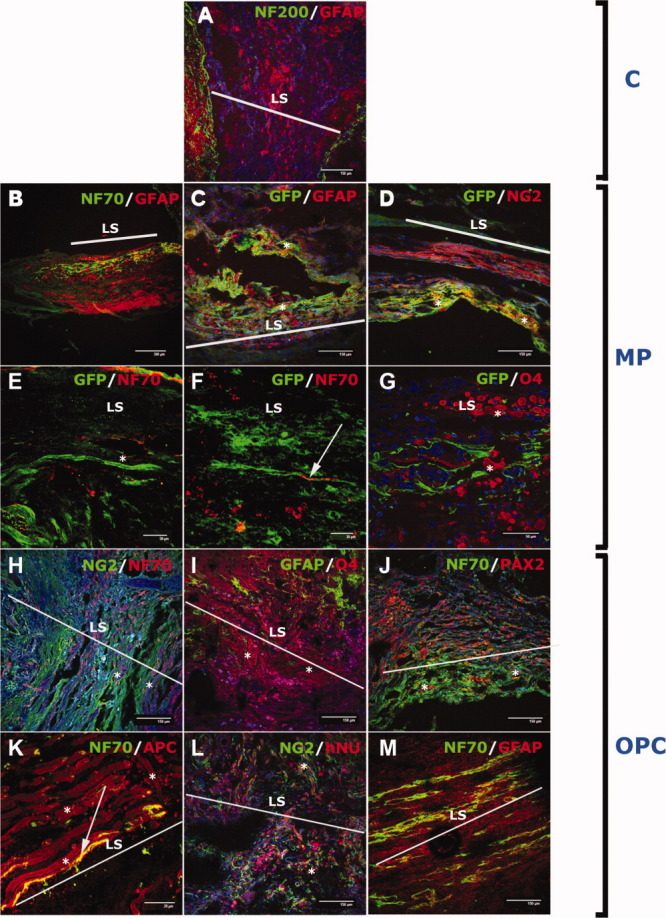
Acute transplantation of human embryonic stem cell-derived OPC or MP resulted in differentiation toward oligodendrocytes and neurons. (A): The neuronal fibers (NF200+) were stopped at host-scar interface in control (nontransplanted) animals. (B): Neuronal fibers positive for human-specific NF70+ (green) were detected in the lesion site surrounded with glial GFAP+ cells in MP-transplanted animals. In the lesion of the GFP-MP treated animals many GFP+ cells were double-labeled with glial GFAP (C) and oligodendrocyte (NG2) markers ([D], marked as “*”). Dual fates of the transplanted MP were confirmed with double labeling of the GFP (marked as “*”) and NF70 (red; arrow; [E] and [F]) surrounded by oligodendrocytes (G) (marked as “*”). In the lesion site of the OPC-transplanted animals, human-specific neurons were observed because the cells were positive for NF70 ([H]; marked as “*”). The majority of the cells in the lesion site were astrocytes, GFAP+ (green), and oligodendrocytes O4+ (red; [I]; marked as “*”). (J): Many cells were positive for the human-specific neuronal marker NF70 and interneuronal marker PAX2 (marked as “*”). (K): In the lesion site, we observed myelination of transplanted cells. The NF70+ fibers (marked as arrow) were surrounded with oligodendrocytes (APC+, marked as “*”). (L): The majority of the cells were oligodendrocytes and double-labeled with NG2 and hNU (marked as “*”). (M): Many NF+ fibers were localized only in the lesion site with GFAP+ cells. Observations: (B): Immunoflourescence was done with the spinal cord samples, where MP (without GFP) were injected. Abbreviations: APC, adematous polyposis coli; GFAP, glial fibrillary acidic protein; GFP, green fluorescent protein; LS, lesion site; MP, motoneuron progenitors; OPC, oligodendrocyte progenitors.
Figure 3
Figure 3
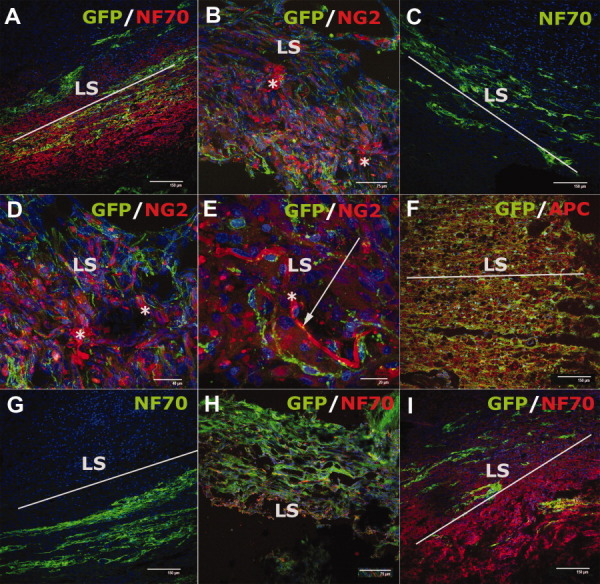
Acute transplantation of human embryonic stem cell-derived oligodendrocyte progenitors (OPC) and motoneuron progenitors (MP) resulted in differentiation toward oligodendrocytes and neurons. Many GFP+ cells were observed in the lesion site and colabeled with oligodendrocyte markers NG2 (A, B, C) and APC (D) (marked as “*”). We observed NG2+ (marked as “*”) cells surrounding GFP+ (arrow; [E]). Many NF70+ cells were observed in the lesion site often localized in bundles (G, H). All NF70+ cells were not GFP+ revealing that other human neurons proceed from OPC (E, F, I). Observations: (C, G): Immunoflourescence was done with the spinal cord samples, where MPs (without GFP) were injected. Abbreviations: APC, adematous polyposis coli; GFP, green fluorescent protein; LS, lesion site.
Figure 4
Figure 4
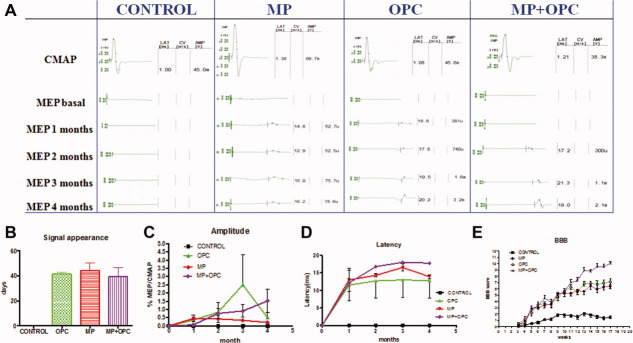
In vivo electrophysiology and BBB test. (A): Representative electrophysiological recordings in control and transplanted animals during 4 months of the experiments. (B): After ∼40 days, the electrophysiological signal appeared in the transplanted but not in the control animals. Plot graphics of the evolution of amplitude (C) and latency (D). (E): Starting 4 weeks after the transplantation, a significant increase (p < .001) in locomotor recovery as determined by the BBB locomotor rating scale was observed in all transplanted animals compared with controls. The values are presented as mean ± SEM. The statistic analysis of BBB score for each time point is presented in Supporting Information Table 1. Abbreviations: BBB, Basso-Beattie-Bresnahan locomotor rating scale; CMAP, compound motor action potential; MEP, motor-evoked potentials; MP, motoneuron progenitors; OPC, oligodendrocyte progenitors.

References

    1. Beattie MS, Li Q, Bresnahan JC. Cell death and plasticity after experimental spinal cord injury. Prog Brain Res. 2000;128:9–21. - PubMed
    1. Blight AR. Spinal cord injury models: Neurophysiology. J Neurotrauma. 1992;9:147–149. discussion 149–150. - PubMed
    1. Grossman SD, Rosenberg LJ, Wrathall JR. Relationship of altered glutamate receptor subunit mRNA expression to acute cell loss after spinal cord contusion. Exp Neurol. 2001;168:283–289. - PubMed
    1. Deumens R, Koopmans GC, Jaken RJ, et al. Stimulation of neurite outgrowth on neonatal cerebral astrocytes is enhanced in the presence of BDNF. Neurosci Lett. 2006;407:268–273. - PubMed
    1. Dietz V, Curt A. Neurological aspects of spinal-cord repair: Promises and challenges. Lancet Neurol. 2006;5:688–694. - PubMed

Publication types

MeSH terms

Substances