Rapid association learning in the primate prefrontal cortex in the absence of behavioral reversals
- PMID: 20666598
- PMCID: PMC3260045
- DOI: 10.1162/jocn.2010.21555
Rapid association learning in the primate prefrontal cortex in the absence of behavioral reversals
Abstract
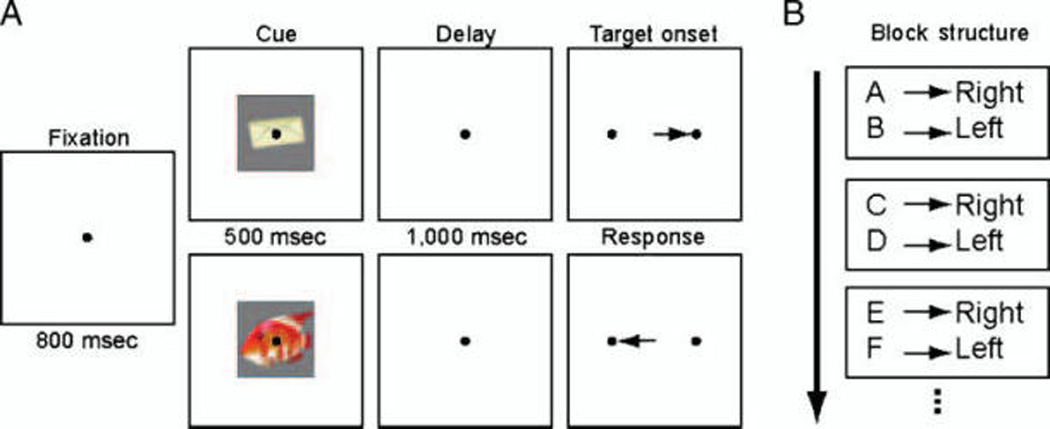
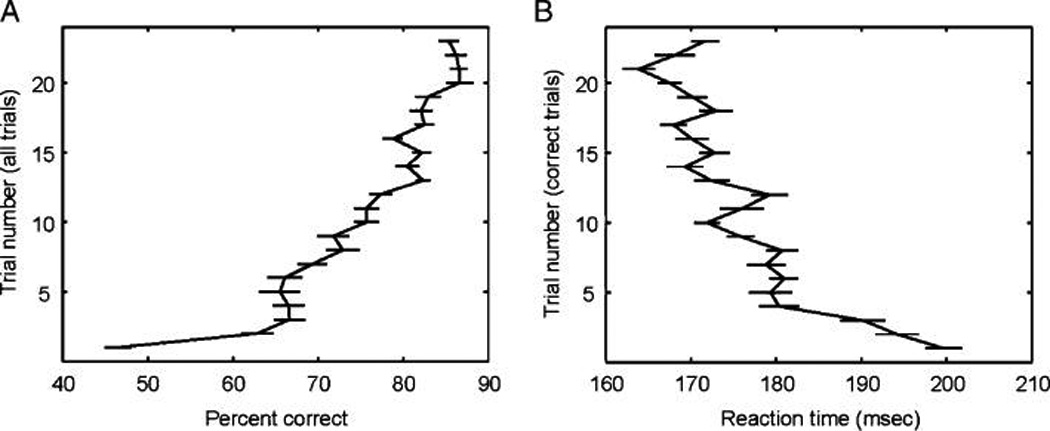
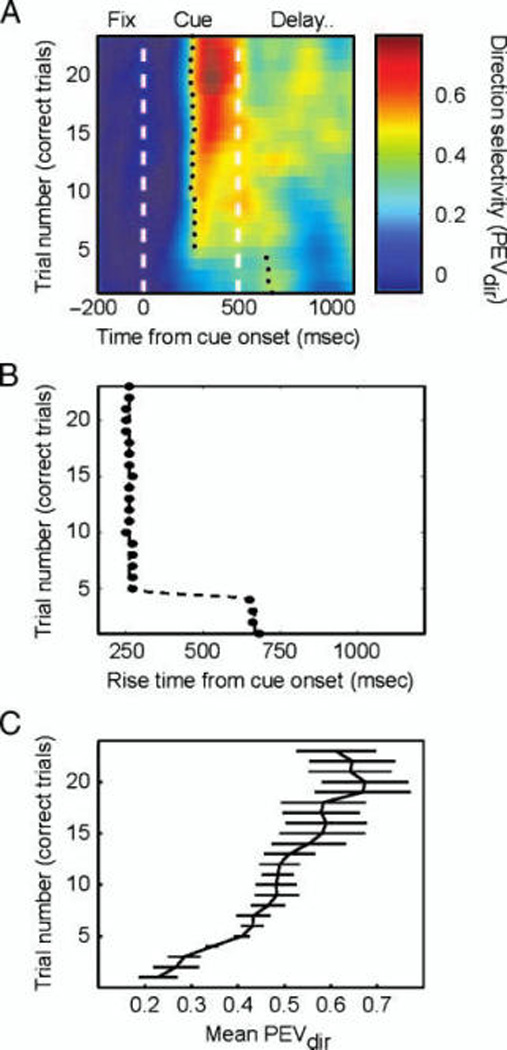
The PFC plays a central role in our ability to learn arbitrary rules, such as "green means go." Previous experiments from our laboratory have used conditional association learning to show that slow, gradual changes in PFC neural activity mirror monkeys' slow acquisition of associations. These previous experiments required monkeys to repeatedly reverse the cue-saccade associations, an ability known to be PFC-dependent. We aimed to test whether the relationship between PFC neural activity and behavior was due to the reversal requirement, so monkeys were trained to learn several new conditional cue-saccade associations without reversing them. Learning-related changes in PFC activity now appeared earlier and more suddenly in correspondence with similar changes in behavioral improvement. This suggests that learning of conditional associations is linked to PFC activity regardless of whether reversals are required. However, when previous learning does not need to be suppressed, PFC acquires associations more rapidly.
Figures
References
-
- Aron AR, Poldrack RA. The cognitive neuroscience of response inhibition: Relevance for genetic research in attention-deficit/hyperactivity disorder. Biological Psychiatry. 2005;57:1285–1292. - PubMed
-
- Aron AR, Robbins TW, Poldrack RA. Inhibition and the right inferior frontal cortex. Trends in Cognitive Sciences. 2004;8:170–177. - PubMed
Publication types
MeSH terms
Grants and funding
LinkOut - more resources
Full Text Sources
Other Literature Sources
Miscellaneous