


A comparative study of Merkel cell, BK and JC polyomavirus infections in renal transplant recipients and healthy subjects
- PMID: 20667770
- PMCID: PMC2943003
- DOI: 10.1016/j.jcv.2010.06.017
A comparative study of Merkel cell, BK and JC polyomavirus infections in renal transplant recipients and healthy subjects
Abstract
Background: Merkel cell carcinoma (MCC) is a rare skin cancer associated with immunosuppression and the integration of Merkel cell polyomavirus (MCPyV) DNA into the tumor cell genome. Little is known about the natural history of MCPyV infection.
Objectives: To investigate the presence of MCPyV, BK and JC polyomaviruses in serum and urine from immunosuppressed kidney transplant patients (KTx) and a control group of normal volunteers.
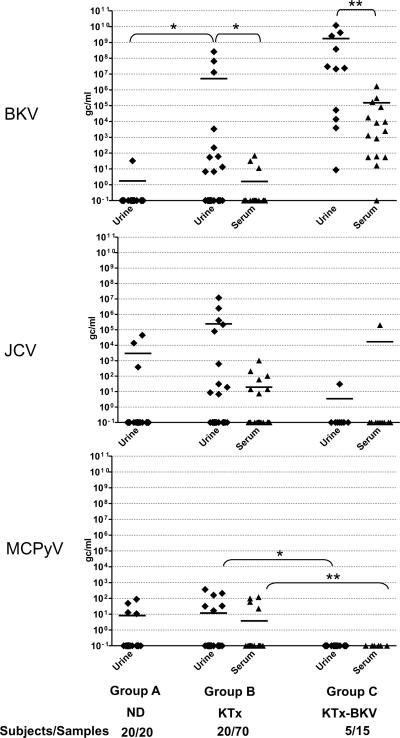
Study design: Quantitative real-time PCR (q-PCR) was used to assess MCPyV, BKV and JCV viral load in urine and serum samples collected from normal donors (Group A), prospectively enrolled KTx patients (Group B) and from KTx with documented BK reactivation and/or nephropathy (Group C).
Results: Low levels of MCPyV viruria was seen in 15% of the subjects in Group A, 30% of Group B, and was not detected in Group C. No individuals in the study developed MCPyV viremia. BK viruria was seen in 5% of Group A, 30% of Group B, and 100% of Group C. Consistent with previous reports, the mean BKV urinary load was significantly higher in immunosuppressed patients compared to non-immunosuppressed controls and also higher in urine compared to serum samples.
Conclusions: Like BKV and JCV, MCPyV is likely a common infection in adult humans. Low level shedding of MCPyV in urine was similar in immunosuppressed organ transplant recipients to non-immunosuppressed subjects. However, MCPyV was not detected and JCV was infrequent in samples from KTx patients with clinical BKV reactivation.
Copyright © 2010 Elsevier B.V. All rights reserved.
Figures
References
-
- Hodgson NC. Merkel cell carcinoma: changing incidence trends. J Surg. Oncol. 2005;89:1–4. - PubMed
-
- Swann MH, Yoon J. Merkel cell carcinoma. Semin. Oncol. 2007;34:51–56. - PubMed
-
- Penn I, First MR. Merkel's cell carcinoma in organ recipients: report of 41 cases. Transplantation. 1999;68:1717–1721. - PubMed
-
- Harwood CA, McGregor JM, Swale VJ, Proby CM, Leigh IM, Newton R, Khorshid SM, Cerio R. High frequency and diversity of cutaneous appendageal tumors in organ transplant recipients. J Am. Acad. Dermatol. 2003;48:401–408. - PubMed
Publication types
MeSH terms
Grants and funding
LinkOut - more resources
Full Text Sources
