


Supramodal representations of perceived emotions in the human brain
- PMID: 20668196
- PMCID: PMC6633378
- DOI: 10.1523/JNEUROSCI.2161-10.2010
Supramodal representations of perceived emotions in the human brain
Abstract
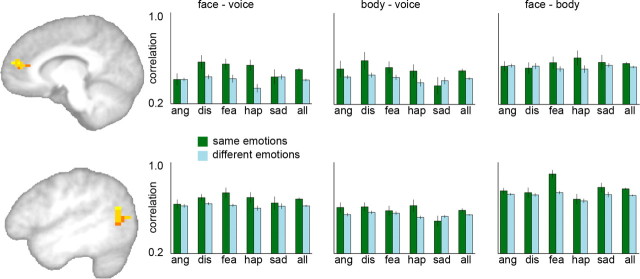
Basic emotional states (such as anger, fear, and joy) can be similarly conveyed by the face, the body, and the voice. Are there human brain regions that represent these emotional mental states regardless of the sensory cues from which they are perceived? To address this question, in the present study participants evaluated the intensity of emotions perceived from face movements, body movements, or vocal intonations, while their brain activity was measured with functional magnetic resonance imaging (fMRI). Using multivoxel pattern analysis, we compared the similarity of response patterns across modalities to test for brain regions in which emotion-specific patterns in one modality (e.g., faces) could predict emotion-specific patterns in another modality (e.g., bodies). A whole-brain searchlight analysis revealed modality-independent but emotion category-specific activity patterns in medial prefrontal cortex (MPFC) and left superior temporal sulcus (STS). Multivoxel patterns in these regions contained information about the category of the perceived emotions (anger, disgust, fear, happiness, sadness) across all modality comparisons (face-body, face-voice, body-voice), and independently of the perceived intensity of the emotions. No systematic emotion-related differences were observed in the overall amplitude of activation in MPFC or STS. These results reveal supramodal representations of emotions in high-level brain areas previously implicated in affective processing, mental state attribution, and theory-of-mind. We suggest that MPFC and STS represent perceived emotions at an abstract, modality-independent level, and thus play a key role in the understanding and categorization of others' emotional mental states.
Figures



Comment in
-
Decoding modality-independent emotion perception in medial prefrontal and superior temporal cortex.J Neurosci. 2010 Dec 8;30(49):16417-8. doi: 10.1523/JNEUROSCI.5078-10.2010. J Neurosci. 2010. PMID: 21147980 Free PMC article. No abstract available.
References
-
- Allison T, Puce A, McCarthy G. Social perception from visual cues: role of the STS region. Trends Cogn Sci. 2000;4:267–278. - PubMed
-
- Anderson AK, Christoff K, Stappen I, Panitz D, Ghahremani DG, Glover G, Gabrieli JD, Sobel N. Dissociated neural representations of intensity and valence in human olfaction. Nat Neurosci. 2003;6:196–202. - PubMed
-
- Atkinson AP, Dittrich WH, Gemmell AJ, Young AW. Emotion perception from dynamic and static body expressions in point-light and full-light displays. Perception. 2004;33:717–746. - PubMed
-
- Atkinson AP, Tunstall ML, Dittrich WH. Evidence for distinct contributions of form and motion information to the recognition of emotions from body gestures. Cognition. 2007;104:59–72. - PubMed
Publication types
MeSH terms
Substances
LinkOut - more resources
Full Text Sources
