


Adaptation to herbivory by the Tammar wallaby includes bacterial and glycoside hydrolase profiles different from other herbivores
- PMID: 20668243
- PMCID: PMC2930436
- DOI: 10.1073/pnas.1005297107
Adaptation to herbivory by the Tammar wallaby includes bacterial and glycoside hydrolase profiles different from other herbivores
Abstract
Metagenomic and bioinformatic approaches were used to characterize plant biomass conversion within the foregut microbiome of Australia's "model" marsupial, the Tammar wallaby (Macropus eugenii). Like the termite hindgut and bovine rumen, key enzymes and modular structures characteristic of the "free enzyme" and "cellulosome" paradigms of cellulose solubilization remain either poorly represented or elusive to capture by shotgun sequencing methods. Instead, multigene polysaccharide utilization loci-like systems coupled with genes encoding beta-1,4-endoglucanases and beta-1,4-endoxylanases--which have not been previously encountered in metagenomic datasets--were identified, as were a diverse set of glycoside hydrolases targeting noncellulosic polysaccharides. Furthermore, both rrs gene and other phylogenetic analyses confirmed that unique clades of the Lachnospiraceae, Bacteroidales, and Gammaproteobacteria are predominant in the Tammar foregut microbiome. Nucleotide composition-based sequence binning facilitated the assemblage of more than two megabase pairs of genomic sequence for one of the novel Lachnospiraceae clades (WG-2). These analyses show that WG-2 possesses numerous glycoside hydrolases targeting noncellulosic polysaccharides. These collective data demonstrate that Australian macropods not only harbor unique bacterial lineages underpinning plant biomass conversion, but their repertoire of glycoside hydrolases is distinct from those of the microbiomes of higher termites and the bovine rumen.
Conflict of interest statement
The authors declare no conflict of interest.
Figures
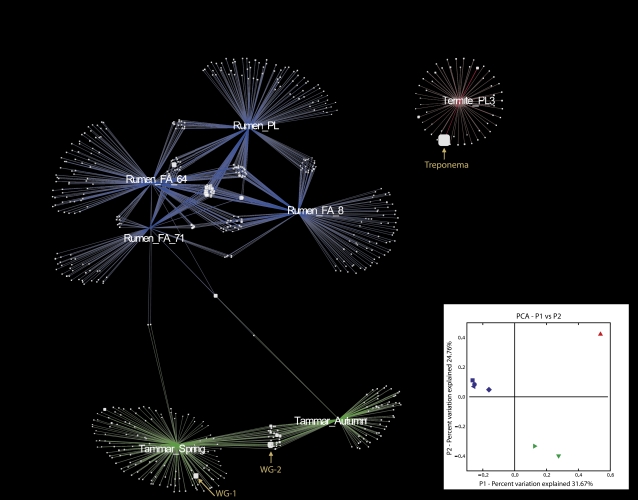
 ) blue; Termite (▲) red and Tammar (Spring,
  ; Autumn,▼) green. For complete inventory and comparisons between the two Tammar wallaby sample dates at an OTU definition (SONS analysis), see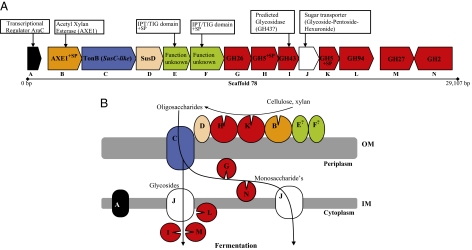
References
-
- Hume ID. Microbial fermentation in herbivorous marsupials. Bioscience. 1984;34:435–440.
-
- Smith JA. Macropod nutrition. Vet Clin North Am Exot Anim Pract. 2009;12:197–208, xiii. - PubMed
-
- Flint HJ. The rumen microbial ecosystem—some recent developments. Trends Microbiol. 1997;5:483–488. - PubMed
-
- Kempton TJ, Murray RM, Leng RA. Methane production and digestibility measurements in the grey kangaroo and sheep. Aust J Biol Sci. 1976;29:209–214. - PubMed
-
- Engelhardt W, Wolter S, Lawrenz H. Production of methane in two non-ruminant herbivores. Comp Biochem Physiol. 1978;60:309–311.
Publication types
MeSH terms
Substances
Associated data
- Actions
- Actions
- Actions
- Actions
- Actions
- Actions
- Actions
- Actions
- Actions
- Actions
- Actions
- Actions
- Actions
- Actions
- Actions
- Actions
- Actions
- Actions
- Actions
- Actions
- Actions
- Actions
- Actions
- Actions
- Actions
- Actions
- Actions
- Actions
- Actions
- Actions
- Actions
- Actions
- Actions
- Actions
- Actions
- Actions
- Actions
- Actions
- Actions
- Actions
- Actions
- Actions
- Actions
- Actions
- Actions
- Actions
- Actions
- Actions
- Actions
- Actions
- Actions
- Actions
- Actions
- Actions
- Actions
- Actions
- Actions
- Actions
- Actions
- Actions
- Actions
- Actions
- Actions
- Actions
- Actions
- Actions
- Actions
- Actions
- Actions
- Actions
- Actions
- Actions
- Actions
- Actions
- Actions
- Actions
- Actions
- Actions
- Actions
- Actions
- Actions
- Actions
- Actions
- Actions
- Actions
- Actions
- Actions
- Actions
- Actions
- Actions
- Actions
- Actions
- Actions
- Actions
- Actions
- Actions
- Actions
- Actions
- Actions
- Actions
- Actions
- Actions
- Actions
- Actions
- Actions
- Actions
- Actions
- Actions
- Actions
- Actions
- Actions
- Actions
- Actions
- Actions
- Actions
- Actions
- Actions
- Actions
- Actions
- Actions
- Actions
- Actions
- Actions
- Actions
- Actions
- Actions
- Actions
- Actions
- Actions
- Actions
- Actions
- Actions
- Actions
- Actions
- Actions
- Actions
- Actions
- Actions
- Actions
- Actions
- Actions
- Actions
- Actions
- Actions
- Actions
- Actions
- Actions
- Actions
- Actions
- Actions
- Actions
- Actions
- Actions
- Actions
- Actions
- Actions
- Actions
- Actions
- Actions
- Actions
- Actions
- Actions
- Actions
- Actions
- Actions
- Actions
- Actions
- Actions
- Actions
- Actions
- Actions
- Actions
- Actions
- Actions
- Actions
- Actions
- Actions
- Actions
- Actions
- Actions
- Actions
- Actions
- Actions
- Actions
- Actions
- Actions
- Actions
- Actions
- Actions
- Actions
- Actions
- Actions
- Actions
- Actions
- Actions
- Actions
- Actions
- Actions
- Actions
- Actions
- Actions
- Actions
- Actions
- Actions
- Actions
- Actions
- Actions
- Actions
- Actions
- Actions
- Actions
- Actions
- Actions
- Actions
- Actions
- Actions
- Actions
- Actions
- Actions
- Actions
- Actions
- Actions
- Actions
- Actions
- Actions
- Actions
- Actions
- Actions
- Actions
- Actions
- Actions
- Actions
- Actions
- Actions
- Actions
- Actions
- Actions
- Actions
- Actions
- Actions
- Actions
- Actions
- Actions
- Actions
- Actions
- Actions
- Actions
- Actions
- Actions
- Actions
- Actions
- Actions
- Actions
- Actions
- Actions
- Actions
- Actions
- Actions
- Actions
- Actions
- Actions
- Actions
- Actions
- Actions
- Actions
- Actions
- Actions
- Actions
- Actions
- Actions
- Actions
- Actions
- Actions
- Actions
- Actions
- Actions
- Actions
- Actions
- Actions
- Actions
- Actions
- Actions
- Actions
- Actions
- Actions
- Actions
- Actions
- Actions
- Actions
- Actions
- Actions
- Actions
- Actions
LinkOut - more resources
Full Text Sources
Other Literature Sources
Molecular Biology Databases
